
📏 BAI Calculator
Calculate your Body Adiposity Index to estimate body fat percentage using hip circumference and height
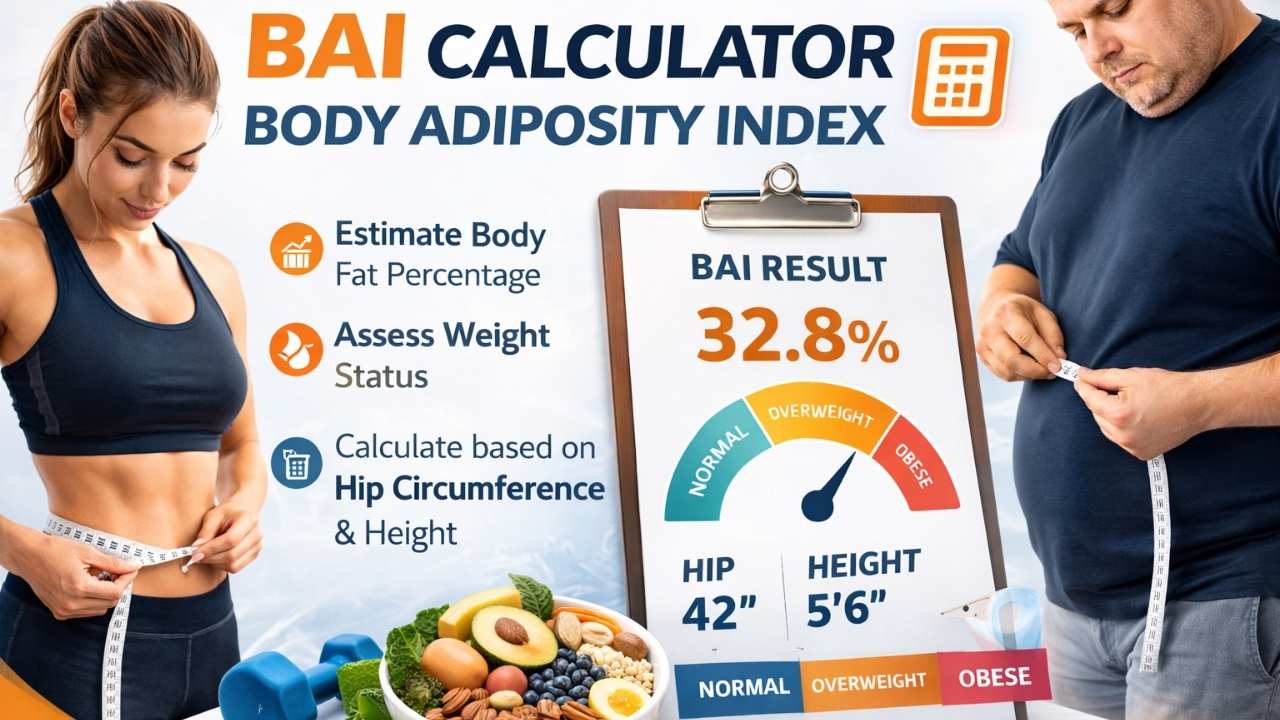
📊 Your BAI Results
Body Fat Percentage Scale
💡 Understanding Your Results
- BAI provides an estimate of body fat percentage
- Results may vary based on individual body composition
- Compare with other methods for a complete picture
- Focus on overall fitness, not just numbers
What is Body Adiposity Index (BAI)?
Body Adiposity Index (BAI) is a method for estimating body fat percentage using only hip circumference and height measurements. Unlike BMI, BAI doesn’t require body weight, making it useful when scales aren’t available or for quick assessments. The formula was developed by Bergman et al. in 2011 as an alternative approach to body composition estimation.
BAI was designed to directly estimate body fat percentage, whereas BMI only provides a weight-to-height ratio that correlates with body fat. Research published in PLOS ONE has examined BAI’s accuracy across different populations, finding it useful as a screening tool alongside other measurements.
The BAI Formula
The Body Adiposity Index uses a straightforward calculation based on hip circumference and height:
The result directly represents an estimated body fat percentage. For example, a BAI of 25 suggests approximately 25% body fat.
Person: Hip circumference 100 cm, Height 170 cm (1.70 m)
Step 1: Calculate height^1.5: 1.70^1.5 = 2.216
Step 2: Divide hip by height^1.5: 100 ÷ 2.216 = 45.13
Step 3: Subtract 18: 45.13 – 18 = 27.1% body fat
How to Measure Hip Circumference
Accurate hip measurement is essential for reliable BAI results. Follow these steps:
- Stand Straight: Keep your feet together and weight evenly distributed
- Find the Widest Point: Locate the widest part of your hips and buttocks
- Use a Flexible Tape: Wrap the measuring tape around this widest point
- Keep It Level: Ensure the tape is parallel to the floor all the way around
- Don’t Pull Tight: The tape should be snug but not compressing the skin
- Measure Over Thin Clothing: Or directly on skin for most accurate results
For consistent results, take measurements at the same time of day and use the same technique each time. Learn more about body measurements for body fat assessment.
Body Fat Categories by Gender
Body fat percentage ranges differ between men and women due to physiological differences:
| Category | Men | Women |
|---|---|---|
| Essential Fat | 2-5% | 10-13% |
| Athletic | 6-13% | 14-20% |
| Fitness | 14-17% | 21-24% |
| Average | 18-24% | 25-31% |
| Above Average | 25%+ | 32%+ |
Women naturally carry more body fat than men due to hormonal differences and reproductive functions. These ranges are general guidelines—individual optimal levels may vary based on age, activity level, and personal goals.
BAI vs BMI: Key Differences
Both BAI and BMI are anthropometric measures, but they work differently:
| Feature | BAI | BMI |
|---|---|---|
| Measurements Needed | Hip circumference, height | Weight, height |
| Output | Estimated body fat % | Weight-to-height ratio |
| Requires Scale | No | Yes |
| Gender-Specific | Interpretation varies | Same categories |
| Best For | Body fat estimation | General weight screening |
According to recent research, BMI often shows stronger correlations with measured body fat in many populations, but BAI remains useful as an alternative when weight measurement isn’t practical. For comprehensive body composition assessment, consider using multiple methods alongside regular fitness activities.
Limitations of BAI
While BAI offers advantages, it has important limitations to consider:
- Population Variability: Accuracy varies across different ethnic groups and populations
- Tends to Underestimate: May underestimate body fat at higher adiposity levels
- Hip Shape Differences: Doesn’t account for variations in hip bone structure
- Not for Athletes: May be less accurate for highly muscular individuals
- Age Effects: Accuracy may decrease in older adults
- Single Measurement: Relies on one circumference, unlike skinfold methods
For the most accurate body composition assessment, consider combining BAI with other measurements like waist circumference or using methods such as visual body fat estimation.
BAI Reference Values by Height
Here are example BAI values for different hip and height combinations:
| Height | Hip 90 cm | Hip 100 cm | Hip 110 cm |
|---|---|---|---|
| 160 cm | 26.5% | 31.4% | 36.4% |
| 165 cm | 24.5% | 29.2% | 33.9% |
| 170 cm | 22.6% | 27.1% | 31.6% |
| 175 cm | 20.9% | 25.2% | 29.5% |
| 180 cm | 19.3% | 23.4% | 27.6% |
| 185 cm | 17.8% | 21.8% | 25.8% |
Improving Body Composition
Regardless of your BAI result, focusing on overall fitness and body composition is more important than any single number:
- Strength Training: Build lean muscle through resistance exercises
- Cardiovascular Exercise: Include regular cardio for overall fitness
- Balanced Nutrition: Focus on whole foods and adequate protein
- Consistency: Small, sustainable changes over time produce best results
- Multiple Metrics: Track progress with various measurements, not just one
- Rest and Recovery: Allow adequate recovery time between workouts
Frequently Asked Questions
BAI provides a reasonable estimate of body fat percentage but isn’t as accurate as methods like DEXA scans or hydrostatic weighing. Research shows BAI correlates moderately well with measured body fat (r = 0.7 in many studies) but may underestimate body fat at higher levels. It’s best used as a screening tool or when other methods aren’t available, not as a definitive measurement.
BAI was specifically designed to estimate body fat without requiring a scale. This makes it useful in field settings, resource-limited environments, or situations where accurate scales aren’t available. The formula relies on the relationship between hip circumference and height to approximate body fat distribution, though this approach has trade-offs in accuracy compared to weight-based methods.
Neither is definitively “better”—they measure different things. BAI attempts to directly estimate body fat percentage, while BMI is a weight-to-height ratio that correlates with body fat. Research suggests BMI often has stronger correlations with measured body fat in many populations. However, BAI is useful when you don’t have access to a scale or want an alternative perspective on body composition.
BAI was developed and validated primarily in adult populations. Its accuracy varies across different ethnic groups, ages, and body types. It may be less accurate for highly athletic individuals with significant muscle mass, older adults, or populations different from those in the original validation studies. Always interpret results in context with other measurements and individual factors.
If you’re tracking body composition changes, measuring monthly is typically sufficient. Body fat changes slowly, so more frequent measurements may not show meaningful differences and could be affected by measurement variability. For best results, measure at the same time of day using consistent technique. Combine BAI tracking with other metrics like how your clothes fit, strength improvements, and energy levels.
Different body fat estimation methods use different measurements and formulas, so some variation is expected. BAI relies solely on hip circumference and height, while other methods might use skinfolds, bioelectrical impedance, or weight. BAI tends to underestimate body fat at higher levels and may overestimate at lower levels. Consider BAI as one data point among several rather than a definitive measurement.

Manish is a NASM-certified fitness and nutrition coach with over 10 years of experience in weight lifting and fat loss fitness coaching. He specializes in gym-based training and has a lot of knowledge about exercise, lifting technique, biomechanics, and more.
Through “Fit Life Regime,” he generously shares the insights he’s gained over a decade in the field. His goal is to equip others with the knowledge to start their own fitness journey.