
💪 Body Recomposition Calculator
Calculate your personalized calorie and macro targets for building muscle while losing fat simultaneously. Get science-based recommendations for optimal body recomposition.
What is Body Recomposition?
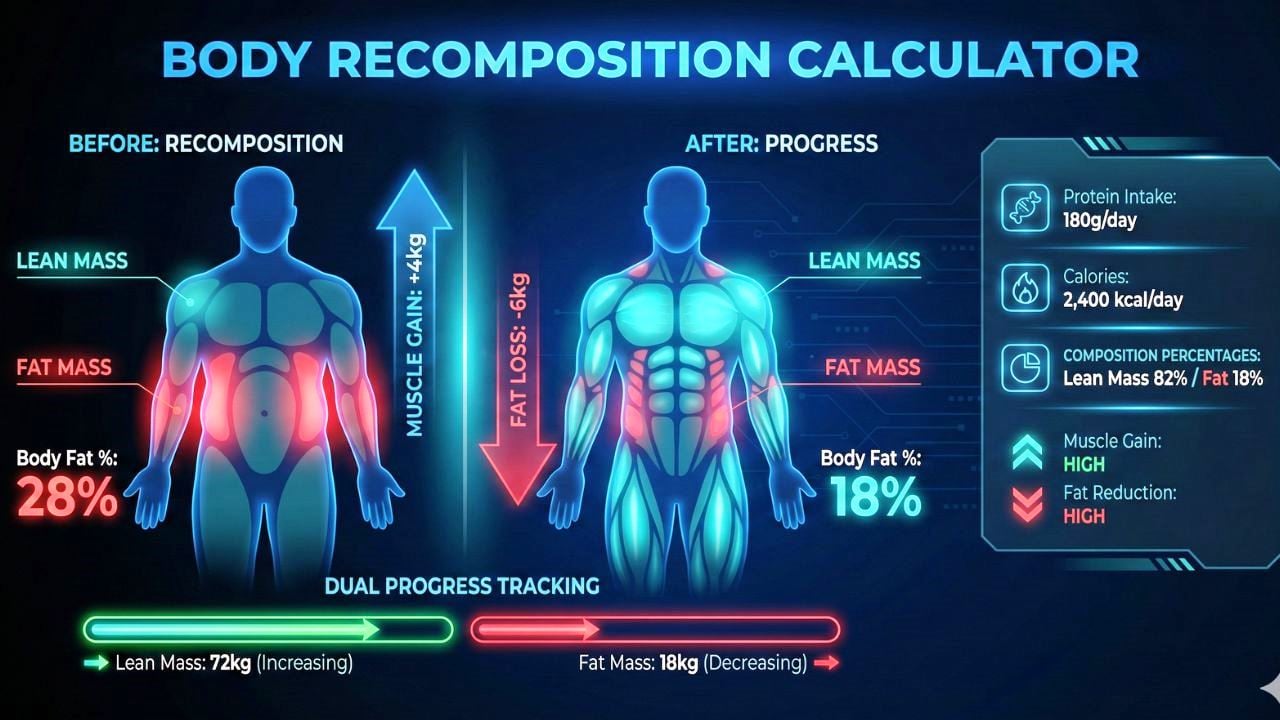
Body recomposition means simultaneously building muscle while losing fat, leading to improved body composition without dramatic weight changes. Unlike traditional cutting or bulking cycles, recomp allows you to look better and perform better at a stable weight.
This works best for beginners (fastest results), people with 20%+ body fat (men) or 30%+ (women), and those returning to training after a break. Research published in the Journal of Applied Physiology confirms muscle gain is possible in a calorie deficit when protein intake is high (2.4-3.0g/kg lean mass) and progressive resistance training is applied.
The Science Behind Recomposition
Your body can build muscle in a calorie deficit through a process called “energy partitioning.” When you have adequate body fat stores, high protein intake, and a progressive training stimulus, your body uses stored fat for energy while directing dietary protein toward muscle building.
Three Key Requirements:
1. High Protein (2.4-3.0g/kg LBM): Provides amino acids for muscle protein synthesis even in a deficit
2. Progressive Resistance Training: Signals your body to prioritize muscle retention and growth
3. Moderate Calorie Deficit (10-20%): Creates fat loss while preserving energy for muscle building
This works because your fat stores can provide 50-70% of your energy needs, allowing dietary nutrients to fuel muscle growth. Learn more about optimal protein requirements for muscle building.
BMR & TDEE Calculations
Women: BMR = (10 × weightkg) + (6.25 × heightcm) – (5 × age) – 161
TDEE = BMR × Activity Multiplier
Sedentary: 1.2 | Lightly Active: 1.375 | Moderately Active: 1.55 | Very Active: 1.725
BMR: (10 × 80) + (6.25 × 175) – (5 × 30) + 5 = 1,743 calories
TDEE: 1,743 × 1.55 = 2,701 calories/day
Recomp Target: 2,701 × 0.90 = 2,431 calories/day (10% deficit)
The Mifflin-St Jeor equation is the most accurate formula for estimating metabolic rate. Calculate your precise TDEE here.
Protein Requirements for Muscle Building
LBM = Body Weight × (1 – Body Fat % ÷ 100)
Step 2: Determine Protein Multiplier
High Body Fat (>25%): 2.4g per kg LBM
Moderate (20-25%): 2.6g per kg LBM
Lower (15-20%): 2.8g per kg LBM
Lean (<15%): 3.0g per kg LBM
LBM: 80 × (1 – 20 ÷ 100) = 64kg lean mass
Protein Multiplier: 2.6g per kg (moderate body fat)
Daily Protein: 64 × 2.6 = 166g protein/day
High protein is critical for recomp success. Research shows that protein intakes of 2.3-3.1g/kg lean mass maximize muscle retention during calorie deficits. Calculate your exact needs with our protein calculator.
Macro Distribution Strategy
After setting protein (2.4-3.0g/kg LBM), distribute remaining calories between fats and carbs:
Fats: Set at 0.8-1.0g per kg body weight for hormone production and health. Don’t go below 0.6g/kg. Good sources: olive oil, avocados, fatty fish, nuts.
Carbs: Fill remaining calories with carbs to fuel training. Use carb cycling for better results:
• Training Days: Higher carbs (maintenance calories) = fuel workouts, support recovery
• Rest Days: Lower carbs (deficit) = promote fat loss while maintaining high protein
This approach maximizes both muscle building and fat loss. Calculate your complete macro breakdown with our macro calculator.
Training for Body Recomposition
Resistance Training (3-6 days/week):
• Focus on compound movements: squats, deadlifts, bench press, rows
• Train each muscle 2x per week minimum
• Use progressive overload (increase weight/reps weekly)
• 3-4 sets of 8-12 reps per exercise
Explore proven programs: workout plan generator, chest workouts, back exercises, leg training.
Cardio (2-4 sessions/week):
• Low-impact steady state: 20-40 minutes
• Don’t overdo it – excessive cardio interferes with recovery
• Prioritize lifting over cardio for recomp
Track cardio calories: walking calculator | running calculator
Frequently Asked Questions
Q: Can I build muscle and lose fat simultaneously?
A: Yes! Especially for beginners, those with 20%+ body fat, or people returning to training. Research confirms it’s possible with high protein (2.4-3.0g/kg LBM) and progressive training.
Q: Why isn’t my weight changing?
A: Normal for recomp! You’re gaining muscle while losing fat, so scale weight stays similar. Use photos, measurements, and strength gains to track progress.
Q: How long until I see results?
A: Beginners: 6-8 weeks for visible changes. Significant transformation: 3-6 months. Focus on strength gains weekly and photos monthly.
Q: Recomp vs bulking/cutting?
A: Recomp is slower but sustainable – stay lean year-round. Bulk/cut is faster for size but requires getting fatter. Choose based on your goals and preferences.
Q: Best if I’m already lean?
A: Difficult if under 12% (men) or 20% (women) body fat. Traditional bulk/cut works better. Recomp optimal at 15%+ body fat.
Related Tools
Calculators: BMR | TDEE | Macros | Protein | Body Fat | Lean Mass
Strength: 1RM Calculator | Workout Plans
Medical Disclaimer
This calculator provides estimates based on the Mifflin-St Jeor equation and research-based recommendations. Results are educational only, not medical advice. Individual results vary based on genetics, training quality, adherence, sleep, stress, and health status.
Consult healthcare providers, registered dietitians, or certified fitness professionals before starting any nutrition or exercise program, especially if you have medical conditions or take medications.

Manish is a NASM-certified fitness and nutrition coach with over 10 years of experience in weight lifting and fat loss fitness coaching. He specializes in gym-based training and has a lot of knowledge about exercise, lifting technique, biomechanics, and more.
Through “Fit Life Regime,” he generously shares the insights he’s gained over a decade in the field. His goal is to equip others with the knowledge to start their own fitness journey.