
One Rep Max (1RM) Calculator
Estimate your max bench press, squat, or deadlift from any working set. Compare Brzycki, Epley, Lander, and Lombardi formulas instantly — add body weight for a relative strength score.
What Is a One Rep Max (1RM)?
Estimated vs. Tested Max
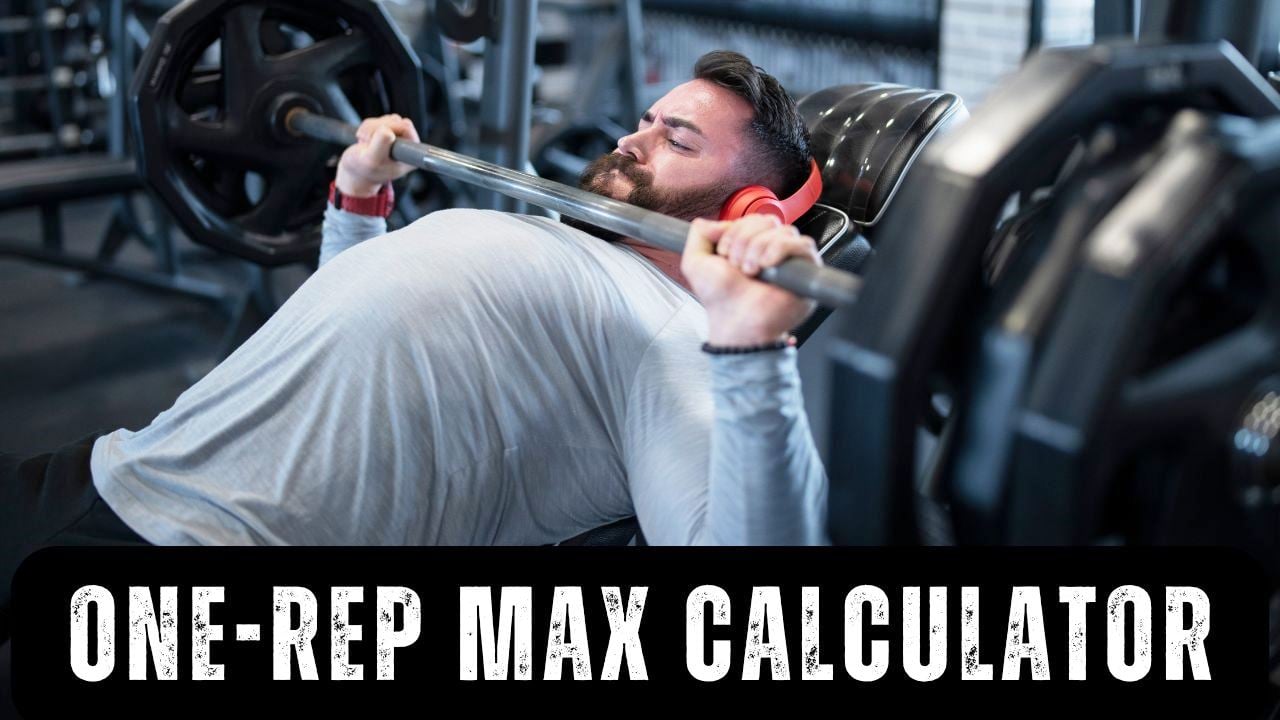
Your one rep max (1RM) is the heaviest weight you can lift once with proper form. This 1RM calculator estimates that number from a submaximal set — the weight and reps you already lifted in training — so you can program percentages without attempting a true max every session. Research confirms direct 1RM testing is valid for strength assessment; submaximal formulas are a practical, lower-risk alternative for everyday use.
Four 1RM Formulas Compared
- Brzycki — 1RM = Weight × (36 ÷ (37 − Reps)). Best for 2–10 reps; widely used for bench press max estimates.
- Epley — 1RM = Weight × (1 + 0.0333 × Reps). Most versatile across rep ranges.
- Lander — conservative estimate; suits moderate rep sets (5–10).
- Lombardi — 1RM = Weight × Reps^0.10. Strong choice for 1–5 rep powerlifting sets.
We show all four plus the average so you see your likely max range — not just a single number.
Bodyweight Strength Rating
Absolute kg numbers mislead across body sizes. Enter your body weight to get a lift-to-bodyweight ratio (e.g., 1.25× bodyweight bench) — the same method strength standards use to compare lifters fairly. Approximate gym benchmarks; not federation qualification cutoffs.
Using Your 1RM for Training
Percentage-Based Programming
Once you know your estimated max, set training loads as percentages: 85–95% for strength, 65–80% for muscle growth, 50–65% for endurance. Systematic reviews support %1RM prescription — adjust for recovery and experience. Your results include a full percentage chart for immediate use.
Accuracy & Safety
Validated formulas correlate strongly with tested 1RM (often r > 0.95) at ≤10 reps on the tested lift — accuracy drops above 12 reps. Proper warm-up and spotting are essential if you test a true max. This tool is for programming estimates, not a substitute for safe lifting practice.
References
- Mayhew, Jerry L; Johnson, Blair D; LaMonte, Michael J; Lauber, Dirk; Kemmler, Wolfgang (September 2008). “Accuracy of Prediction Equations for Determining One Repetition Maximum Bench Press in Women Before and After Resistance Training”. Journal of Strength and Conditioning Research. 22 (5): 1570–1577.
- Knutzen, Kathleen; Brilla, Lorraine; Caine, Dennis (August 1999). “Validity of 1RM Prediction Equations for Older Adults”. The Journal of Strength & Conditioning Research. 13 (3): Vol 13, Issue 3, Page 242–246. Retrieved 11 July 2014.
- Epley, Boyd (1985). “Poundage Chart”. Boyd Epley Workout. Lincoln, NE: Body Enterprises. p. 86.
- Brzycki, Matt (1998). A Practical Approach To Strength Training. McGraw-Hill. ISBN 978-1-57028-018-4.
- Kemmler, Wolfgang K.; Lauber, Dirk; Wassermann, Alfred; Mayhew, Jerry L. (2006-11-01). “Predicting maximal strength in trained postmenopausal woman”. Journal of Strength and Conditioning Research. 20 (4): 838–842. doi:10.1519/R-18905.1. ISSN 1064-8011. PMID 17194251. S2CID 12769411.
- Chapman, Paul P.; Whitehead, James R.; Binkert, Ronald H. (November 1998). “The 225–1b Reps-to-Fatigue Test as a Submaximal Estimate of 1-RM Bench Press Performance in College Football Players”. Journal of Strength and Conditioning Research. 12 (4): 258–261.
- LeSuer, Dale A.; McCormick, James H.; Mayhew, Jerry L.; Wasserstein, Ronald L.; Arnold, Michael D. (November 1997). “The Accuracy of Prediction Equations for Estimating 1-RM Performance in the Bench Press, Squat, and Deadlift”. Journal of Strength and Conditioning Research. 11 (4): 211–213.
- Reynolds, JM; Gordon, TJ; Robergs, RA (August 2006). “Prediction of one repetition maximum strength from multiple repetition maximum testing and anthropometry” (PDF). Journal of Strength and Conditioning Research. 20 (3): 584–92.
- Naclerio Ayllón, Fernando; Jiménez Gutiérrez, Alfonso; Alvar, Brent A.; Peterson, Mark D. (2009). “Assessing strength and power in resistance training”. Journal of Human Sport and Exercise. 4 (2): 100–113.

Manish is a NASM-certified fitness and nutrition coach with over 10 years of experience in weight lifting and fat loss fitness coaching. He specializes in gym-based training and has a lot of knowledge about exercise, lifting technique, biomechanics, and more.
Through “Fit Life Regime,” he generously shares the insights he’s gained over a decade in the field. His goal is to equip others with the knowledge to start their own fitness journey.
“Great breakdown of the different 1RM formulas! Using submaximal sets with a good calculator like this saves so much recovery time compared to testing maxes every week. For anyone tracking overall fitness numbers alongside their strength goals, pairing this with a tool like the TDEE Calculator is a fantastic way to dial in nutrition as well. Keep up the great content!”