
📊 Body Roundness Index Calculator
Calculate your Body Roundness Index (BRI) using scientifically validated formulas. Assess body shape, visceral fat distribution, and health risks based on height and waist circumference measurements.
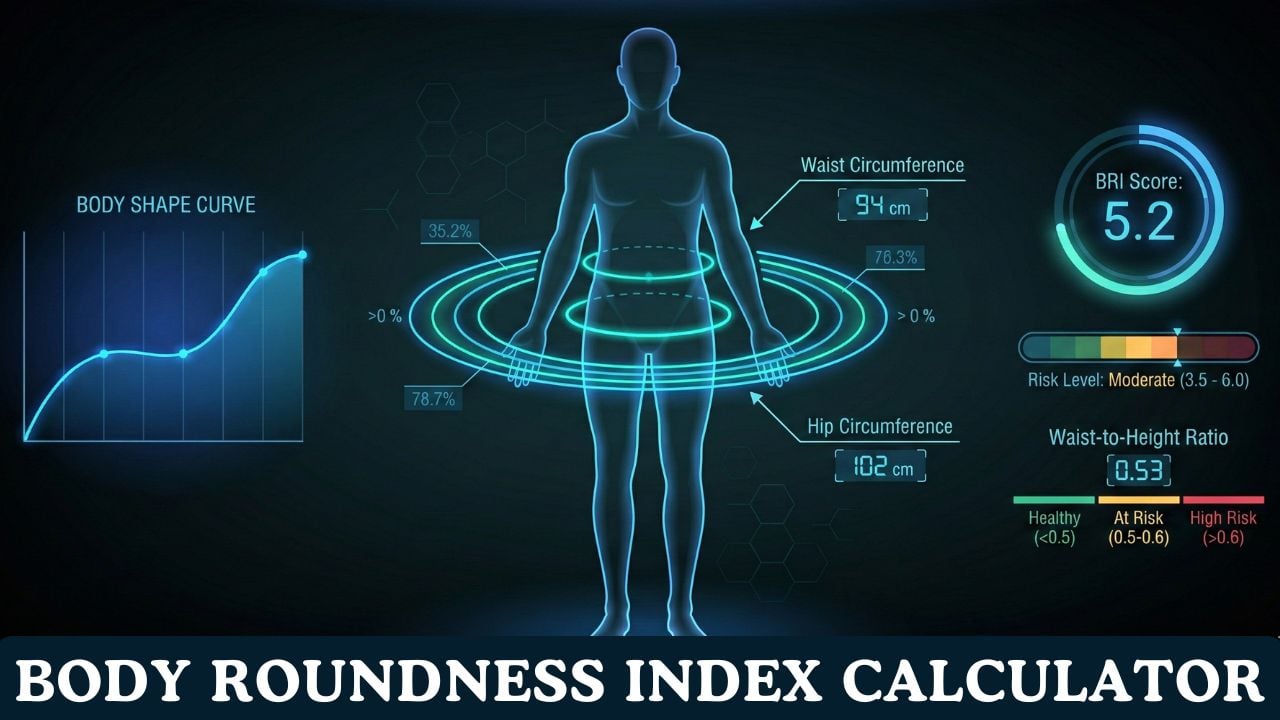
What is Body Roundness Index (BRI)
Body Roundness Index (BRI) is a modern measurement that assesses your body shape and fat distribution. Unlike BMI, which only uses weight and height, BRI considers your waist circumference to better predict health risks.
Research published in JAMA Network Open shows that BRI is more accurate than BMI in predicting mortality risk. The study analyzed data from over 32,000 adults and found that people with higher BRI scores had significantly increased risk of death from all causes, including heart disease.
How BRI Works: The Science Explained
BRI treats your body as an ellipse (oval shape) rather than just measuring weight. This approach captures how round or elongated your body is, which directly relates to visceral fat – the dangerous fat around your organs.
The formula uses mathematical geometry to calculate body roundness. When you have more abdominal fat, your body becomes “rounder” and your BRI score increases. This matters because belly fat is strongly linked to diabetes, heart disease, and early death.
The BRI Formula
WC = Waist Circumference (meters)
H = Height (meters)
π = Pi (3.14159…)
Example Calculation:
Let’s say you’re 170 cm tall (1.70 m) with a waist of 90 cm (0.90 m):
Step 1: Calculate WC/2π = 0.90 / 6.283 = 0.143 m
Step 2: Calculate 0.5 × Height = 0.5 × 1.70 = 0.85 m
Step 3: Find ratio: 0.143 / 0.85 = 0.168
Step 4: Square it: 0.168² = 0.028
Step 5: BRI = 364.2 – 365.5 × √(1 – 0.028) = 364.2 – 365.5 × 0.986 = 4.1
A BRI of 4.1 falls in the “Normal Range” category, indicating healthy body composition.
BRI and Health Risks: What Research Shows
Recent research in Obesity Pillars examined BRI in relation to mortality risk and found significant correlations:
Key Findings:
• Low Risk (BRI < 3.41): Reference group with baseline mortality risk
• Normal Range (3.41-4.44): 5% increased mortality risk
• Moderate Risk (4.45-5.45): 15% increased mortality risk
• Moderate-High Risk (5.46-6.90): 30% increased mortality risk
• High Risk (> 6.90): 49% increased mortality risk
These numbers represent your chance of early death compared to people with low BRI scores. The higher your BRI, the greater your risk of heart disease, stroke, diabetes, and certain cancers.
BRI vs Other Body Measurements
A 2024 study in BMC Endocrine Disorders compared BRI with other measurements in predicting metabolic syndrome. Here’s what they found:
BRI vs BMI: BRI is better at identifying people with high visceral fat, even when BMI is normal. Many people with “healthy” BMI actually have dangerous belly fat that BRI can detect.
BRI vs Waist Circumference: While waist circumference alone is useful, BRI adjusts for height, making it more accurate across different body types. A 90 cm waist means different things for someone 150 cm tall versus 180 cm tall.
BRI vs Waist-to-Hip Ratio: Both measure fat distribution, but BRI’s mathematical approach provides more precise risk assessment.
Who Should Track Their BRI?
BRI is especially useful for:
Adults Over 40: Visceral fat accumulation increases with age. Regular BRI monitoring helps catch problems early before they lead to serious health issues.
People with “Normal” BMI: You can have healthy weight but unhealthy fat distribution. This is called “normal weight obesity” and BRI helps identify it.
Those with Family History: If diabetes or heart disease runs in your family, tracking BRI helps you take preventive action before problems develop.
People Losing Weight: BRI shows whether you’re losing dangerous visceral fat or just subcutaneous fat. Decreasing BRI indicates you’re improving health, not just appearance. Track your progress with our weight loss calculator.
How to Improve Your BRI Score
The good news: BRI responds well to lifestyle changes. Here’s what works based on scientific evidence:
1. Reduce Waist Circumference
Focus on losing belly fat specifically. Core exercises
strengthen abdominal muscles, but you need calorie deficit to reduce fat. Combine cardio with
strength training for best results.
2. Increase Physical Activity
Aim for 150-300 minutes of moderate exercise weekly. Walking, jogging, cycling, and swimming all help reduce visceral fat.
Calculate your walking calories
to track progress.
3. Improve Diet Quality
Reduce refined carbs and added sugars. Increase protein, fiber, and healthy fats. Calculate your
protein needs and
macro ratios for optimal results.
4. Manage Stress and Sleep
Poor sleep and chronic stress increase cortisol, which promotes belly fat storage. Aim for 7-9 hours of quality sleep
and practice stress-reduction techniques.
Related Health Calculators
For comprehensive health assessment, consider using these related tools:
• Body Fat Percentage Calculator – Measure your total body fat
• Waist-to-Hip Ratio Calculator – Alternative fat distribution measurement
• BMR Calculator – Calculate your metabolic rate
• Ideal Weight Calculator – Find your healthy weight range
• Lean Body Mass Calculator – Calculate muscle mass
Frequently Asked Questions
Q: How often should I calculate my BRI?
A: Check monthly if actively trying to improve. Quarterly is sufficient for maintenance. More frequent measurement doesn’t provide
useful additional information since BRI changes slowly.
Q: Can BRI be too low?
A: BRI below 3.0 is extremely rare and usually indicates very low body fat or measurement error. If you get such results, verify
measurements and consider consulting healthcare provider.
Q: Does gender affect BRI interpretation?
A: Research shows BRI thresholds are similar for men and women, though women naturally store more subcutaneous fat while men store
more visceral fat. The same BRI score indicates similar health risks regardless of gender.
Q: Is BRI accurate for athletes or bodybuilders?
A: BRI is less accurate for people with exceptional muscle mass. If you’re a serious athlete or bodybuilder, combine BRI with
other measures like body fat percentage for complete assessment.
Q: Can I improve BRI without losing weight?
A: Yes! Changing body composition (less fat, more muscle) improves BRI even at same weight. Strength training while maintaining
weight can reduce waist circumference and improve BRI. Start with
bodyweight exercises if you’re new to training.
Scientific References
This calculator and information are based on peer-reviewed scientific research:
1. JAMA Network Open (2024)
– “Prognostic Value of Body Roundness Index in U.S. Adults”
2. Obesity Pillars (2024)
– “Body Roundness Index and All-Cause Mortality”
3. BMC Endocrine Disorders (2024)
– “Body Shape Index (ABSI), Body Roundness Index (BRI) and Risk Factors of Metabolic Syndrome”
Disclaimer
This Body Roundness Index calculator is provided for educational and informational purposes only. It is not intended to replace professional medical advice, diagnosis, or treatment. BRI is a screening tool that estimates health risks based on body shape and fat distribution.
Individual health depends on many factors including genetics, lifestyle, medical history, and environmental factors. Always consult with qualified healthcare providers for personalized health assessment, diagnosis, and treatment recommendations.
If you have concerns about your weight, body composition, or metabolic health, schedule an appointment with your doctor or a registered dietitian who can provide comprehensive evaluation and personalized guidance.

Manish is a NASM-certified fitness and nutrition coach with over 10 years of experience in weight lifting and fat loss fitness coaching. He specializes in gym-based training and has a lot of knowledge about exercise, lifting technique, biomechanics, and more.
Through “Fit Life Regime,” he generously shares the insights he’s gained over a decade in the field. His goal is to equip others with the knowledge to start their own fitness journey.