
Deadlift Calories Burned Calculator
How Many Calories Do Deadlifts Burn?
Calorie Burn During Deadlift Training: What to Expect
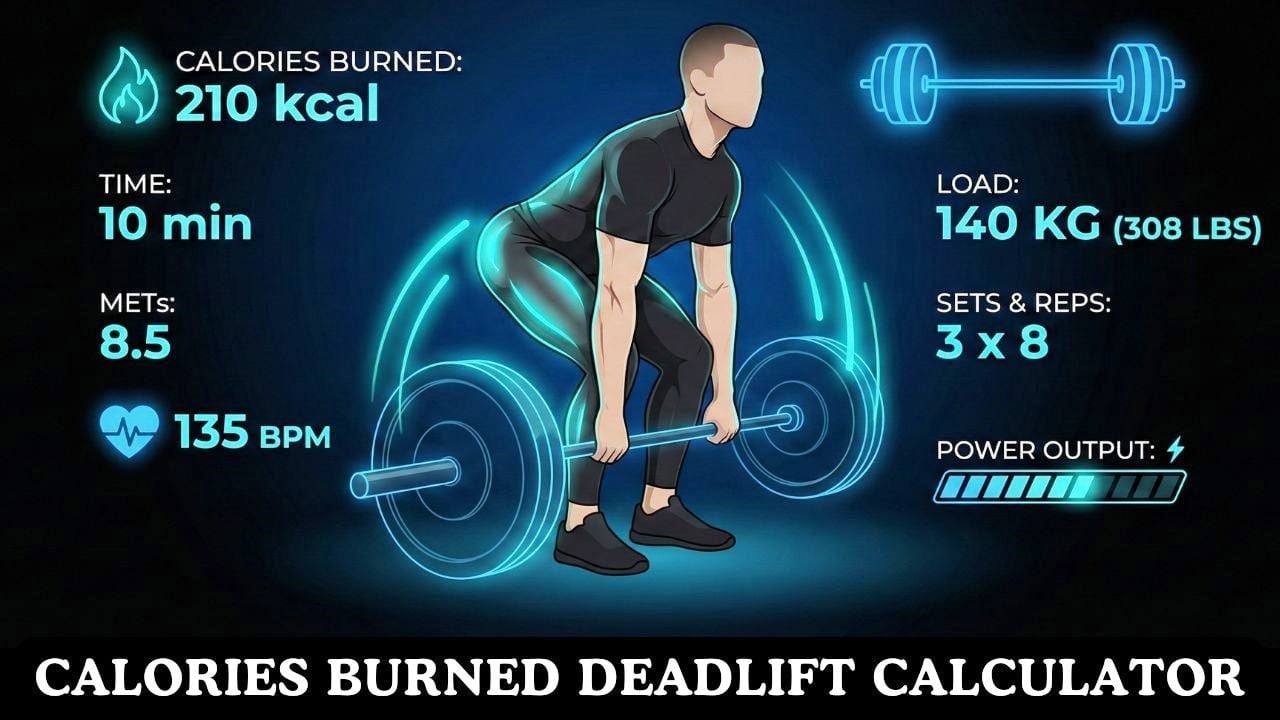
Deadlifts burn approximately 210-260 calories per 30-minute session for a 155 lb (70 kg) person performing standard strength training (6.0 MET), making them one of the most efficient strength exercises for energy expenditure. A typical deadlift workout burns 7-9 calories per minute during active lifting, with vigorous circuit-style training burning up to 11 calories per minute when accounting for post-exercise oxygen consumption (EPOC).
The deadlift is unique among strength exercises because it engages the largest muscle groups simultaneously—glutes, hamstrings, quadriceps, lower back, lats, traps, and core. This full-body engagement creates substantial metabolic demand, burning more calories than isolation exercises like bicep curls or leg extensions.
Calories = (MET × 3.5 × Body Weight in kg ÷ 200) × Duration in minutes
Calories = (6.0 × 3.5 × 73 ÷ 200) × 30
Calories = (7.665) × 30 = 230 calories burned
Important Context: The formula above calculates calories during the workout itself. Heavy deadlifts create significant EPOC (Excess Post-Exercise Oxygen Consumption), burning an additional 6-15% of workout calories over the next 24-48 hours. A 230-calorie session may actually burn 244-265 total calories when accounting for this “afterburn effect.” Learn more about exercise benefits and metabolism.
Calories Burned by Training Duration & Body Weight
Your body weight and training duration significantly impact total calorie expenditure. Here’s comprehensive data for deadlift sessions at 6.0 MET (general strength training intensity):
| Body Weight | 15 Minutes | 30 Minutes | 45 Minutes | 60 Minutes |
|---|---|---|---|---|
| 130 lbs (59 kg) | 93 cal | 186 cal | 278 cal | 371 cal |
| 150 lbs (68 kg) | 107 cal | 214 cal | 321 cal | 428 cal |
| 160 lbs (73 kg) | 114 cal | 229 cal | 343 cal | 458 cal |
| 180 lbs (82 kg) | 129 cal | 257 cal | 386 cal | 514 cal |
| 200 lbs (91 kg) | 143 cal | 286 cal | 429 cal | 572 cal |
| 220 lbs (100 kg) | 158 cal | 315 cal | 473 cal | 630 cal |
Key Insight: Heavier individuals burn proportionally more calories—a 220 lb person burns 70% more than a 130 lb person during identical workouts (630 vs 371 cal/hour). These values represent workout calories only at 6.0 MET intensity; add 6-15% for EPOC effect with heavy training, or multiply by intensity factors for different training styles.
Calories Burned by Training Intensity & Style
Training intensity and style dramatically affect calorie expenditure. Here’s how different approaches compare for a 160 lb (73 kg) person during 30 minutes:
| Training Style | MET Value | Description | Calories (30 min) |
|---|---|---|---|
| Circuit/Metabolic Training | 8.0 | 30-60 sec rest, continuous work | 306 cal |
| Vigorous Weight Training | 6.5 | 60-90 sec rest, moderate intensity | 249 cal |
| Standard Strength Training | 6.0 | 90-120 sec rest, compound lifts | 230 cal |
| Powerlifting (Heavy Singles) | 5.5 | 3-5 min rest, 85-95% 1RM | 211 cal |
| Light/Technique Work | 4.5 | 50-60% 1RM, form practice | 172 cal |
Training Insight: Circuit-style deadlifts burn 45% more calories than powerlifting-style training due to shorter rest periods and continuous metabolic demand. However, powerlifting creates greater EPOC effect (10-15% vs 6-8% for circuits).
Calories Per Rep & Volume Considerations
Individual rep energy cost varies by load intensity and body weight. Here’s what research reveals about per-rep calorie expenditure:
| Load Intensity | Calories/Rep (130 lb) | Calories/Rep (160 lb) | Calories/Rep (200 lb) | Example Volume |
|---|---|---|---|---|
| Light (50-60% 1RM) | 0.4 cal | 0.5 cal | 0.6 cal | 50 reps = 25-30 cal |
| Moderate (65-75% 1RM) | 0.6 cal | 0.7 cal | 0.9 cal | 35 reps = 25-32 cal |
| Heavy (80-90% 1RM) | 0.9 cal | 1.1 cal | 1.3 cal | 20 reps = 22-26 cal |
| Maximal (90-100% 1RM) | 1.2 cal | 1.5 cal | 1.8 cal | 10 reps = 12-18 cal |
Volume Strategy: Moderate loads (65-75% 1RM) for 30-40 reps provide optimal calorie burn while minimizing injury risk. Heavy singles burn fewer workout calories but create maximum EPOC effect. Track your strength with our One Rep Max Calculator.

Manish is a NASM-certified fitness and nutrition coach with over 10 years of experience in weight lifting and fat loss fitness coaching. He specializes in gym-based training and has a lot of knowledge about exercise, lifting technique, biomechanics, and more.
Through “Fit Life Regime,” he generously shares the insights he’s gained over a decade in the field. His goal is to equip others with the knowledge to start their own fitness journey.