
✋ Height to Finger Length Calculator
Estimate your finger length from your height using anthropometric formulas. Calculate middle finger, index finger, and ring finger lengths based on scientifically validated body proportion relationships.
Understanding Height to Finger Length Relationship
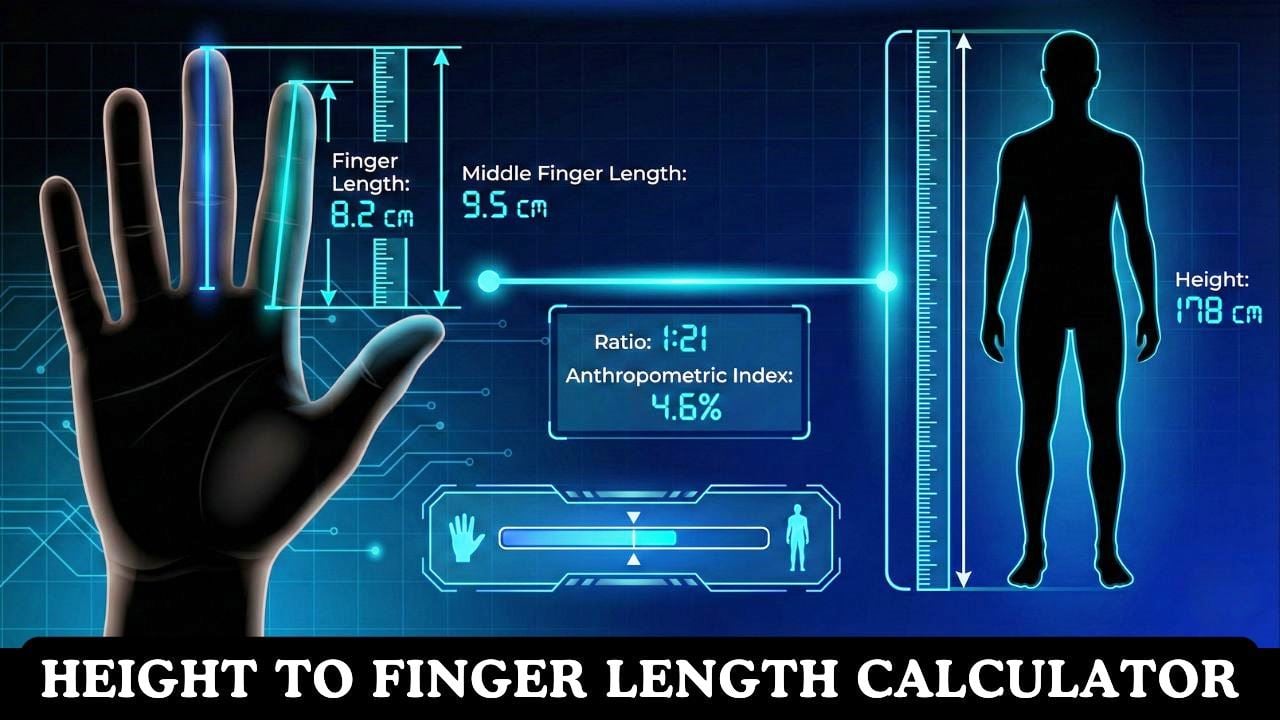
FL = 65 × 0.054 + 0.2275 = 3.738 inches = 9.49 cm
What is the Height-Finger Relationship?
Finger length correlates with overall body height through skeletal proportions determined during fetal development. Studies in
anthropometry show that middle finger length represents approximately 5.5-6.0% of total height in adults (not to be confused with
hand length from wrist to fingertip, which is ~10.8-11.5% of height). This relationship is consistent across populations, though
individual variation exists.
The formula used (FL = H × 0.054 + 0.2275) is derived from regression analysis of large population samples measuring both height
and finger length. The coefficient 0.054 represents the proportional relationship, while 0.2275 is a constant offset that accounts
for baseline finger length regardless of height. This produces accurate estimates within ±10-15% for most individuals. Explore more
body proportion calculators with our Ape Index Calculator.
The 2D:4D Ratio Explained
The 2D:4D ratio compares the length of the index finger (2D) to the ring finger (4D). This ratio is a biomarker of prenatal hormone
exposure—specifically the balance between testosterone and estrogen in the womb. Lower ratios (ring finger longer than index)
suggest higher prenatal testosterone, while higher ratios suggest lower testosterone exposure.
Typical Ranges:
• Males: 0.95-0.99 (ring finger typically longer)
• Females: 0.97-1.00 (fingers more equal in length)
Research has linked 2D:4D ratios to various traits including athletic ability, spatial reasoning, aggression, fertility, and disease
susceptibility. Lower ratios in males correlate with better athletic performance in sports requiring endurance and spatial awareness.
However, individual predictions based solely on finger ratios should be interpreted cautiously—this is a statistical correlation,
not a deterministic relationship. Optimize your athletic performance with our
VO2 Max Calculator.
Gender Differences in Finger Proportions
Sexual dimorphism in finger proportions is well-documented. Males typically have longer fingers relative to height compared to
females, and different finger length ratios. The most notable difference is in the 2D:4D ratio—males average 0.97, females average 0.99.
Male Characteristics:
• Longer ring finger relative to index (lower 2D:4D)
• Slightly longer fingers overall relative to height
• Greater variation in 2D:4D ratios
Female Characteristics:
• More equal index and ring finger lengths (higher 2D:4D)
• Slightly shorter fingers relative to height
• Less variation in 2D:4D ratios
These differences emerge during fetal development due to differential hormone exposure. Testosterone promotes growth of the ring
finger more than the index finger, creating the characteristic male pattern. Understanding these patterns helps in forensic
anthropology, ergonomic design, and medical assessments. Track your overall health metrics with our
BMI Calculator.
Practical Applications & Interpretations
Sports Performance & Finger Length
Finger length influences performance in sports requiring grip strength, ball handling, or reaching. Longer fingers provide advantages
in basketball (ball control, blocking), rock climbing (reach, crimping), volleyball (blocking, spiking), and swimming (propulsion
surface area).
Basketball: Professional players often have finger lengths 1-2 standard deviations above average, providing better ball
control and shooting mechanics. The ability to palm a basketball correlates strongly with finger length and hand span.
Rock Climbing: Longer fingers allow climbers to reach distant holds and crimp on small edges more effectively. Elite
climbers typically have above-average finger length-to-height ratios. However, finger strength matters more than length for high-level
performance.
Grip Sports: Shorter, thicker fingers may provide advantages in powerlifting and strongman competitions where crushing
grip strength is paramount. The shorter lever arm allows greater force generation. Optimize your strength training with our
One Rep Max Calculator.
Measurement Methods & Accuracy
Standard Finger Length Measurement:
1. Place hand palm-down on flat surface
2. Straighten finger completely (not hyperextended)
3. Measure from base crease (where finger meets palm) to fingertip
4. Use ruler or calipers for precision (±1mm accuracy)
5. Measure middle finger for height correlation, index and ring for 2D:4D ratio
Common Errors: Measuring from wrong reference point (use base crease, not knuckle), not straightening finger
completely, measuring curved rather than straight line. Professional anthropometric measurements use digital calipers for 0.1mm
precision, but ruler measurements within ±2mm are sufficient for general purposes.
Calculator estimates provide good approximations (±10-15% typical error) but cannot replace direct measurement. Individual skeletal
proportions vary based on genetics, ethnicity, nutrition during growth, and developmental factors. Measure your actual fitness progress with our
Body Composition Calculator.
Developmental & Genetic Factors
Finger length relative to height is primarily determined during fetal development and early childhood growth. Key factors include:
Prenatal Hormones: Testosterone and estrogen levels in the womb influence finger development, particularly the 2D:4D
ratio. This is why finger ratios are considered “fossilized” markers of fetal hormone exposure.
Genetic Inheritance: Finger length and proportions are heritable traits (h² ≈ 0.6-0.7), meaning 60-70% of variation
is genetic. Multiple genes influence skeletal proportions, with some specific to finger development (e.g., HOX genes).
Growth Patterns: Fingers grow proportionally faster during infancy and slower during puberty compared to overall height.
Final finger-to-height ratio stabilizes around age 16-18 when growth plates close. Nutrition and health during growth phases affect
final proportions.
Ethnic Variation: Some populations show slightly different average ratios. For example, East Asian populations tend
toward higher 2D:4D ratios on average compared to European populations. These are statistical tendencies with substantial overlap
between groups. Understand your genetic potential with our
Muscle Mass Calculator.
Frequently Asked Questions
How accurate is the height-to-finger length calculator?
The calculator provides estimates accurate to within ±10-15% for most individuals. The formula is based on regression analysis of population data, predicting the average finger length for a given height. Individual variation exists due to genetics, skeletal proportions, and measurement methodology. For medical or forensic applications requiring high precision, direct finger measurement is necessary. For general interest and approximate predictions, calculator estimates are reliable.
Does finger length affect grip strength?
Finger length has a complex relationship with grip strength. Longer fingers provide greater moment arm for flexor tendons, potentially generating more torque. However, shorter fingers have biomechanical advantages in crushing grip tasks due to shorter lever arms requiring less muscle force. Research shows grip strength correlates more strongly with hand size (palm width) and forearm muscle mass than finger length alone. Elite climbers have strong fingers regardless of length—training matters more than anatomy. Measure your grip strength development by tracking your climbing or lifting progress.
Can finger length predict height in forensics?
Yes, forensic anthropologists use finger length (along with other skeletal measurements) to estimate height from incomplete remains. The relationship works bidirectionally—height predicts finger length, and finger length predicts height. Regression equations provide height estimates with standard errors of ±3-5 cm when using finger length alone. Combining multiple skeletal measurements (fingers, hand, foot, long bones) improves accuracy to ±2-3 cm. Gender and ancestry must be known or estimated for accurate height prediction, as these factors affect the height-finger relationship constants.
What does my 2D:4D ratio mean for health?
The 2D:4D ratio has been studied in relation to numerous health outcomes, with mixed evidence. Lower ratios (higher prenatal testosterone)
show weak correlations with increased risk of ADHD, autism spectrum traits, and prostate cancer in males. Higher ratios show weak
associations with increased anxiety, depression risk, and breast cancer in females. However, these are weak statistical
associations at population level—individual predictions are unreliable.
Most health outcomes depend far more on lifestyle factors (diet, exercise, sleep, stress management) than finger ratios. The 2D:4D ratio
is primarily useful as a research tool for studying prenatal hormone effects, not as a diagnostic or predictive tool for individuals.
Focus on modifiable health factors rather than finger ratios for health optimization.

Manish is a NASM-certified fitness and nutrition coach with over 10 years of experience in weight lifting and fat loss fitness coaching. He specializes in gym-based training and has a lot of knowledge about exercise, lifting technique, biomechanics, and more.
Through “Fit Life Regime,” he generously shares the insights he’s gained over a decade in the field. His goal is to equip others with the knowledge to start their own fitness journey.