The single arm cable fly is a chest isolation exercise where one arm sweeps across your body against a cable while your other hand stays free.
You can do it with the pulley at chest height, set low (low-to-high), or set high (high-to-low). The pulley height changes the angle of your arm path, which shifts how much each part of the chest and shoulder contributes. It does not isolate separate chest muscles.
This guide covers the correct setup (including which hand to hold the handle with), the muscles involved, the three variations, common mistakes, and how to fit the exercise into a chest workout.

- Quick Setup Summary
- Single Arm Cable Fly Muscles Worked
- How to Do the Single Arm Cable Fly (Mid-Level)
- Common Mistakes
- Single Arm Cable Fly Low to High
- Single Arm Cable Fly High to Low
- Single Arm vs Two-Arm Cable Fly
- Benefits and Limitations
- Sets and Reps
- When to Modify or Skip It
- FAQ
- Which hand do you use for a single arm cable fly?
- Does the single arm cable fly work the upper chest?
- How high should I set the pulley?
- Is a single arm cable fly better than a two-arm cable fly?
- Why does my torso twist during the exercise?
- References
Quick Setup Summary
- Stand side-on to the cable stack and hold the handle in the hand closest to the stack.
- Step away until the cable is taut and pulls your arm back toward the stack.
- Use a staggered stance, keep your free hand on your hip, and keep your ribs down.
- Hold a soft, fixed bend in the elbow and sweep your hand across your body to the midline.
- Return slowly, without letting your torso twist toward the stack.
Single Arm Cable Fly Muscles Worked
The main muscle is the pectoralis major. It is a single muscle with clavicular (upper), sternocostal (middle) and abdominal (lower) segments, not a set of separate “inner” and “outer” chest muscles.
In an EMG study of eight men, the segments were controlled independently, so which ones worked hardest depended on the arm position and the direction of the effort.
Horizontal flexion of the shoulder, which is the cross-body motion of a fly, mainly used the middle segments (Paton and Brown, 1994). That study tested isometric contractions, not cable exercises, so treat it as a guide, not a rule.
- Prime mover: pectoralis major, moving the arm across the body (shoulder horizontal adduction).
- Assisting: anterior deltoid and coracobrachialis, plus the muscles at the elbow that hold the bend in place.
- Stabilizing: serratus anterior, pectoralis minor and the rotator cuff around the shoulder, plus your trunk muscles, which resist the cable pulling you sideways.
How to Do the Single Arm Cable Fly (Mid-Level)
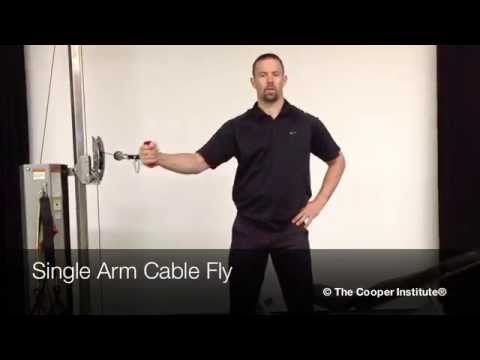
Start with the pulley at about chest height. This is the version to learn first, because the arm path is the most straightforward.
- Attach a single D-handle and set the pulley around chest height.
- Stand side-on to the stack and take the handle in the hand nearest to it.
- Step away until the cable is taut. Your arm should be out to the side at roughly shoulder height, with a soft bend in the elbow, and the cable should be pulling it back toward the stack.
- Take a staggered stance for balance. Place your free hand on your hip or on the frame, and keep your ribs down.
- Keeping the elbow angle fixed, sweep your hand in a wide arc across your body until it reaches the midline in front of your chest.
- Pause briefly, then let the arm open back out under control until you feel a stretch across the chest. Stop before you feel a pull at the front of the shoulder.
- Finish your reps on one side, then switch.
Which hand? A cable resists any movement of the handle away from the pulley. Holding the handle in the hand nearest the stack means the cable works against the sweep across your body, which is the chest’s job.
If the cable instead pulls your arm across your body as you set up, you are holding it with the wrong hand. Switch hands.
Common Mistakes
- Twisting toward the stack. The weight pulls one side of your torso. Keep your hips and shoulders square and let only the arm move.
- Bending and straightening the elbow. That turns the fly into a press and shifts work to the triceps. Fix the elbow angle and move at the shoulder.
- Opening too far behind your body. Stop when you feel a stretch across the chest. A pull at the front of the shoulder means you have gone too far.
- Standing too close to the stack. The weight can touch the stack and tension drops. Step far enough away that the plates stay lifted.
- Shrugging or letting the shoulder roll forward. Keep your shoulder down and back so the chest does the work.
- Using too much weight. This exercise needs far less load than a press. If the path changes from rep to rep, drop the weight.
Single Arm Cable Fly Low to High
With the pulley at its lowest setting, your arm rises as it crosses your body. That adds shoulder flexion to the horizontal sweep. Isometric EMG research suggests that shoulder flexion uses the upper segments of the pectoralis major more (Paton and Brown, 1994).
In the bench press, the clavicular (upper) head was more active at 44 and 56 degrees of incline than on a flat bench, and the anterior deltoid was more active on inclines too (Trebs et al., 2010). Both studies measured muscle activity, not growth, and neither used a cable fly, so treat this as a shift in emphasis, not a way to isolate the upper chest.
- Set the pulley at its lowest position with a D-handle attached.
- Stand side-on, take the handle in the hand nearest the stack, and step away until the cable is taut.
- Start with your hand low beside your hip on the stack side, with a soft bend in the elbow.
- Sweep the handle up and across your body in a diagonal arc, finishing at roughly chest to shoulder height near the midline.
- Pause briefly, then lower along the same path under control.
If your shoulder has to lift toward your ear to reach a higher finish, you have gone too far. For the two-arm version, see the low-to-high cable fly.

Single Arm Cable Fly High to Low
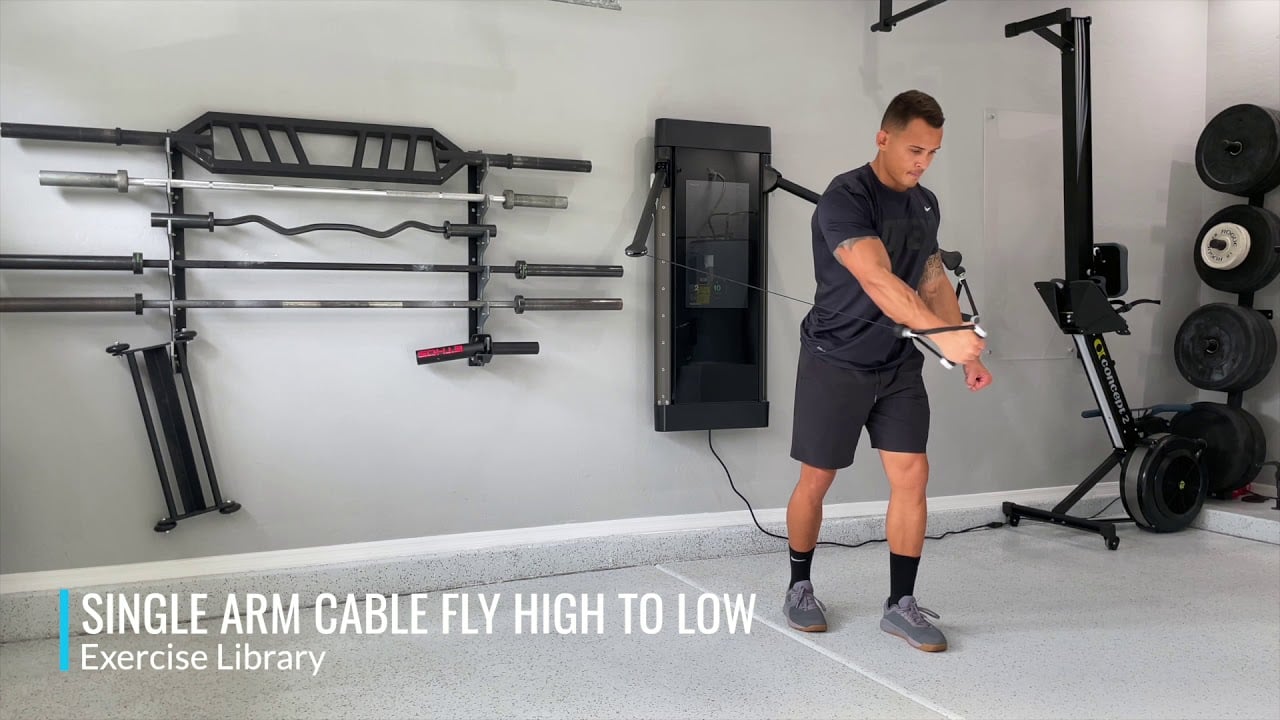
With the pulley set high, your arm starts raised and travels down and across your body. In isometric tests, pulling the arm down from a raised (flexed) position used the lower segments of the pectoralis major most (Paton and Brown, 1994). Other muscles that pull the arm down, such as the latissimus dorsi, can also help, so the chest is not working alone.
- Set the pulley at about head height or slightly above and attach a D-handle.
- Stand side-on, take the handle in the hand nearest the stack, and step away until the cable is taut. Place your free hand on your hip.
- Start with your arm raised out to the side and a soft bend in the elbow.
- Sweep the handle down and across your body toward the opposite hip, keeping the elbow angle fixed and your torso upright.
- Pause briefly, then return to the start under control.
Avoid leaning forward to finish the rep. The two-arm version is covered in the high cable chest fly guide.
Single Arm vs Two-Arm Cable Fly
Neither version is better for everyone. The two-arm cable fly trains both sides at once, which saves time and is simpler to set up. The single arm version lets you set the load and reps for each side separately, gives you a free hand for balance and feedback, and makes your trunk work to resist the cable pulling you sideways.
It is worth being clear about what it does not do. In a two-arm cable fly each arm already moves its own cable, so a stronger side cannot take over the way it can on a barbell press. Going single-arm mainly lets you adjust each side.
A 2025 meta-analysis of nine studies on unilateral versus bilateral training found no significant difference in muscle growth, although the authors describe the evidence as limited. Strength followed the specificity principle: unilateral training improved one-sided strength more, and bilateral training improved two-sided strength more (Kassiano et al., 2025).
The same caution applies to the cable versus the dumbbell fly. In general, a cable keeps tension on the chest as your arm nears the midline, while a dumbbell is hardest at the stretched position. They load the muscle differently, and I am not aware of evidence that either builds more muscle.
Benefits and Limitations
- Benefit: you can load and track each side independently.
- Benefit: it adds a trunk-stability demand, because the one-sided load tries to rotate you. In a small study of 11 people, unilateral chest presses produced higher trunk muscle activity than bilateral presses (Behm et al., 2005). That study used presses, not cable flies, so treat the core effect as modest. This is not a replacement for ab training.
- Benefit: a cable generally keeps the chest under load as your arm approaches the midline.
- Limit: you cannot use heavy weights, and the exercise takes longer per session than a two-arm fly.
- Limit: it can bother the front of the shoulder if you open too far behind your body.
- Keep in mind: in a 12-week pec deck study of 15 untrained men, ultrasound showed the upper (clavicular) and middle (sternocostal) parts of the pectoralis major thickening by about 17 to 18% and 21%, and the authors concluded the results do not support regional hypertrophy from that exercise (Pinto et al., 2025). That was a different machine, but I am not aware of good evidence that one pulley angle builds one region alone.
Sets and Reps
These are practical starting points, not exact prescriptions. Muscle growth can happen across a wide range of loads (Schoenfeld et al., 2021), so 8 to 15 reps is a sensible range for a controlled fly. A meta-analysis found no evidence that training to momentary failure beats stopping short of it for muscle growth (Refalo et al., 2023).
| Variable | Starting point (per side) |
|---|---|
| Reps | 8 to 15 |
| Sets | 2 to 4 |
| Effort | Stop about 1 to 3 reps before you cannot continue |
| Rest | About 60 to 90 seconds; alternating sides gives you rest |
| Placement | After your presses, as an accessory movement |
Think in weekly sets for your whole chest, not just this exercise. A meta-regression found that more weekly sets were associated with greater gains in muscle size (Schoenfeld et al., 2017), and a fly usually makes up a few of those sets, not all of them.
Use the sets and reps calculator or the training volume calculator to plan the rest of your week. You can also find more cable options on the cable machine exercises page.
When to Modify or Skip It
Shorten the range and use a lighter load if you feel pinching or strain at the front of the shoulder, and stop if pain sharpens or spreads down the arm. If you have a shoulder injury or instability, or pain that does not settle, check with a qualified clinician before continuing. This guide is general information, not medical advice.
FAQ
Which hand do you use for a single arm cable fly?
Use the hand nearest the cable stack when you stand side-on. The cable should pull your arm back toward the stack, so your chest works as you sweep across your body.
Does the single arm cable fly work the upper chest?
The low-to-high version may shift some emphasis toward the upper fibers, but the whole pectoralis major works. Evidence that a specific angle grows one region more is limited.
How high should I set the pulley?
Chest height for the mid-level version, the lowest setting for low-to-high, and about head height or slightly above for high-to-low.
Is a single arm cable fly better than a two-arm cable fly?
Current evidence does not show either one is better for muscle growth. The single arm version is useful when you want to set load per side or add a trunk-stability challenge.
Why does my torso twist during the exercise?
The one-sided load pulls your torso toward the stack. Lower the weight, use a staggered stance, brace your trunk, and keep your hips and shoulders square.
References
- Paton ME, Brown JM. An electromyographic analysis of functional differentiation in human pectoralis major muscle. J Electromyogr Kinesiol. 1994;4(3):161-169. PMID 20870556.
- Trebs AA, Brandenburg JP, Pitney WA. An electromyography analysis of 3 muscles surrounding the shoulder joint during the performance of a chest press exercise at several angles. J Strength Cond Res. 2010;24(7):1925-1930. PMID 20512064.
- Behm DG, Leonard AM, Young WB, Bonsey WAC, MacKinnon SN. Trunk muscle electromyographic activity with unstable and unilateral exercises. J Strength Cond Res. 2005;19(1):193-201. PMID 15705034.
- Kassiano W, Nunes JP, Costa B, Ribeiro AS, Loenneke JP, Cyrino ES. Comparison of muscle growth and dynamic strength adaptations induced by unilateral and bilateral resistance training: a systematic review and meta-analysis. Sports Med. 2025;55(4):923-936. PMID 39794667.
- Pinto MD, Ughini C, Nunes JP, Cadore EL, Pinto RS. Pectoralis clavicular and sternocostal thicknesses increase similarly in response to one and three sets of pec deck resistance training in untrained young men. J Strength Cond Res. 2025;39(5):523-530. doi:10.1519/JSC.0000000000005045.
- Refalo MC, Helms ER, Trexler ET, Hamilton DL, Fyfe JJ. Influence of resistance training proximity-to-failure on skeletal muscle hypertrophy: a systematic review with meta-analysis. Sports Med. 2023;53(3):649-665. PMID 36334240.
- Schoenfeld BJ, Ogborn D, Krieger JW. Dose-response relationship between weekly resistance training volume and increases in muscle mass: a systematic review and meta-analysis. J Sports Sci. 2017;35(11):1073-1082. PMID 27433992.
- Schoenfeld BJ, Grgic J, Van Every DW, Plotkin DL. Loading recommendations for muscle strength, hypertrophy, and local endurance: a re-examination of the repetition continuum. Sports (Basel). 2021;9(2):32. PMC7927075.

Manish is a NASM-certified fitness and nutrition coach with over 10 years of experience in weight lifting and fat loss fitness coaching. He specializes in gym-based training and has a lot of knowledge about exercise, lifting technique, biomechanics, and more.
Through “Fit Life Regime,” he generously shares the insights he’s gained over a decade in the field. His goal is to equip others with the knowledge to start their own fitness journey.