
Ideal Thigh Size Calculator
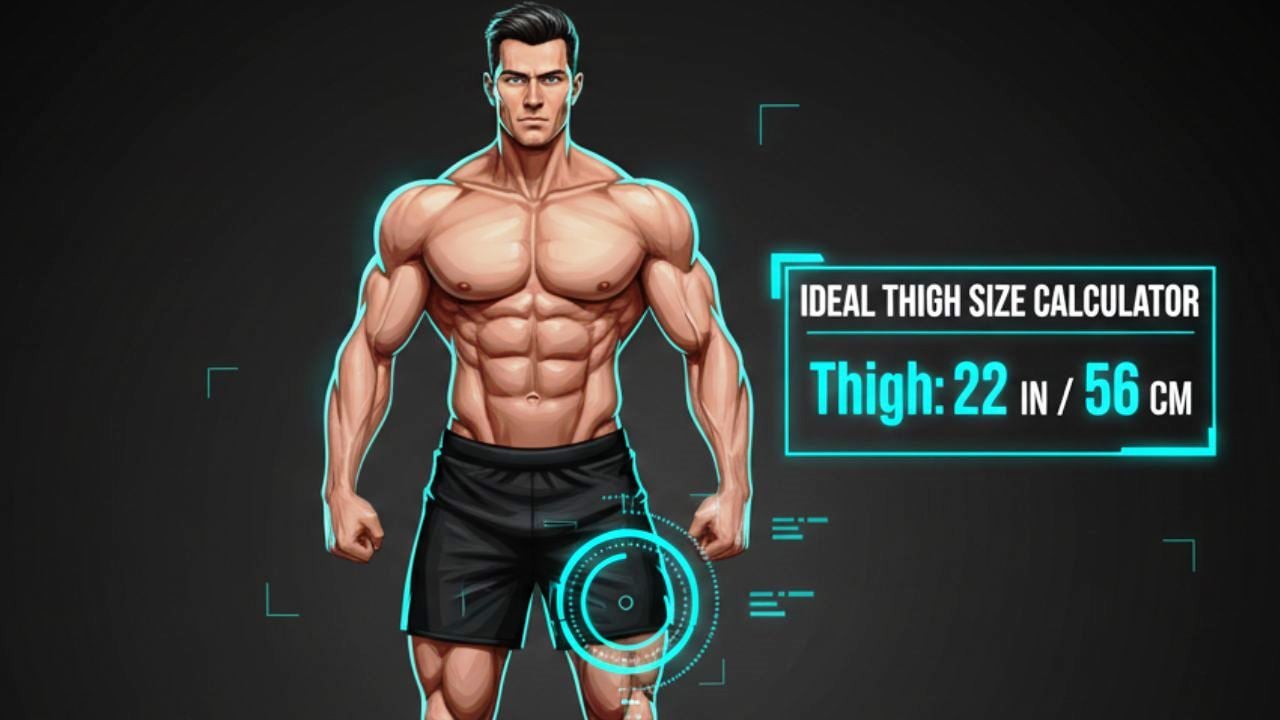
What Determines Ideal Thigh Measurements?
Ideal thigh size represents the thigh circumference that creates balanced lower body proportions, supports functional strength, and reflects adequate quadriceps and hamstring development. Unlike arbitrary standards, your ideal measurement is relative to your height, knee circumference, waist measurement, body frame type, and training objectives.
Research demonstrates that thigh circumference strongly correlates with lower body strength, athletic performance, and metabolic health. Well-developed thighs indicate functional muscle mass—the quadriceps (among the largest muscle groups) and hamstrings work synergistically for walking, running, jumping, and power generation. Proportional thighs create aesthetic balance in your overall physique.
Calculation Formulas Explained
Calculation: 70 × 0.335 = 23.5 inches (59.6 cm)
Result: Ideal thigh = 23.5 inches for proportional balance
Calculation: 65 × 0.34 = 22.1 inches (56.1 cm)
Result: Ideal thigh = 22.1 inches proportional to height
This method ensures thigh measurements remain proportional to overall body height, creating balanced aesthetics. The multipliers derive from anthropometric studies of well-proportioned physiques.
Calculation: 15 × 1.75 = 26.3 inches (66.8 cm)
Result: Ideal thigh = 26.3 inches for aesthetic taper
Note: This creates the classic quad “sweep” appearance
The 1.75:1 ratio creates visually pleasing leg taper. Thighs should be significantly larger than knees to demonstrate proper muscular development while maintaining proportional aesthetics.
Waist = 33 inches (84 cm)
33 × 0.75 = 24.8 inches (62.9 cm)
Female Example:
Waist = 28 inches (71 cm)
28 × 0.80 = 22.4 inches (56.9 cm)
Result: Lower body proportional balance
This method ensures thighs are appropriately sized relative to waist circumference, creating balanced lower body proportions. Women typically have larger thigh-to-waist ratios due to natural body composition differences.
Knee Method: 26.3 inches (66.8 cm)
Weighted Average: (23.5 × 0.7) + (26.3 × 0.3) = 24.3 inches (61.8 cm)
Body Type (Mesomorph): 24.3 × 1.0 = 24.3 inches
Goal (Strength): 24.3 × 1.05 = 25.5 inches (64.8 cm)
Final Target: 25.5 inches (64.8 cm)
Proper Thigh Measurement Technique
Step-by-Step Measurement Guide
1. Preparation: Stand with feet shoulder-width apart, weight evenly distributed, leg muscles completely relaxed
2. Locate Point: Find widest point of thigh (typically 1-3 inches below gluteal fold at mid-thigh)
3. Position Tape: Wrap measuring tape around thigh at widest point, parallel to floor
4. Check Alignment: Ensure tape is level all around, not twisted or angled
5. Take Reading: Keep tape snug but not compressing muscle tissue, record measurement
6. Verify Accuracy: Measure both legs and use the larger measurement for consistency
Common Measurement Errors:
• Flexing quadriceps during measurement (artificially inflates reading)
• Measuring too high (near hip) or too low (mid-thigh)
• Tape not parallel to floor (creates inaccurate measurement)
• Pulling tape too tight (compresses soft tissue)
• Inconsistent location between measurement sessions
• Measuring immediately post-workout (temporary muscle pump adds 1-2 cm)
Building Your Ideal Thighs
Evidence-Based Training Approach
Essential Exercises for Thigh Development:
• Barbell Back Squats: Foundation exercise for overall thigh mass, targeting quads, hamstrings, and glutes (4-5 sets, 6-10 reps). Research confirms squats as the most effective compound leg exercise for muscle growth.
• Romanian Deadlifts: Essential for hamstring development and posterior chain strength (3-4 sets, 8-12 reps). Learn proper technique with our hamstring exercise guide.
• Leg Press: Allows heavy loading for quad mass with reduced spinal stress (4 sets, 10-15 reps). Explore effective variations in our leg machine training guide.
• Bulgarian Split Squats: Unilateral exercise for balanced development and functional strength (3 sets, 10-12 reps per leg)
Training Frequency: Train legs twice weekly with 72 hours between sessions for optimal recovery. Progressive overload is critical—systematically increase weight by 5-10 lbs when completing all sets at top of rep range. Track workouts to ensure continuous progression.
Volume Guidelines: Perform 12-18 total working sets weekly for quads and 8-12 sets for hamstrings. Beginners start lower (10-12 total sets), advanced lifters may handle higher volumes (16-22 sets). Monitor recovery and adjust accordingly.
Nutrition for Leg Development
Building thigh muscle requires caloric surplus and adequate protein intake. Target 250-400 calories above maintenance with 0.8-1.0g protein per pound bodyweight. Quality nutrition combined with consistent leg training drives optimal muscle hypertrophy.
Macronutrient Focus: Prioritize lean proteins (chicken, fish, eggs, Greek yogurt), complex carbohydrates (rice, oats, sweet potatoes) to fuel intense leg training, and healthy fats (avocado, nuts, olive oil) for hormone production. Adequate carbohydrate intake (2-3g per pound bodyweight) is essential for training intensity and glycogen replenishment after demanding leg workouts.
Average Thigh Sizes by Training Level
| Training Experience | Male Average | Female Average | Development Stage |
|---|---|---|---|
| Untrained | 19.7-21.3 inches (50-54 cm) | 18.9-20.5 inches (48-52 cm) | Average adult, no resistance training |
| Novice (6-12 months) | 21.3-22.8 inches (54-58 cm) | 20.5-21.7 inches (52-55 cm) | Consistent training, visible development |
| Intermediate (1-3 years) | 22.8-24.8 inches (58-63 cm) | 21.7-22.8 inches (55-58 cm) | Solid foundation, noticeable muscle |
| Advanced (3-5 years) | 24.8-26.8 inches (63-68 cm) | 22.8-24.0 inches (58-61 cm) | Significant mass, approaching genetic limits |
| Elite Natural | 26.8-28.0 inches (68-71 cm) | 24.0-24.8 inches (61-63 cm) | Near genetic maximum, rare naturally |
Reference Note: These ranges represent naturally achievable measurements at different training levels. Individual results vary based on genetics, training consistency, nutrition quality, and recovery. Natural thigh development requires patient, progressive training over several years.
Common Questions About Ideal Thigh Size
What is the average thigh size for adults?
Average thigh circumference for untrained adult men is 50-54 cm (20-21 inches); for women 48-52 cm (19-20 inches). However, “average” doesn’t equal “ideal”—your target depends on height, bone structure, and training goals. Someone 180 cm tall should have proportionally larger thighs than someone 165 cm. With proper training, men can naturally develop 58-68 cm (23-27″) thighs; women 55-61 cm (22-24”) thighs over several years.
How long does it take to build 25-inch thighs?
Building 25-inch (63.5 cm) thighs from average starting point (20-21″) requires 2-4 years of consistent leg training and proper nutrition for most natural lifters. First year gains are fastest (1-2 inches possible with optimal programming). Progress slows significantly as you approach genetic limits. Typical progression from 20″ starting point: Year 1: 20-22″, Year 2: 22-23.5″, Year 3: 23.5-24.5″, Year 4: 24.5-25″. Genetics heavily influence leg development potential.
Should thighs be larger than calves?
Yes, thighs should always be significantly larger than calves for proportional lower body aesthetics. Typical ratio is approximately 1.5-1.7:1 (thigh:calf). For example, if calves are 38 cm (15″), thighs should be 57-65 cm (22-25″). Thigh circumference naturally exceeds calf because quadriceps and hamstrings are much larger muscle groups than gastrocnemius and soleus. Explore comprehensive leg training programs for balanced development.
Can I build ideal thighs without squats?
While squats are highly effective, you can build impressive thighs with alternatives like leg press, lunges, Bulgarian split squats, and hack squats. The key is progressive overload with compound movements that challenge your legs with heavy resistance. However, squats remain the gold standard for simultaneous quad, hamstring, and glute development. If avoiding squats due to injury or mobility limitations, focus on quad-focused machine exercises combined with targeted hamstring work.
Related Training Resources
Complete Lower Body Programs
Maximize your leg development with our comprehensive guides on cable leg exercises, bodyweight leg training, and machine-based leg workouts. These evidence-based programs provide progressive exercise selections for all experience levels.
⚕️ Medical Disclaimer
Consult with healthcare professionals, certified personal trainers, or sports medicine specialists before starting intensive leg training programs, especially if you have pre-existing knee, hip, or lower back conditions.

Manish is a NASM-certified fitness and nutrition coach with over 10 years of experience in weight lifting and fat loss fitness coaching. He specializes in gym-based training and has a lot of knowledge about exercise, lifting technique, biomechanics, and more.
Through “Fit Life Regime,” he generously shares the insights he’s gained over a decade in the field. His goal is to equip others with the knowledge to start their own fitness journey.