The quadriceps are the largest muscle group in your body by volume. They generate the force behind every squat, lunge, jump, and sprint — and building them bigger and stronger has some of the highest returns in lower-body training for both performance and physique.
While barbell squats are a solid foundation, gym machines offer something free weights struggle to match: consistent resistance curves, guided mechanics, and the ability to push each muscle close to failure without a spotter or balance limitations. When used strategically alongside compound lifts, they are among the most effective tools for complete quad development.
This guide gives you the full picture — from the anatomy behind why multiple machines are needed, to accurate form cues, to a structured workout program you can apply immediately.
- Quad Anatomy: Why All 4 Heads Need Targeted Work
- Top Gym Machines Exercises For Quad Workout
- 1. Leg Press Machine
- 2. Leg Extension Machine
- 3. Hack Squat Machine
- 4. Smith Machine For Quad Workout
- 5. Cable Machine for Quad Exercises
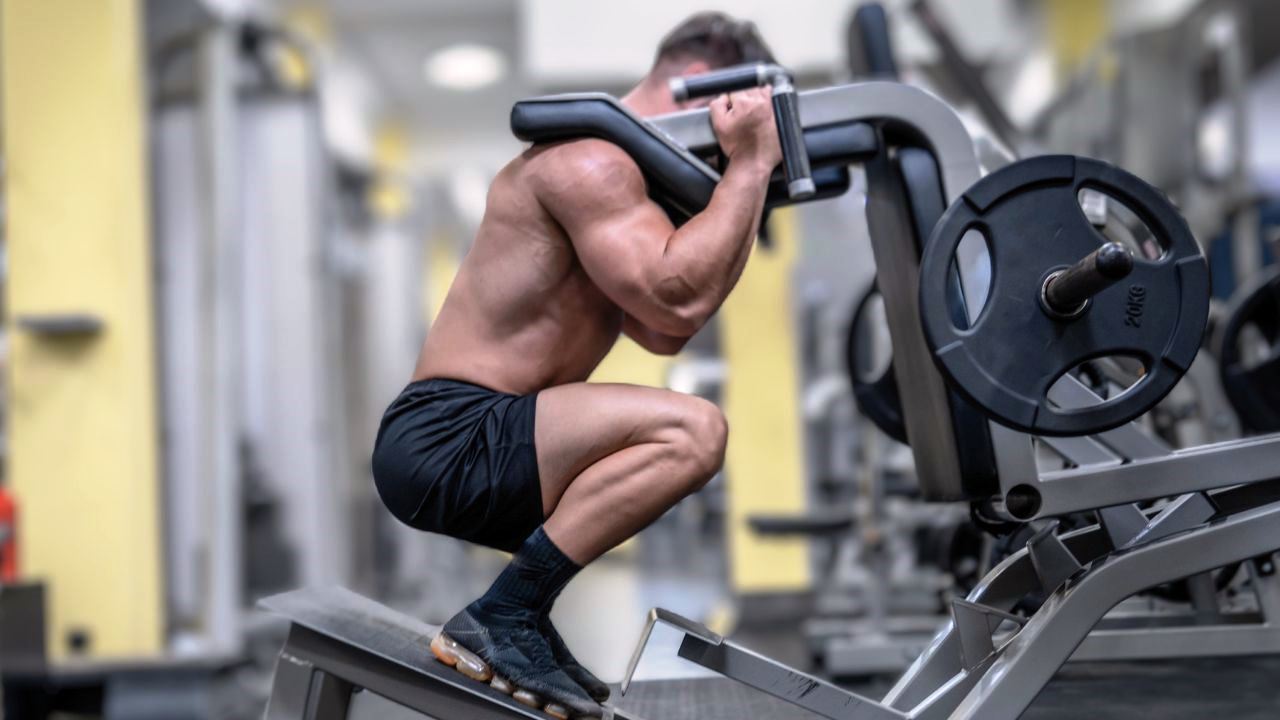
- 6. Sissy Squat Machine
- 7. Pendulum Squat Machine
- Which Machine Matches Your Goal?
- Conclusion
- References
Quad Anatomy: Why All 4 Heads Need Targeted Work
The quadriceps femoris is not one muscle — it is four distinct heads sharing a common tendon at the patella.
Each head has its own origin, fiber orientation, and functional emphasis. No single exercise fully develops all four, which is exactly why machine variety matters.
| Head | Location | Key Function | Best Targeted By |
|---|---|---|---|
| Rectus Femoris | Front center of thigh | Knee extension + hip flexion (bi-articular) | Leg extension (hip flexed under load) |
| Vastus Lateralis (VL) | Outer thigh | Knee extension | Hack squat, leg press (narrow stance) |
| Vastus Medialis (VMO) | Inner thigh / teardrop | Knee extension + medial patellar tracking | Terminal knee extension, hack squat (wider stance) |
| Vastus Intermedius | Deep, beneath rectus femoris | Knee extension | Trained alongside VL and VMO in compound movements |
The rectus femoris is the only quad head that crosses the hip joint. It is only fully loaded when the hip is flexed during knee extension — as in the leg extension machine.
Squats and leg press keep the hip at varying angles but do not replicate this position. This is why the leg extension provides a distinct stimulus no squat variation can fully replace
Top Gym Machines Exercises For Quad Workout
While barbell squats are a staple for building a quad, adding strength machines to your program is important to make your quad bigger and stronger.
The top 7 workout machines to add for a complete quad workout.
1. Leg Press Machine
The leg press is the most widely available quad machine in any gym, and for good reason. It’s a safe and effective way to target your quads, hamstrings, and glutes.
You sit in a reclined seat and drive a weighted platform away by extending your knees and hips — a closed-chain push that loads the lower body with significantly less spinal compression than a barbell squat.
Its adjustable setup and intuitive mechanics make it the ideal starting point for most people.
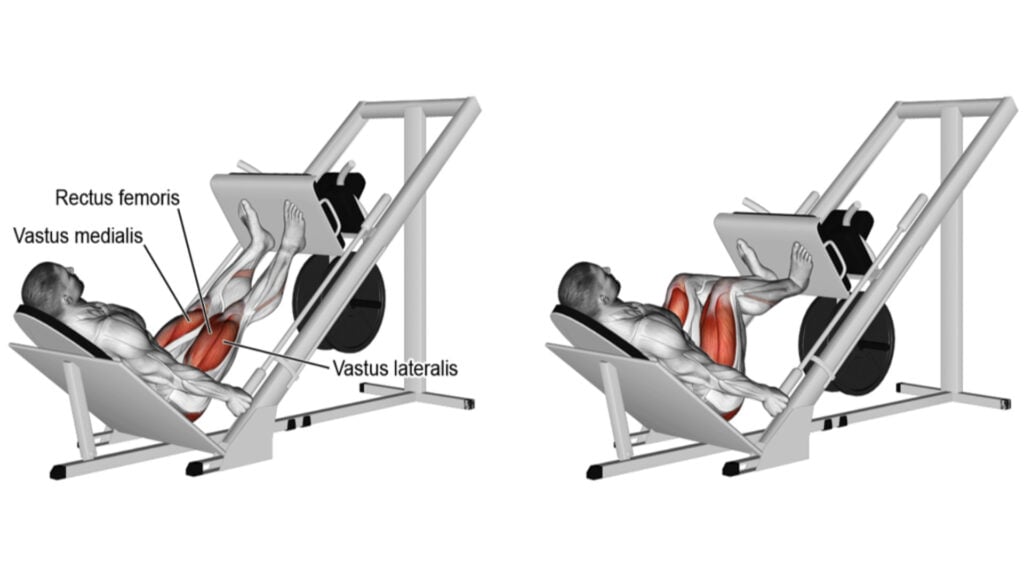
Muscles Worked
- The primary muscles the Leg Press works are the quadriceps, hamstrings, and gluteus Maximus.
- Secondary muscles worked are the calves and, to a lesser extent, the lower back and hip adductors.
How To Do It
- The seat should be adjusted so that your feet are on the platform when you sit on the machine.
- You should place your feet shoulder-width apart on the platform.
- Different foot positions can target different muscle groups. Place feet shoulder-width apart at mid-platform height, toes angled out 10–30 degrees.
- Keep your back and hips pressed flat against the seat pad throughout — do not allow your lower back to round or your hips to lift at the bottom.
- Release the safety handles and lower the platform under control until your knees reach 90 degrees or slightly deeper.
- Drive through the whole foot to press the platform up, stopping just short of full knee lockout to keep tension on the quads
Know More: 100+ Leg Exercises (With Images)
2. Leg Extension Machine
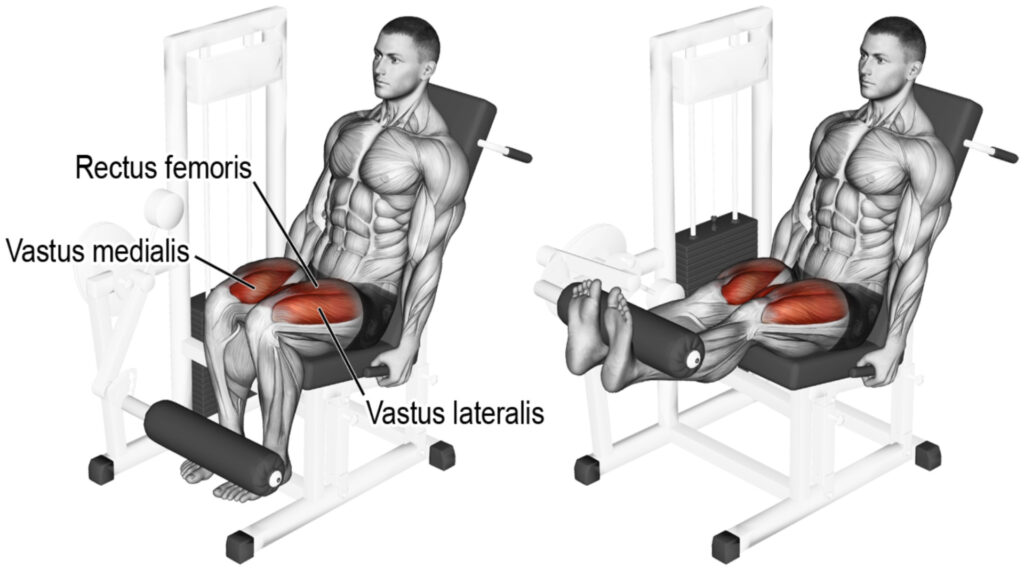
The leg extension is the only common gym exercise that isolates the quadriceps as the sole prime mover through open-chain knee extension.
Because the hip remains stationary in a flexed position, the rectus femoris operates at a length where it generates maximal torque, a unique stimulus no squat or press variation can replicate. It is an essential part of any complete quad program.
Muscles Worked
Different positions of the toes work different quad muscles.
- Pointing your toes directly upward hits all sections of the quadriceps equally,
- Toes inward and internally rotate the tibia to target the inner quad.
- Placing your toes outward externally rotates the tibia to hit the outer quad.
How To Do It
- Adjust the seat backrest so your knees align with the machine’s pivot point — this minimises uneven joint torque.
- Set the shin pad just above the ankle, not on the shin itself.
- Sit upright and grip the side handles; keep your back fully against the pad throughout the set.
- Extend both legs in a smooth arc until fully straight, squeezing the quads hard at the top for 1–2 seconds.
- Lower the weight under control (3–4 seconds) back to the starting position. Do not let the weight stack slam between reps.
3. Hack Squat Machine
The hack squat machine eliminates the positional, shoulder, and core demands of a barbell squat while providing a powerful closed-chain stimulus to the quadriceps.
It allows you to execute a deep, heavily loaded squat pattern with the spine fully supported. Its guided motion and high loading potential make it one of the best machines available for building quad mass.
Foot Placement
Foot position shifts muscle emphasis, but the effects are more nuanced than the common “inner vs outer quad” shorthand suggests:
- Wider stance with toes flared: Increases adductor and VMO involvement at deeper flexion angles. It is more accurate to say this increases VMO demand, not simply “targets the inner quad.”
- Narrower stance, toes forward: Reduces adductor contribution. The VL becomes slightly more dominant, but the machine’s guided path limits how different this feels compared to free-weight squatting.
- Foot height on the platform: Higher placement = more hip extension and glute involvement. Lower placement = greater knee travel, more quad-dominant stimulus.
Muscles Worked
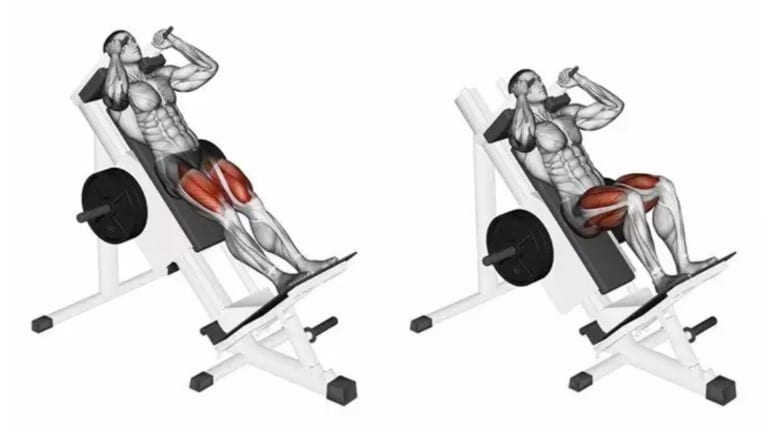
The hack squat will target Quadriceps, glutes & hip flexors and also involves calves and hamstrings.
How To Do
- Get on a hack squat machine, place your back flat against the back pad, and get your shoulders under the support.
- Grip the side handles of the machine.
- Place your legs in a shoulder-width stance with your toes pointed out slightly.
- Straighten your legs, but do not lock your knees. Bend your knees as you slowly lower the weight.
- Go down until parallel to the platform. Hold for a count of one.
- Then, return to the start position by pushing down through your heels and extending your legs.
Want to take your gains to the next level? Discover your daily calorie needs with our free TDEE calculator
4. Smith Machine For Quad Workout
The Smith machine is a barbell fixed on vertical rails with a safety catch at any point in the movement.
For quad training, it excels at exercises that demand unilateral stability like Bulgarian split squats and lunges, where balance limitations would otherwise cap how hard you can load each leg. It is also an excellent tool for learning squat mechanics without a spotter.
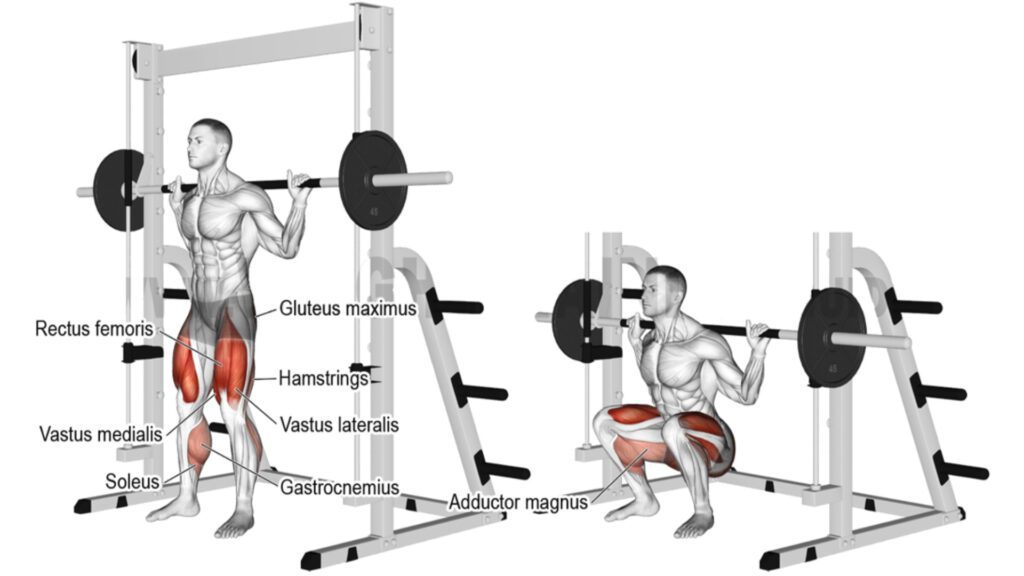
The muscles targeted during quad workouts on the Smith Machine can vary based on the exercises selected. However, here are some of the most commonly targeted quad muscles:
- Smith Machine Squats: It is a compound exercise that targets the quadriceps, hamstrings, and glutes.
- Smith Machine Lunges: Emphasize quad engagement by focusing on each leg individually.
- Smith Machine Step-Ups: Target the quadriceps and glutes.
- Smith Machine Bulgarian Split Squats: This variation focuses on each leg independently and also promotes quad development.
How to Do It
- Set the bar at upper-chest height. Step under it so the bar sits across your upper traps (high bar) or rear deltoids (low bar). Grip just outside shoulder width.
- Position your feet slightly forward of directly below the bar — the fixed bar path allows a more upright torso when feet are a few inches in front of vertical.
- Twist to unrack. Stand tall, chest up, core braced.
- Descend by breaking at the hips and knees simultaneously. Aim for thighs parallel or below.
- Drive through the heel and mid-foot to return to the start. Twist to re-rack safely at the top.
5. Cable Machine for Quad Exercises
The Double Pulley Cable Machine can be used for many exercises targeting the quads. Unlike traditional free weights, this cable machine ensures consistent tension throughout each movement. It allows for effective isolation and muscle engagement.
The machine has two adjustable pulleys that can be moved in different ways to help you work your quad muscles stronger, and bigger.
The cable machine workout can work all your legs major and smaller muscles by using different attachments, angles, and weights.
Here are some effective quad exercises you can perform on this versatile machine:
- Cable Squat: Build quality muscle mass in the legs.
- Cable Lunges: Build leg strength and stability and improve balance and coordination.
- Cable Standing Hip Abduction: Targets the outer thighs and glutes
- Cable Pull-Through Lunges: Engage quads, hamstrings, and glutes.
- Cable Kickbacks: Targets the glutes and hamstrings, providing a dynamic quad workout.
- Cable Deadlift: Target multiple muscle groups, including the quadriceps, glutes, hamstrings, spinal erectors, latissimus dorsi, trapezius, rhomboids, obliques, and abs.
- Cable Front Squat: Primarily targets the quadriceps but also engages the glutes, hamstrings, and core.
- Cable Step Up: This exercise targets the quadriceps and also involves calves and glutes & hip flexors.
How To Do Front Cable Squat
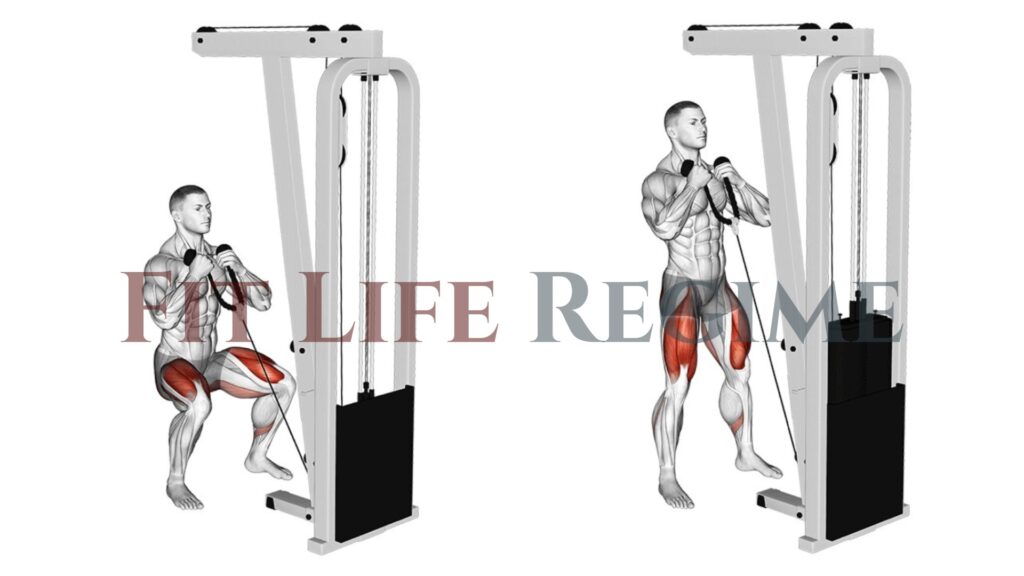
The squat and the cable front squat work the same target and synergistic muscles. However, the cable front squat recruits more stabilizer muscles, including various back muscles, your shoulders, and chest.
The cable front squat is the best option for leg workout, it is more advanced than the standard squat.
- Stand in front of a low-pulley cable machine with your feet shoulder width apart.
- Then, pull the ropes up to your chest and hold.
- Maintain the natural arch in your lower back and keep your head directed forward.
- Perform a squat, bending your knees and pushing your hips back to lower yourself until your thighs parallel the floor.
- From this position, push yourself back to the starting point.
6. Sissy Squat Machine
The sissy squat machine, while not as widely used as other leg machines, offers a unique and effective way to target your quads and other leg muscles.
It has a platform and a footrest that help you do a specific type of squat that works the quadriceps muscles.
It allows for a deep squat without putting excessive stress on the knees.
How To Do Front Machine Sissy Squat
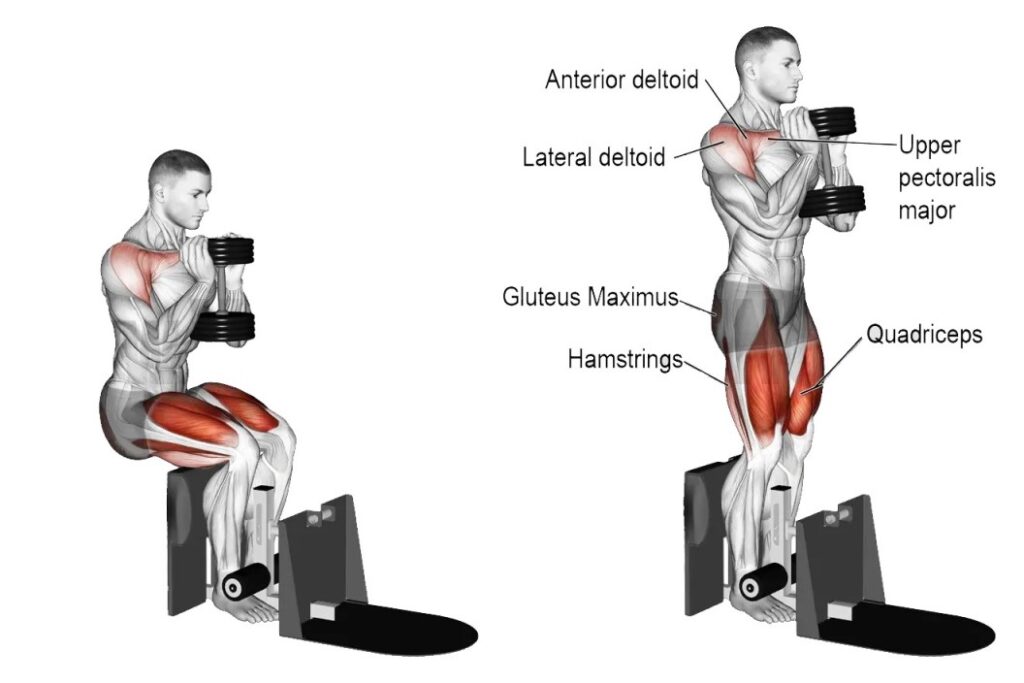
- Set up the Sissy Squat Machine according to your height.
- The footrest should be positioned comfortably to secure your feet.
- Stand on the machine with your feet hip-width apart.
- Secure your feet against the footrest.
- Slowly lean back by bending your knees and lowering your upper body.
- Continue to lower your body unit quad parallel to the floor. Hold for a few sec here.
- Now, raise and go back to the starting position.
Know More: 10 Best Gym Machines To Build Bigger Legs (With Workouts)
7. Pendulum Squat Machine
The pendulum squat is among the most biomechanically sophisticated machines in modern strength training. Its curved arm follows a natural arc that mirrors the knee-over-toe pathway of a deep squat.
It enable deep, quad-dominant loading with minimal spinal compression and a feel that many lifters prefer over the hack squat. If your gym has one, it earns a primary slot in your program.
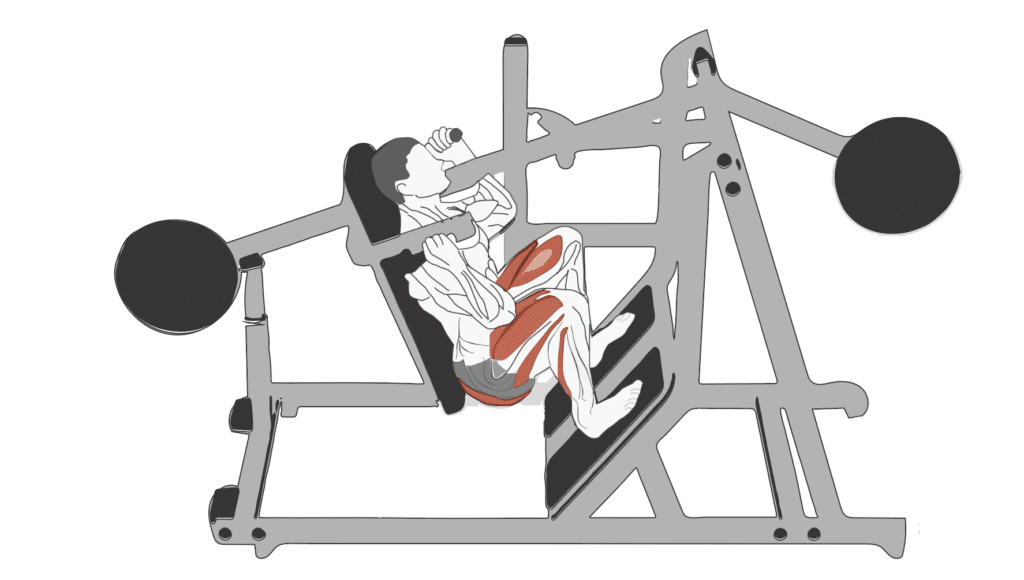
Muscles Worked
- Primary: Quadriceps
- Secondary: Glutes, hamstrings, calves
How To Use It:
- Set the machine to your height.
- Stand on the machine with your feet shoulder-width apart.
- Place your shoulders against the shoulder pads or backrest for stability.
- Hold on to the handles provided for additional stability and control.
- Descend under control until knees are at a 90-degree angle
- Once your thighs are nearly parallel to the ground,
- Exhale and push your feet through the platform to return to the starting position.
- Do 8–12 repetitions for 3–4 sets.
Which Machine Matches Your Goal?
Not all quad machines serve the same purpose. Use this table to select the right tool based on what you are actually trying to achieve:
| Training Goal | Best Machine(s) | Reason |
|---|---|---|
| Maximum quad mass | Hack Squat / Pendulum Squat | Deep ROM + high loading potential = peak mechanical tension on quads |
| Full quad isolation | Leg Extension | The only exercise isolating all 4 heads without hip involvement |
| Beginner / safest entry point | Leg Press | Stable, intuitive setup, low back friendly, easy to load progressively |
| VMO development | Leg Press (high/wide) + Leg Extension | VMO is most active at deep knee flexion and at terminal knee extension |
| Low back issues | Leg Press / Pendulum Squat | Both minimise spinal compressive and shear forces compared to barbell work |
| Functional / athletic strength | Cable Machine / Smith Machine Split Squat | Upright loading patterns with stabiliser demands closer to sport mechanics |
| Advanced quad specialisation | Pendulum + Sissy Squat (healthy knees only) | Extreme stretch-loaded stimulus for experienced, injury-free lifters |
Conclusion
Gym machines can be a great way to build bigger, stronger quads, and reduce injury risk. Move your feet in different ways to work on all parts of your legs.
Some of the most popular gym machines for quad workouts include the leg press machine, leg extension machine, and hack squat machine.
You can also use a sissy squat machine and cable machines to strengthen your quads.
So the next time you’re at the gym, don’t forget these powerful tools for building your quads.
References
- Vigotsky AD, Contreras B, Beardsley C. (2015). The rectus femoris muscle: an undervalued contributing muscle to hip extension. PeerJ, 3, e1293.
- Signorile JF, Kacsik D, Perry A, et al. (1995). The effect of knee and foot position on the electromyographical activity of the superficial quadriceps muscles during the parallel squat and knee extension. Journal of Orthopaedic & Sports Physical Therapy. 22(1): 2–9.
- Escamilla RF, Fleisig GS, Zheng N, et al. (1998). Biomechanics of the knee during closed kinetic chain and open kinetic chain exercises. Medicine & Science in Sports & Exercise. 30(4): 556–569.
- Bloomquist K, Langberg H, Karlsen S, et al. (2013). Effect of range of motion in heavy load squatting on muscle and tendon adaptations. European Journal of Applied Physiology. 113(8): 2133–2142.
- McCurdy K, O’Kelley E, Kutz M, et al. (2010). Comparison of lower extremity EMG between the 2-leg squat and modified single-leg squat in female athletes. Journal of Sport Rehabilitation. 19(1): 57–70.
- Cook JL, Purdam CR. (2009). Is tendon pathology a continuum? A pathology model to explain the clinical presentation of load-induced tendinopathy. British Journal of Sports Medicine. 43(6): 409–416.
- Schoenfeld BJ, Ogborn D, Krieger JW. (2016). Effects of resistance training frequency on measures of muscle hypertrophy: a systematic review and meta-analysis. Sports Medicine. 46(11): 1689–1697.

Manish is a NASM-certified fitness and nutrition coach with over 10 years of experience in weight lifting and fat loss fitness coaching. He specializes in gym-based training and has a lot of knowledge about exercise, lifting technique, biomechanics, and more.
Through “Fit Life Regime,” he generously shares the insights he’s gained over a decade in the field. His goal is to equip others with the knowledge to start their own fitness journey.