Barbell squats and deadlifts should still anchor your leg training, nothing beats them for total-body strength.
But machines solve a problem free weights can’t: true muscle isolation with zero balance demand, so you can push a specific muscle group to failure safely, even training alone.
Gym machines offer several advantages over free weights for leg training. Machines can be used to isolate leg muscles and stimulate greater muscle growth.
These machines offer a safe and effective way to target various leg muscles.
This blog will discuss the following:
- Top gym machines for building bigger legs
- How to perform quad exercises with proper form.
- Quick Comparison: Which Machine for Which Goal
- Top Gym Machines For Leg Workouts
- 1. Leg Press Machine
- 2. Hack Squat Machine
- 3. Leg Curl Machine
- 4. Leg Extension Machine
- 5. Smith Machine For Leg Workout
- 6. Glute And Ham Raise(GHD) Machine
- 7. Cable Machine for Leg Exercises
- 8. Calf Raise Machine
- 9. Leg Abduction/Adduction Machine
- 10. Lever Deadlift Machine
- Frequently Asked Questions
Quick Comparison: Which Machine for Which Goal
| Machine | Primary Muscles | Best For | Session Slot |
|---|---|---|---|
| Leg Press | Quadriceps, glutes | Heavy overload with low back safety | 1st (compound) |
| Hack Squat | Quadriceps (vastus lateralis emphasis) | Quad sweep, squat-pattern practice | 1st–2nd (compound) |
| Smith Machine | Quadriceps, glutes, hamstrings | Beginners, fixed-path safety | 1st–2nd (compound) |
| Lever Deadlift | Hamstrings, glutes, erector spinae | Posterior chain without spinal loading risk | 1st–2nd (compound) |
| Leg Extension | Quadriceps (isolation) | Quad finisher, rehab-friendly loading | Mid (isolation) |
| Leg Curl | Hamstrings | Hamstring isolation, injury prevention | Mid (isolation) |
| Glute-Ham Raise | Glutes, hamstrings, erectors | Posterior-chain strength & hamstring durability | Mid (compound-isolation) |
| Cable Machine | Varies by attachment | Constant tension, unilateral work | Mid–late (accessory) |
| Hip Abduction/Adduction | Glute medius, adductors | Hip stability, inner/outer thigh shaping | Late (accessory) |
| Calf Raise | Gastrocnemius, soleus | Calf size and ankle strength | Last |
Top Gym Machines For Leg Workouts
Barbell squats are important for building a leg, but adding strength machines to your workout routine can also help make your legs bigger and stronger.
The top 10 workout machines to add for a complete leg workout.
1. Leg Press Machine
The leg press is the safest way to overload your quads and glutes with heavy weight, because the seat supports your spine and the movement is locked to a single plane.
It’s the machine I recommend first to anyone rebuilding leg strength after a back issue, or anyone who wants to push past their squat numbers without a spotter.
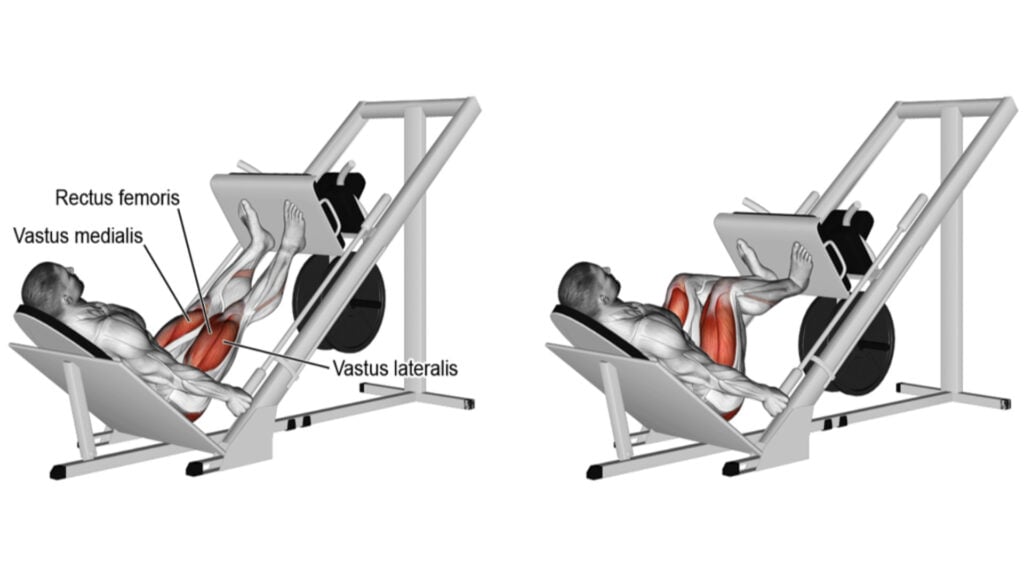
Muscles Worked
- The primary muscles the Leg Press works are the quadriceps, hamstrings, and gluteus Maximus.
- Secondary muscles worked are the calves and, to a lesser extent, the lower back and hip adductors.
How Does It Work?
- The seat should be adjusted so that your feet are on the platform when you sit on the machine.
- You should place your feet shoulder-width apart on the platform.
- Different foot positions can target different muscle groups.
- Extend your legs to push the platform away.
- Do not lock your knees at full extension.
- Slowly return to the starting position by bending your knees.
- Inhale while lowering the weight and exhale while pressing it up.
Know More: 100+ Leg Exercises (With Images)
2. Hack Squat Machine
The hack squat guides you through a squat pattern on a fixed track, which removes the balance and bracing demands of a barbell squat and lets you load your quads directly.
It’s one of the better tools for building the outer quad “sweep” that barbell squats alone don’t always develop.
You can also adjust your foot placement to target different areas of the quadriceps.
- A wider stance emphasizes inner quads.
- While a narrower stance targets outer quads.
Muscles Worked
The hack squat will target Quadriceps, glutes & hip flexors and also involves calves and hamstrings.
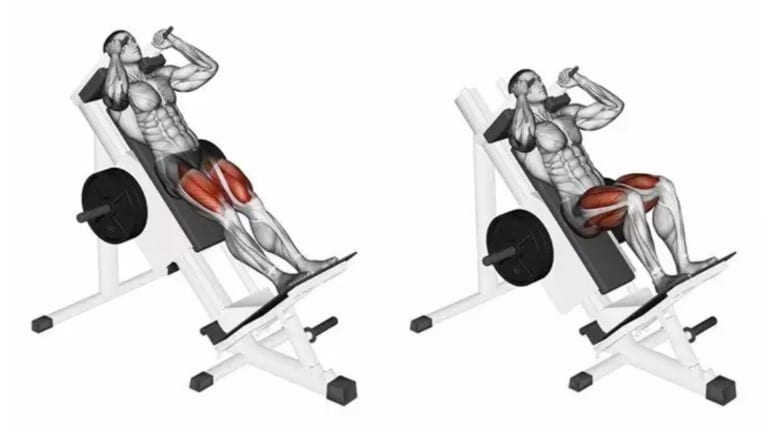
How To Do
- Get on a hack squat machine, place your back flat against the back pad, and get your shoulders under the support.
- Grip the side handles of the machine.
- Place your legs in a shoulder-width stance with your toes pointed out slightly.
- Straighten your legs, but do not lock your knees. Bend your knees as you slowly lower the weight.
- Go down until parallel to the platform. Hold for a count of one.
- Then, return to the start position by pushing down through your heels and extending your legs.
3. Leg Curl Machine
This is the most direct way to isolate your hamstrings, and it matters more than most lifters realize:
Weak hamstrings relative to quads are a well-documented knee and hamstring-strain risk factor, so this machine earns a permanent spot in a well-built leg day.
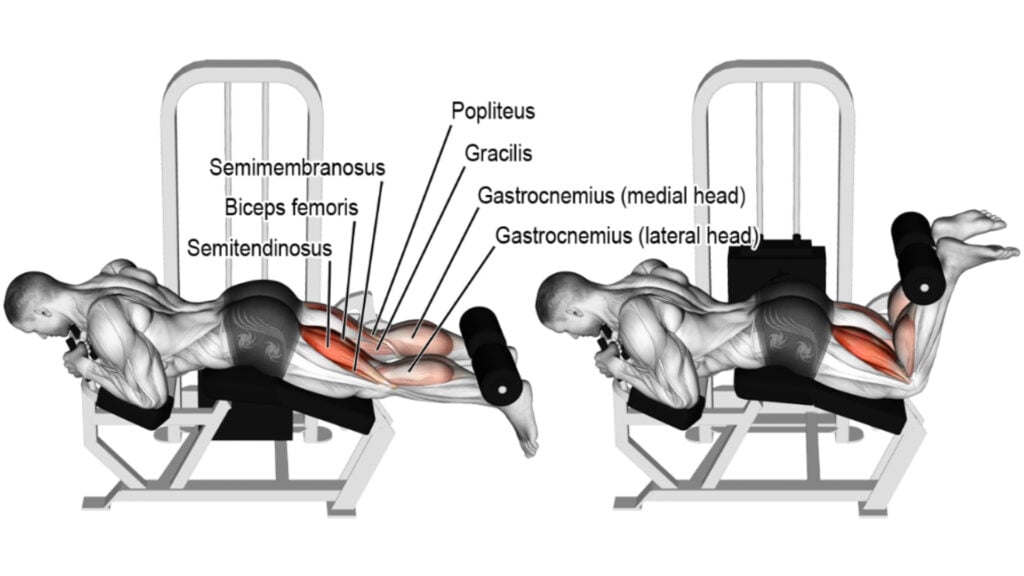
The leg curl machine is common in gyms and helps strengthen your hamstring muscles. It also works the calf and glute muscles.
It typically consists of a padded seat with an adjustable backrest and a lever connected to a weight stack or cable system.
Unlike some free-weight exercises, leg curls minimize stress on the lower back.
Muscles Worked
- The leg curl machine primarily targets the hamstring muscles.
- Additionally, it engages the calf and glutes to a certain extent.
Different positions of the toes work different hamstring muscles.
- Pointing your toes straight targets all three hamstring muscles.
- Pointing the toes inward emphasizes the inner hamstrings (semimembranosus and semitendinosus),
- Pointing the toes outward focuses effort on the outer hamstrings (biceps femoris).
How To Use It
- Lie face down on the machine, with your knees just beyond the edge of the bench.
- Position your ankles securely under the padded lever.
- Grasp the handles for stability and to keep your upper body firmly positioned on the bench.
- Exhale as you flex your knees, lifting the padded lever toward your glutes. Hold the contraction briefly.
- Inhale as you extend your legs back to the starting position.
- Start with a weight that allows 10–12 reps.
4. Leg Extension Machine
The leg extension isolates the quadriceps with zero involvement from your hips or back useful as a pre-exhaust move, a finisher, or a rehab-friendly way to load the knee under a physical therapist’s or coach’s guidance.
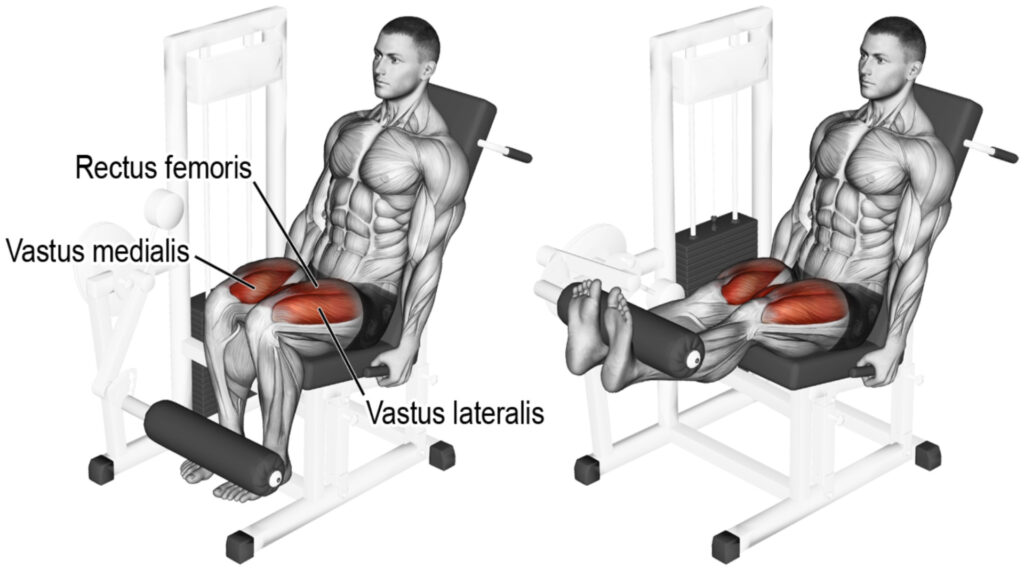
The Leg Extension Machine is a piece of gym equipment designed to target and isolate the quadriceps muscles.
It typically consists of a seat, a backrest, and a padded bar for ankle support.
This machine is popular because it trains the quadriceps without the strain on the back and shoulders.
Muscles Worked
Different positions of the toes work different quad muscles.
- Pointing your toes directly upward hits all sections of the quadriceps equally,
- Toes inward and internally rotate the tibia to target the inner quad.
- Placing your toes outward externally rotates the tibia to hit the outer quad.
How Does It Work?
- Sit on a Leg extension machine with your legs under the pad and with your back pressed firmly against the back pad.
- Grab the handles or the seat edges behind your hips and keep your upper body steady.
- Extend your legs as far as possible in a smooth movement until fully extended to get a maximum thigh contraction.
- Contract your quads at the top and slowly lower the weight under control to the starting position.
Want to take your gains to the next level? Discover your daily calorie needs with our free TDEE calculator.
5. Smith Machine For Leg Workout
A barbell fixed to vertical rails, letting you lock the bar at any height and skip the need for a spotter. It’s a genuinely versatile tool for leg training, not just a squat substitute.
| Exercise | Primary Emphasis |
|---|---|
| Smith Machine Squat | Quads, glutes, hamstrings |
| Smith Machine Lunge | Quads (unilateral) |
| Smith Machine Step-Up | Quads, glutes |
| Bulgarian Split Squat | Quads, glutes (unilateral) |
| Smith Machine Calf Raise | Gastrocnemius, soleus |
| Stiff-Legged Deadlift | Hamstrings, glutes |
| Smith Machine Hip Thrust | Glutes |
| Sumo Squat | Adductors, glutes, quads |
| Reverse Lunge | Quads, glutes (unilateral) |
How to Do Smith Machine Squat
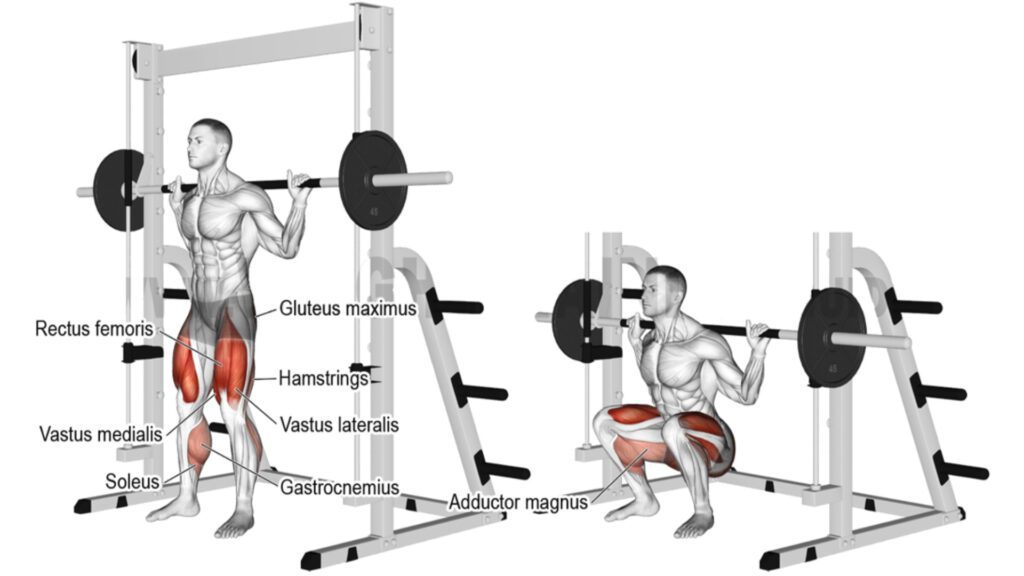
The Smith machine squat allows you to squat a heavy weight safely without a spotter. Just make sure that you use the safety pins.
- Position the bar across your upper back, just below the neck, and grip it wider than shoulder-width.
- Unrack by rotating your wrists to clear the safety hooks; set your feet shoulder-width.
- Take a deep breath and keep your elbows in line with your torso.
- Descend by simultaneously pushing the hips back and bending the knees.
- When your thighs parallel the floor, exhale and push off with your legs to reverse the movement and return to the starting position.
- Exhale and extend your hips and knees fully to get into the starting position.
Know More: 12 Most Effective Smith Machine Leg Workout & Exercises
6. Glute And Ham Raise(GHD) Machine
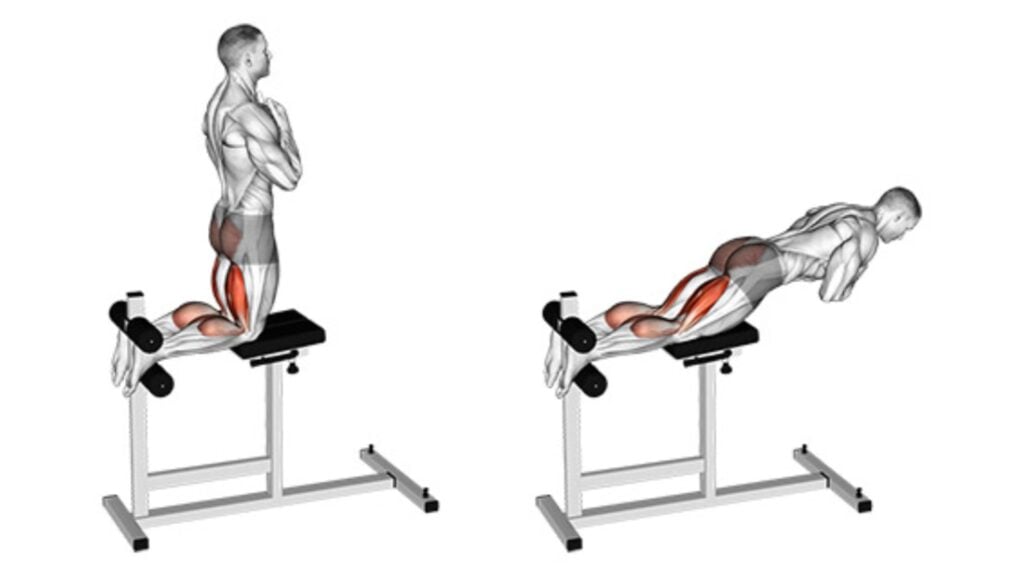
The Glute and Ham Raise Machine, also called the Glute-Ham Developer (GHD), helps strengthen posterior chain muscles, especially your glutes and hamstrings.
The GHD is one of the few machines that trains the hamstrings through hip extension and knee flexion in the same rep, which the leg curl machine doesn’t replicate.
That means that the glutes get involved as well (as the name of the exercise would imply), along with the spinal erectors.
If your gym has one, use it .you should add it to your hamstring exercises arsenal, which helps to build mass and strength in your legs.
Muscles Worked
- The primary muscles targeted by the Glute and Ham Raise Machine include the gluteus maximus (glutes) and the hamstrings.
- Additionally, it engages the erector spinae in the lower back and the calves to some extent.
How to Use It
- Ensure the footplate on the GHD is far enough back so that your knees rest at the bottom of the pad.
- Your feet should firmly touch the footplate, and the bottom of your quads should rest on the pad with your body upright.
- Ensure your back is flat, your legs are slightly less than hip-width, and your torso is upright.
- Bring your arms across your chest.
- Push your toes into the plate and extend your knees. This will move your body forward until you are parallel to the floor.
- To get back up, bend your knees and move your upper body back to where you started.
7. Cable Machine for Leg Exercises
The Cable machine can be used for many exercises that work on the legs. Unlike traditional free weights, this cable machine ensures consistent tension throughout each movement. It helps to isolate and work the leg muscles well.
The machine has two adjustable pulleys that can be moved in different ways to help you strengthen and grow your leg muscles.
The cable machine workout can work all your legs major and smaller muscles by using different attachments, angles, and weights.
Here are some effective leg exercises you can do on this versatile machine.
| Exercise | Primary Target |
|---|---|
| Cable Squat / Front Squat | Quads, glutes |
| Cable Deadlift | Hamstrings, glutes, erectors |
| Cable Standing Leg Curl | Hamstrings |
| Cable Lunge | Quads, glutes (unilateral) |
| Cable Standing Hip Abduction | Glute medius, outer thigh |
| Cable Hip Adduction | Inner thigh (adductors) |
| Cable Glute Kickback | Glutes, hamstrings |
| Cable Pull-Through | Glutes, hamstrings |
| Cable Step-Up | Quads, glutes, hip flexors |
| Cable Standing Calf Raise | Calves |
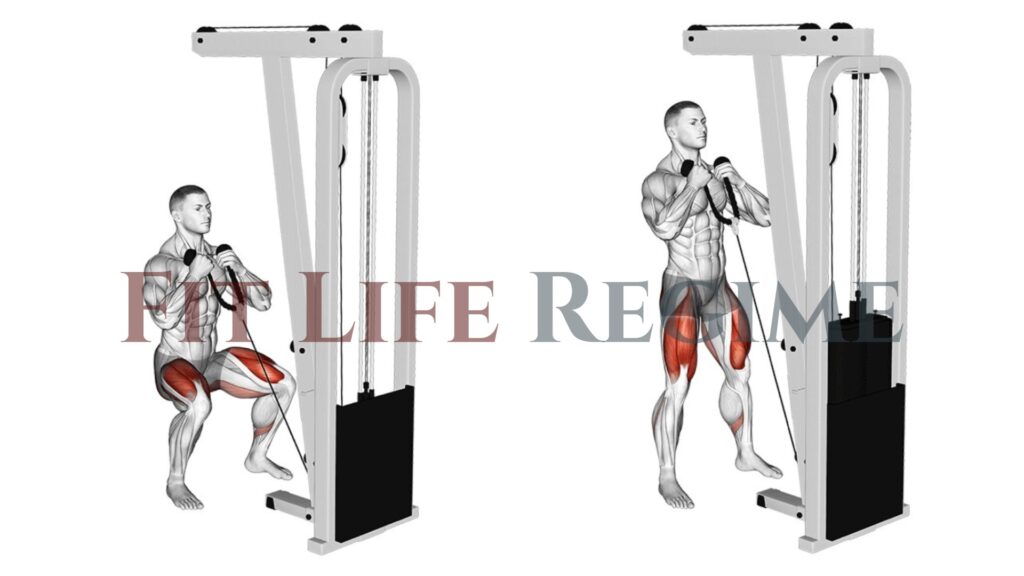
How To Do Front Cable Squat
The cable front squat is the best option for cable leg workouts; it is more advanced than the standard squat.
- Stand facing a low-pulley cable, feet shoulder-width apart.
- Then, pull the ropes up to your chest and hold.
- Maintain the natural arch in your lower back and keep your head directed forward.
- Perform a squat, bending your knees and pushing your hips back to lower yourself until your thighs parallel the floor.
- From this position, push yourself back to the starting point.
To Stay Motivated: 150+ Gym Workout Motivational Quotes To Stay Fit
8. Calf Raise Machine
Calves are one of the most undertrained muscle groups on leg day, mostly because they respond best to controlled, isolated tension — exactly what this machine provides.
Muscles Worked
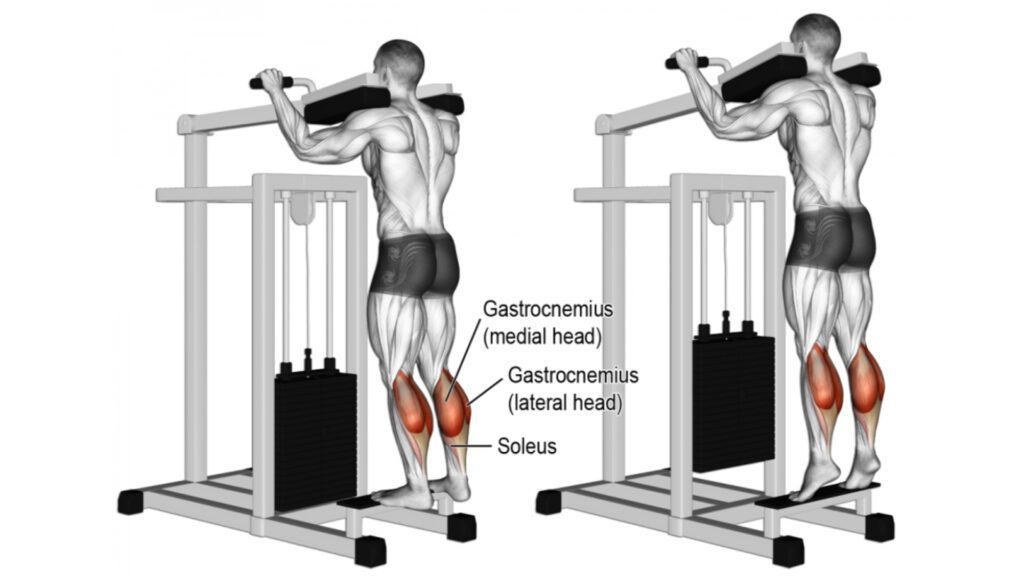
- The primary muscles targeted by the calf raise are the gastrocnemius and soleus.
- The gastrocnemius is the calf’s larger, more visible muscle,
- Meanwhile, the soleus lies beneath the gastrocnemius and contributes to overall calf development.
How To Do
- Step on a Calf raise machine with your toes on a block and heals extended into space.
- Place the shoulders under the pads and hook the weight off the support.
- Now raise yourself up using only the toes and come as far as possible.
- Hold this position for a second, flexing your calf muscles.
- Slowly lower your heals as far as possible towards the floor. Keep your knees slightly bent.
9. Leg Abduction/Adduction Machine
This machine won’t build leg mass on its own, but it strengthens the muscles that stabilize your hips during squats, lunges, and running — and it’s the most direct tool for inner/outer thigh shaping.
Muscles Worked
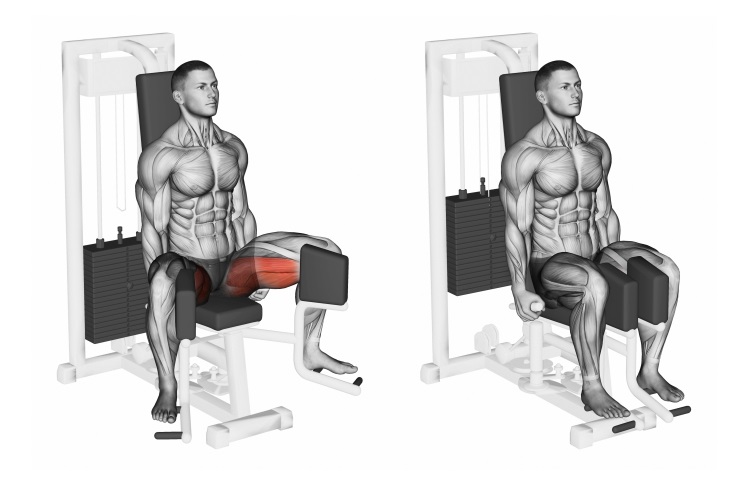
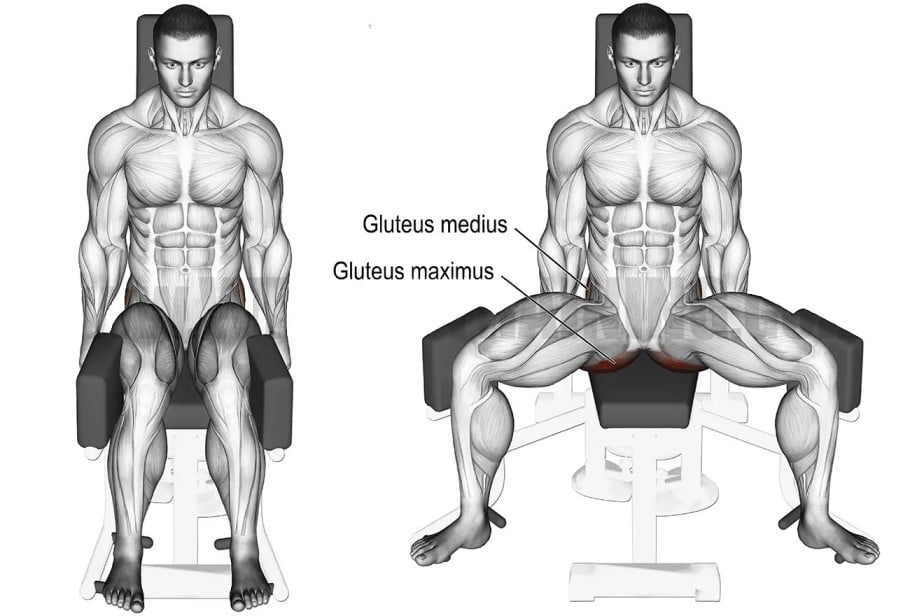
The primary muscles targeted by the Leg Abduction/Adduction Machine include the adductor muscles (inner thighs) during adduction movements and the abductor muscles (outer thighs) during abduction movements.
How to Use It:
- Sit on the machine with your back against the backrest and your feet on the footrests.
- For adduction, place the insides of your thighs against the pads;
- For abduction, position the outsides of your thighs against the pads.
- Press the moving arms or pads together (adduction) or push them apart (abduction) against resistance.
- Perform the exercise with controlled movements.
- Focus on squeezing the targeted muscles during each repetition.
10. Lever Deadlift Machine
A plate-loaded machine that mimics the deadlift pattern along a fixed arc, giving you posterior-chain loading with far less technical demand — and far less risk — than a barbell deadlift.
Compared to free-weight deadlifts, the Lever Deadlift Machine minimizes stress on the lower back.
Muscles Worked
- Primary movers: Hamstrings, glutes, erector spinae, lower back, and upper back
- Secondary movers: Forearms, traps, calves, and core
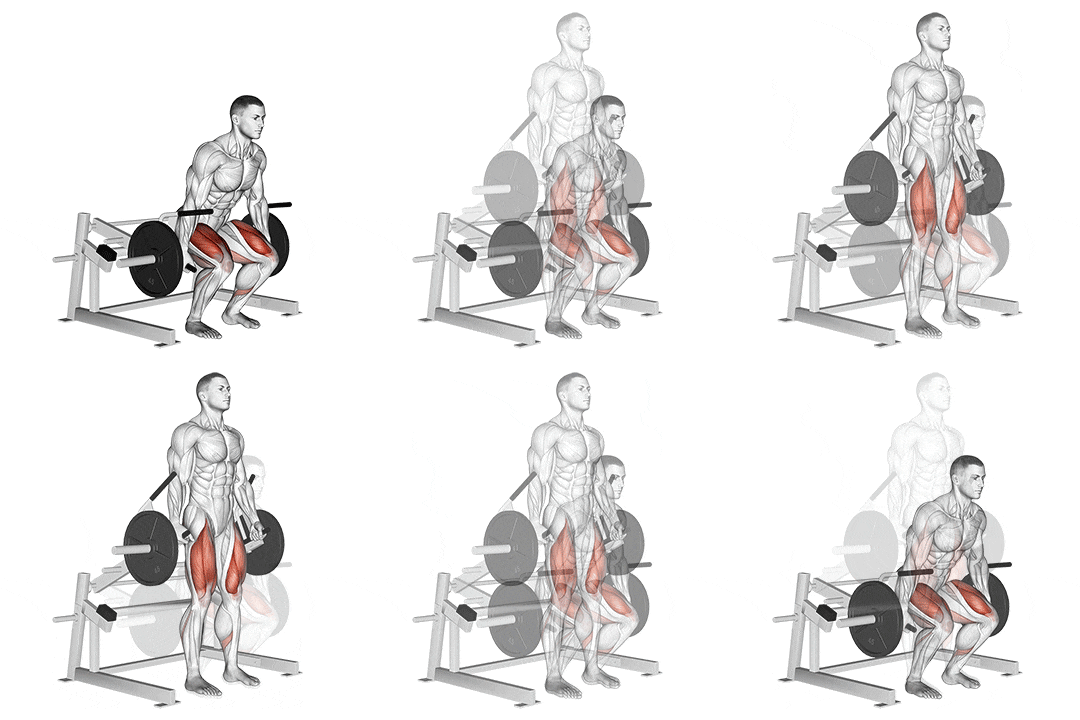
How to use it
- Adjust the lever arms to a comfortable width.
- Stand on the platform with your feet hip-width apart, toes pointed slightly outward.
- Hinge at your hips and grasp the handles firmly.
- Slowly lower the weight by hinging at your hips and pushing your hips back.
- Lower the weight until you feel a stretch in your hamstrings and glutes.
- Drive through your heels and hips to lift the weight back to the starting position.
Frequently Asked Questions
Are leg machines as good as free weights for building legs?
They serve different purposes. Free weights like barbell squats and deadlifts build more overall strength and coordination because they demand balance and multi-joint control. Machines let you isolate a muscle and push it to failure with less injury risk and no spotter needed. A well-built program uses both.
Which machine is best for overall leg growth?
If you can only pick one, the leg press gives the most total-body leg stimulus (quads, glutes, and hamstrings) with the least technical skill required and the lowest spinal loading risk.

Manish is a NASM-certified fitness and nutrition coach with over 10 years of experience in weight lifting and fat loss fitness coaching. He specializes in gym-based training and has a lot of knowledge about exercise, lifting technique, biomechanics, and more.
Through “Fit Life Regime,” he generously shares the insights he’s gained over a decade in the field. His goal is to equip others with the knowledge to start their own fitness journey.
Great article with great pics and information. For people that don’t have a lot of money, maybe you could show an option with just a bar. Thank you. Susan.