
📊 Ponderal Index Calculator
Calculate your Ponderal Index (PI) for a more accurate body proportion assessment than BMI
📊 Your Ponderal Index Results
Ponderal Index Scale
💡 Understanding Your Results
- Your Ponderal Index has been calculated using height cubed
- PI is particularly useful for individuals at height extremes
- Compare with BMI to understand your body proportions better
- Focus on overall fitness rather than a single metric
What is the Ponderal Index?
The Ponderal Index (PI), also known as the Rohrer Index or Corpulence Index, is a measure of body mass relative to height. Unlike the more common Body Mass Index (BMI), which uses height squared, the Ponderal Index uses height cubed. This mathematical difference makes PI more accurate for individuals who are very tall or very short.
The concept was developed by the Swiss physician Fritz Rohrer in 1921 as a means to assess body proportions. Research published in ScienceDirect describes the Ponderal Index as an important anthropometric measure used in various fields including fitness assessment and nutrition research.
The Ponderal Index Formula
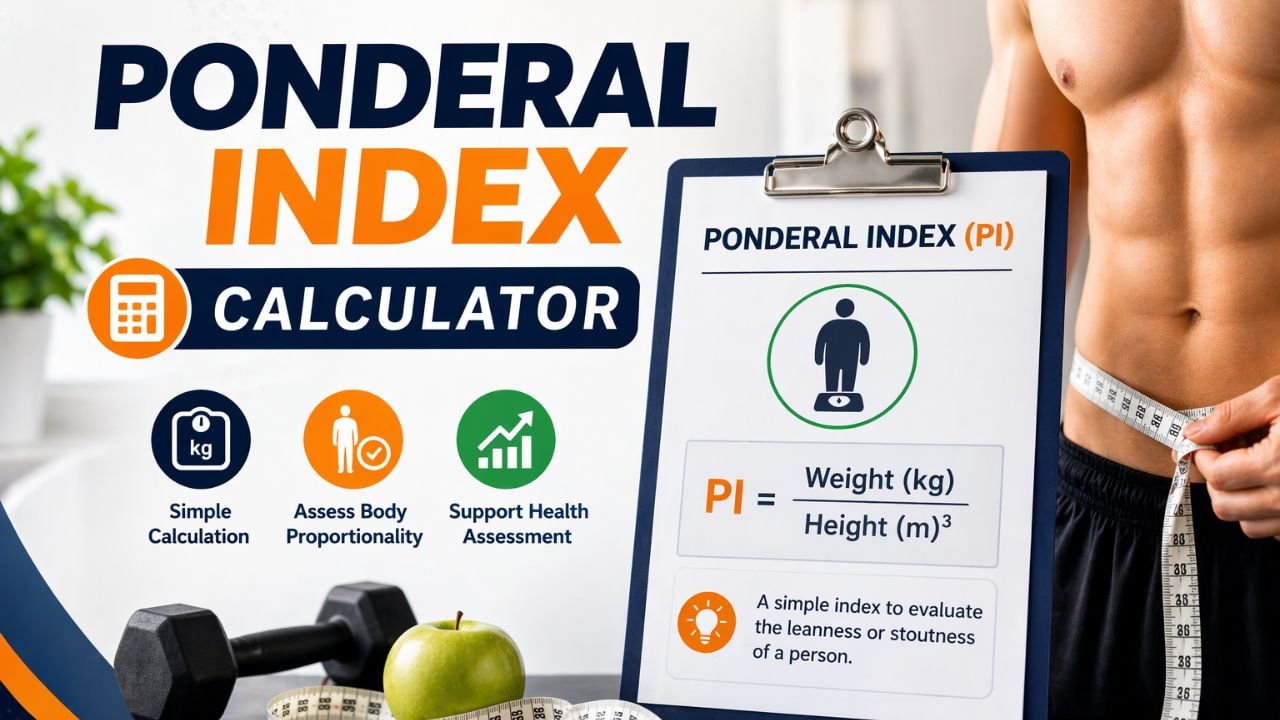
The Ponderal Index is calculated by dividing body mass by the cube of height:
The result is expressed in kg/m³. This cubic relationship with height means that PI remains more stable across different heights compared to BMI, which tends to overestimate body fat in tall people and underestimate it in short people.
Person: Height 175 cm (1.75 m), Weight 70 kg
Step 1: Convert height to meters: 175 cm = 1.75 m
Step 2: Calculate height cubed: 1.75³ = 5.359 m³
Step 3: Divide weight by height cubed: 70 ÷ 5.359 = 13.06
Result: Ponderal Index = 13.06 kg/m³ (Normal range)
Ponderal Index Interpretation
The Ponderal Index values are interpreted differently than BMI. Here are the general categories for adults:
| PI Range (kg/m³) | Category | Description |
|---|---|---|
| < 11.0 | Lean | Lower body mass relative to height |
| 11.0 – 15.0 | Normal | Balanced proportions for most adults |
| 15.0 – 17.0 | Above Normal | Higher body mass relative to height |
| > 17.0 | High | Significantly higher body mass |
Studies in ResearchGate highlight the Ponderal Index as an important anthropometric indicator for assessing physical growth and body proportions.
Ponderal Index vs. BMI
While both PI and BMI assess body mass relative to height, they differ in how they account for height. Here’s a comparison:
| Feature | Ponderal Index | BMI |
|---|---|---|
| Formula | Weight / Height³ | Weight / Height² |
| Units | kg/m³ | kg/m² |
| Height Adjustment | Better for height extremes | May over/underestimate at extremes |
| Normal Range | 11 – 15 | 18.5 – 24.9 |
| Developed | 1921 (Rohrer) | 1832 (Quetelet) |
For very tall individuals (over 180 cm), BMI often overestimates body fat, while for very short individuals (under 155 cm), it may underestimate. The Ponderal Index addresses this limitation through its cubic relationship with height.
Why Use the Ponderal Index?
The Ponderal Index offers several advantages in specific contexts:
- Height Accuracy: More reliable for very tall or short individuals than BMI
- Proportional Assessment: Better reflects body proportions across different body types
- Research Applications: Used in growth studies and anthropometric research
- Alternative Perspective: Provides a second viewpoint alongside BMI for body composition assessment
- Athletic Applications: Useful for athletes where body composition assessment matters
Research published in Wiley Online Library has explored the application of Ponderal Index in various contexts, demonstrating its value as an anthropometric measure.
Limitations of the Ponderal Index
While useful, the Ponderal Index has limitations to consider:
- Doesn’t Measure Body Composition: Like BMI, PI doesn’t distinguish between muscle and fat mass
- Less Widely Used: Most reference data is based on BMI, making comparisons more difficult
- Individual Variation: Normal ranges may vary based on factors like age, gender, and ethnicity
- Complementary Tool: Best used alongside other assessments, not as a sole measure
For a comprehensive view of your body composition, consider combining PI with other measures like visual body fat assessment and regular exercise.
Reciprocal Ponderal Index
Some researchers prefer the Reciprocal Ponderal Index (RPI), which inverts the formula:
The RPI typically yields values around 40-45 for adults. A higher RPI indicates a more linear/lean body type, while a lower RPI indicates a more compact build. This calculator focuses on the standard Ponderal Index, but the RPI is sometimes used in sports science and growth studies.
Frequently Asked Questions
For adults, a Ponderal Index between 11 and 15 kg/m³ is generally considered normal. Values below 11 suggest a leaner body type, while values above 15 indicate higher body mass relative to height. However, what’s “good” depends on individual factors including muscle mass, body type, and fitness goals. Athletes with significant muscle mass may have higher values that are perfectly appropriate for their body composition.
BMI uses height squared, which doesn’t scale correctly with body volume. Since body mass increases with the cube of linear dimensions (not the square), tall people tend to have artificially high BMI values even when they’re lean. The Ponderal Index uses height cubed, which better matches how body volume actually scales with height, providing more accurate results for those at height extremes.
Since Ponderal Index reflects the ratio of weight to height, improving it involves adjusting body composition. For those with high PI, focus on regular exercise and balanced nutrition. For those with low PI, strength training and adequate protein intake can help build lean muscle mass. Remember that PI is just one metric—focus on overall fitness, energy levels, and how you feel rather than a single number.
No, Ponderal Index cannot directly indicate body fat percentage. Like BMI, it only measures total body mass relative to height and cannot distinguish between muscle, fat, bone, and water. A muscular person and someone with higher body fat could have the same PI. For body fat assessment, methods like skinfold measurements, bioelectrical impedance, or DEXA scans are needed.
While BMI is more commonly used in clinical settings, Ponderal Index has applications in research, particularly in studies involving newborns and children, where it’s often used to assess growth and proportionality. Some practitioners use PI alongside BMI for a more complete picture, especially when assessing individuals at height extremes. It’s also used in anthropometric research and sports science.
The standard Ponderal Index (PI) divides weight by height cubed (kg/m³), yielding typical values of 11-15 for adults. The Reciprocal Ponderal Index (RPI) inverts this, dividing height by the cube root of weight. RPI values are typically around 40-45 for adults. Both measure the same relationship but express it differently. Higher PI indicates more mass relative to height, while higher RPI indicates a more linear/slender build.

Manish is a NASM-certified fitness and nutrition coach with over 10 years of experience in weight lifting and fat loss fitness coaching. He specializes in gym-based training and has a lot of knowledge about exercise, lifting technique, biomechanics, and more.
Through “Fit Life Regime,” he generously shares the insights he’s gained over a decade in the field. His goal is to equip others with the knowledge to start their own fitness journey.