
The close grip cable row is a variation of the traditional cable row exercise, specifically targeting the middle back muscles and latissimus dorsi (lats).
The defining feature is your hand placement; you use a close grip. This small change makes you focus on making your back thicker instead of just how wide it is.
Most back programs are built around width: lat pulldowns, wide-grip pull-ups, straight-arm pulldowns. What they quietly neglect is thickness — the dense, three-dimensional musculature of the mid-back that separates a flat back from a truly impressive one.
This is precisely the gap the close grip cable row fills. By positioning your hands narrow and driving your elbows close to your torso, you shift the mechanical emphasis inward — targeting the lower trapezius, rhomboids, and mid-lats that width-focused movements routinely underwork.
You can do a close-grip row with different handles and grips.
Attachments used for the close grip cable row.
- V-Handle/Close-Grip Triangle.
- Kobo Low Row Close Grip.
- Short straight bar
- Rope with two ends
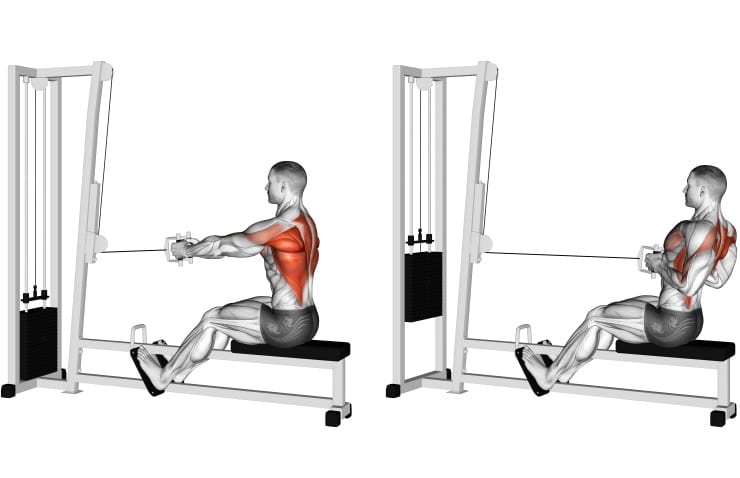
Most commonly used grip positioning.
- A pronated (overhand) grip targets the upper and middle trapezius.
- A neutral (thumbs up) grip hits the middle and lower trapezius.
- The supinated (underhand) grip switches the focus to the latissimus dorsi.
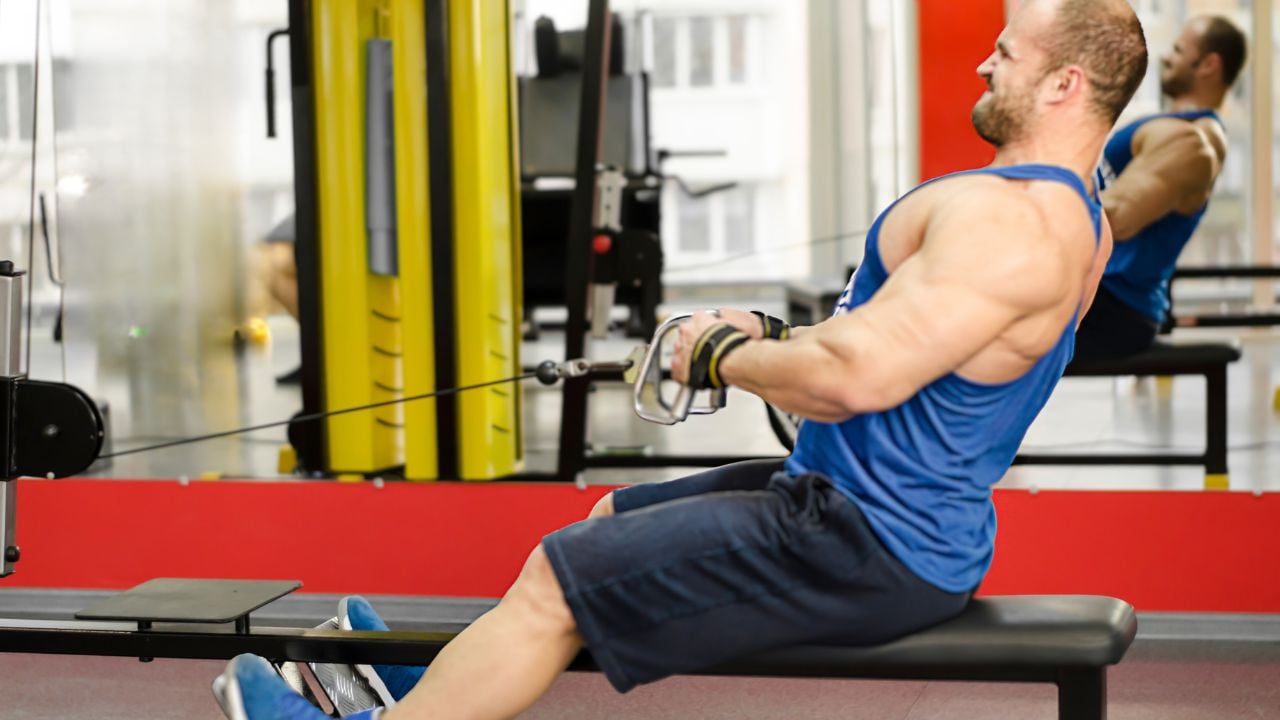
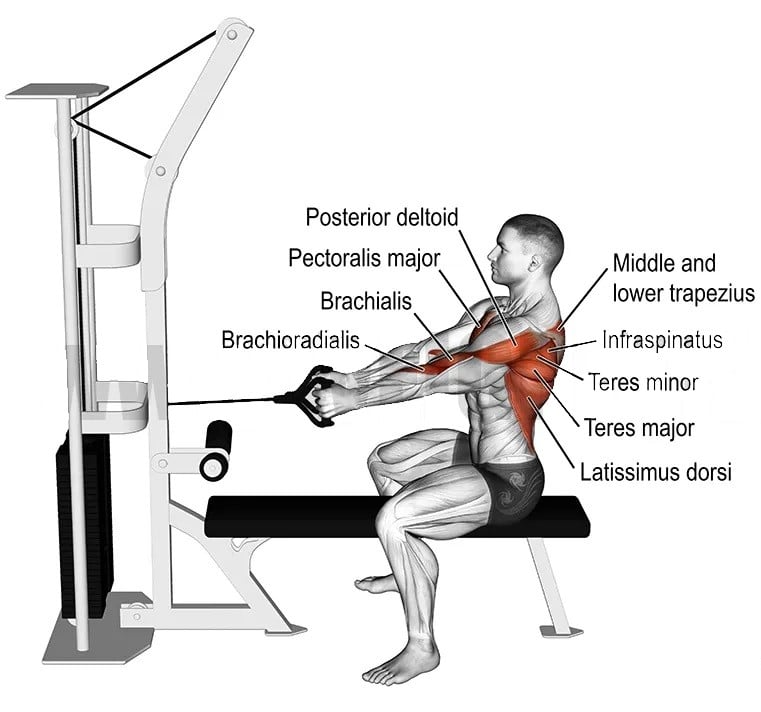
Close Grip Cable Row Muscles Worked
The close grip cable row is a compound pulling movement, meaning it recruits multiple muscle groups simultaneously.
Primary Muscles:
- Latissimus Dorsi (Lats)
- Trapezius (Lower Trap)
- Rhomboids
- Posterior Deltoids (Rear Delt)
Secondary Muscles:
- Biceps Brachii
- Brachialis
- Forearm
- Core (stabilization)
How To Do The Cable Close Grip Row
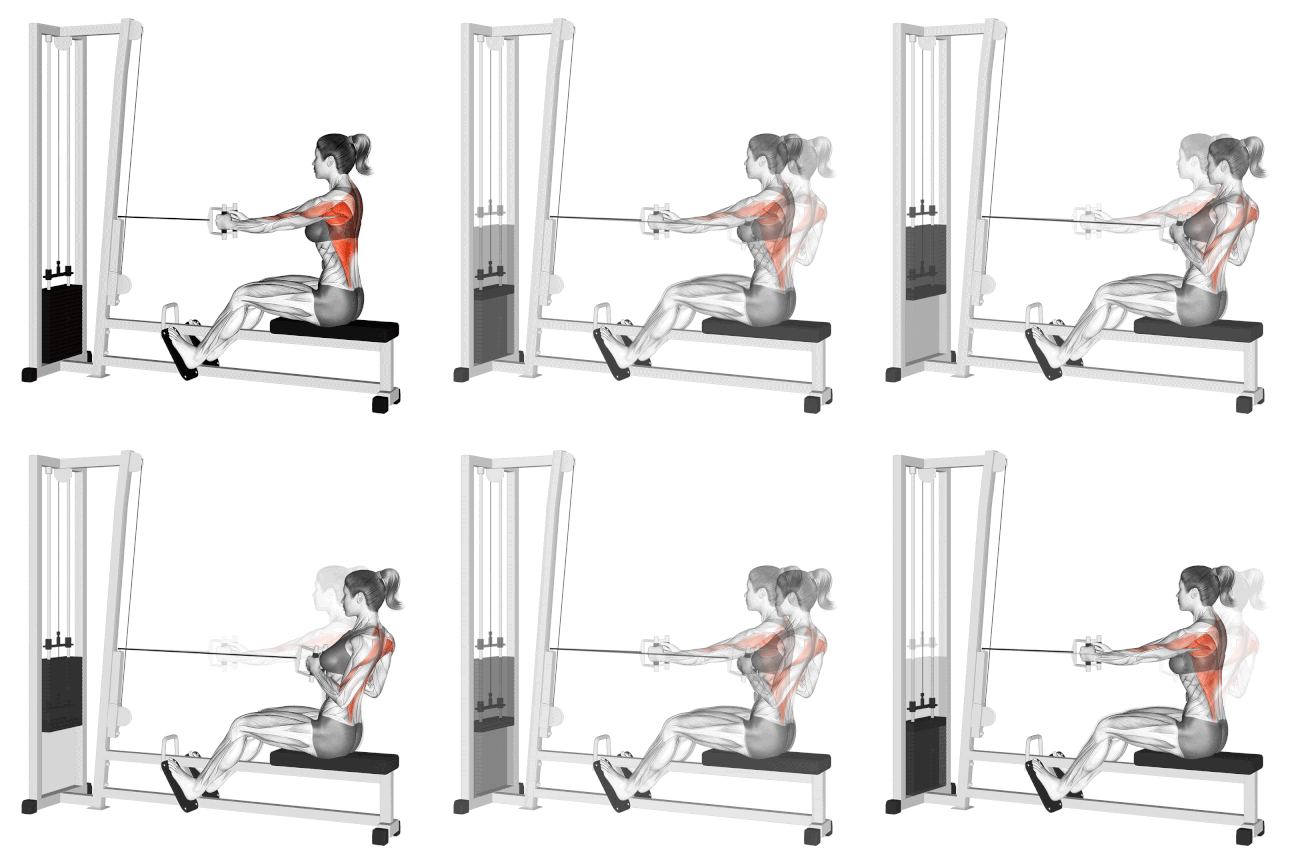
- Adjust the cable pulley to its lowest position. Attach a close-grip attachment (V-bar, neutral grip bar).
- Position the seat, so your knees are slightly bent, and your feet are firmly braced against the footplate when your arms are extended toward the cable machine.
- Grasp the attachment with either an overhand (palms down) or neutral grip (palms facing each other).
- When using a short bar, ensure your hands are closer than shoulder-width apart.
- Sit tall with your chest out and shoulders back. Maintain a slight bend in your knees and a neutral spine.
- Initiate the pull by squeezing your shoulder blades together. Pull the bar towards your lower abdomen. Your elbows should stay tucked close to your sides.
- Take a pause at the top of the movement and squeeze your lat muscles. You should feel it in your lower lats and middle back.
- Slowly return the bar to the starting position by extending your arms.
- Do 8 to 12 repetitions per set, with 2 to 4 sets.
Tips for Close Grip Cable Row
- Start with a lighter weight to make sure you lift correctly before lifting heavier weights.
- Keep your knees slightly bent and your back straight.
- Before initiating every rep, actively draw your shoulders down and away from your ears. Hold that position throughout the entire pull. If you can’t, the weight is too heavy.
- Keep your elbows tracking close to your sides throughout. The handle should contact your lower abdomen, just above your waistband. Think “belly button” as your target, not your sternum.
- Avoid letting the weight slam down or pulling with momentum. Do not swing your torso back and forth; this reduces the effectiveness of the exercise.
- If you’re struggling to feel the exercise in your mid-back, try imagining that you’re trying to put your elbows in your back trouser pockets. This naturally depresses the scapula, tucks the elbows, and drives the humerus into the correct path — all at once.
- If you have a history of shoulder impingement, recent rotator cuff strain, or acute lumbar disc issues, consult a physiotherapist before loading this movement.
- Do a few gentle stretches like a cat-cow or seated spinal twists after your workout to release tension and improve recovery.
Close Grip Cable Row Benefits
- The close grip promotes muscular thickness in the middle back and lower lats.
- Along with your lats, the close grip heavily works your lower traps and rhomboids.
- This row emphasizes the depth and thickness of the back more effectively than other rows.
- Provides additional biceps stimulation as a secondary benefit.
- It adds diversity to your back routine and helps target muscles from slightly different angles.
- It can also help improve grip strength.
Want to take your gains to the next level? Discover your daily calorie needs with our free TDEE calculator.
Close Grip Seated Cable Row Alternatives
If you don’t have a cable machine, or you want to work your back muscles from different angles, you can try these alternatives of close grip row.
- T-Bar Row
- Single-Arm Dumbbell Row
- Machine Row
- Close Grip Lat Pulldown
- Underhand Barbell Row
- Close Grip Chest Supported Row
- Straight Arm Pulldowns
References
- Saeterbakken A, Andersen V, Brudeseth A, Lund H, Fimland MS. The Effect of Performing Bi- and Unilateral Row Exercises on Core Muscle Activation. Int J Sports Med. 2015 Nov;36(11):900-5. doi: 10.1055/s-0034-1398646. Epub 2015 Jul 2. PMID: 26134664.
- Ronai, Peter M.S., FACSM, ACSM-RCEP, ACSM-CEP, ACSM-EP, EIM III, CSCS. Do It Right: The Seated Cable Row Exercise. ACSM’s Health & Fitness Journal 23(4):p 32-37, 7/8 2019.

Manish is a NASM-certified fitness and nutrition coach with over 10 years of experience in weight lifting and fat loss fitness coaching. He specializes in gym-based training and has a lot of knowledge about exercise, lifting technique, biomechanics, and more.
Through “Fit Life Regime,” he generously shares the insights he’s gained over a decade in the field. His goal is to equip others with the knowledge to start their own fitness journey.