
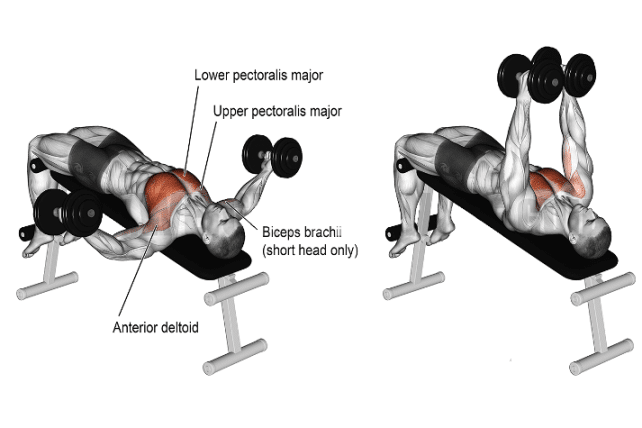
Decline chest fly exercises are variations of the traditional chest fly that is performed on a decline bench. The decline bench is set at a downward slope of around 30 to 45 degrees. This powerful exercise specifically targets your lower pectoral muscles.
Instead of pressing the dumbbells up like a bench press, you move them in a controlled arc, almost like hugging a large tree. This makes it useful for training the chest with lighter loads, better control, and fewer triceps involvement.
However, this exercise should be done carefully. Using too much weight, lowering the dumbbells too far, or losing shoulder control can place unnecessary stress on the shoulder joint.
The goal is not to lift the heaviest weight possible. The goal is to stretch and contract the chest while keeping your shoulders stable and your elbows slightly bent.
- Decline Fly Muscles Worked
- How To Do Decline Dumbbell Fly
- Tips and Techniques
- Decline Chest Fly Variations
- 1. One Arm Dumbbell Decline Fly
- 2. Dumbbell Decline Twist Fly
- 3. Decline Cable Fly
- How To Add Decline Chest Fly In Your Workout Routine
- 1. Sets And Reps
- 2. Frequency
- 3. Combining With Other Chest Exercises
- 4. Used As A Finisher
- FAQs
- Is the decline chest fly suitable for beginners?
- How to do a decline dumbbell fly without a bench?
- Is decline dumbbell fly good?
- What does decline cable flys work?
- What type of flys work lower chest?
- Does chest fly work lower chest?
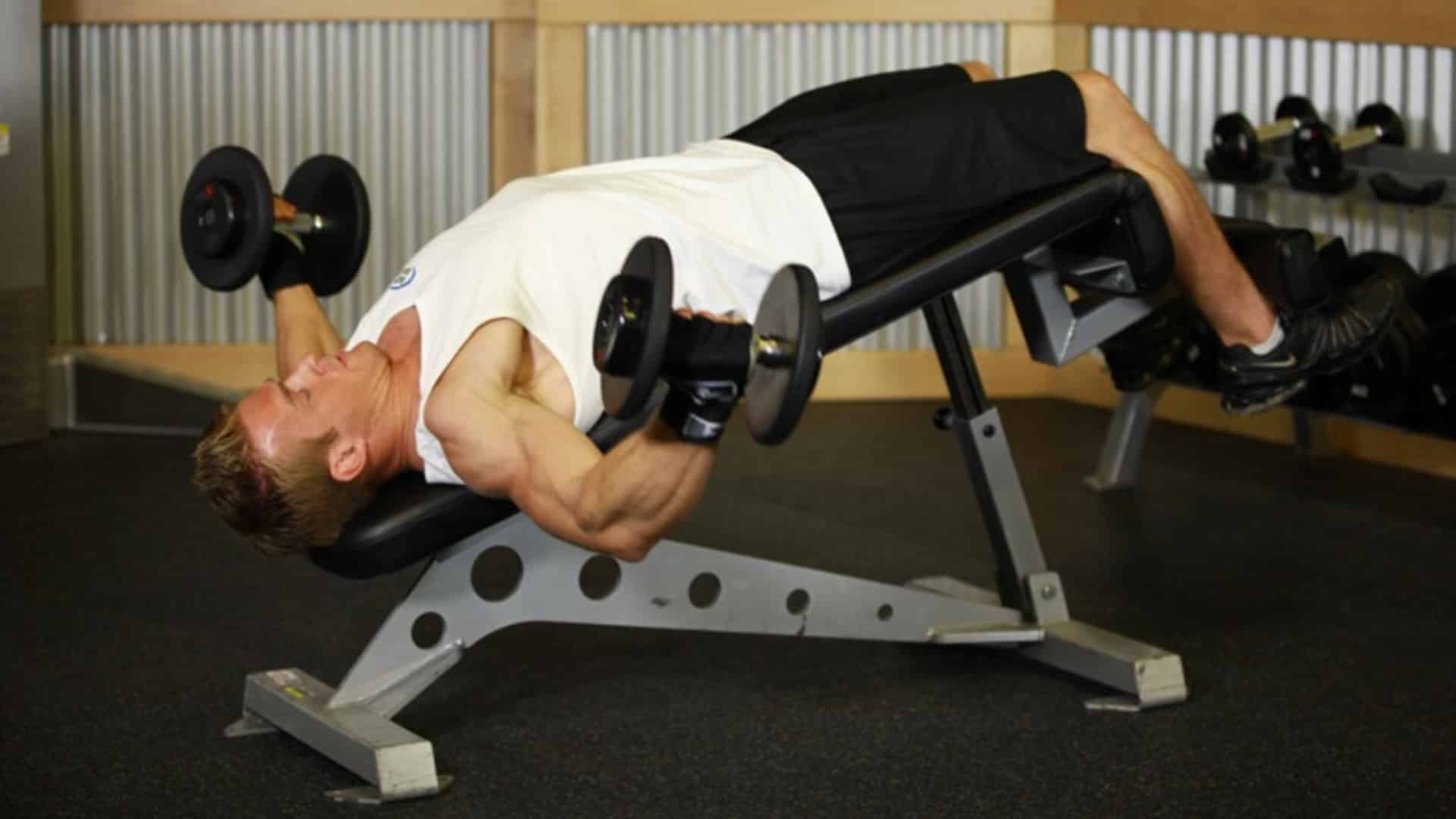
Decline Fly Muscles Worked
A decline dumbbell fly works primarily on the lower pectoral muscle of your chest.
In addition to its target, the main pec muscle. The dumbbell decline fly has the involvement of several synergist muscles, these muscles include,
- Rhomboids,
- Levator scapulae,
- Anterior deltoids, and
- Latissimus dorsi
- Serratus anterior
A handful of other muscles worked or play the role of stabilizer muscles, including your
- Biceps brachii,
- Brachialis,
- Triceps brachii,
- Wrist flexors,
- Obliques, and
- Rectus abdominis.
How To Do Decline Dumbbell Fly
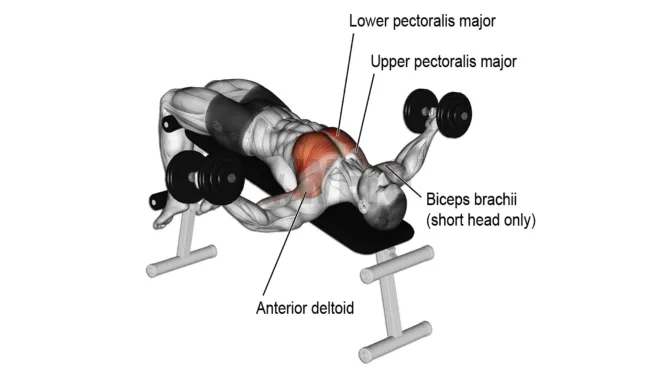
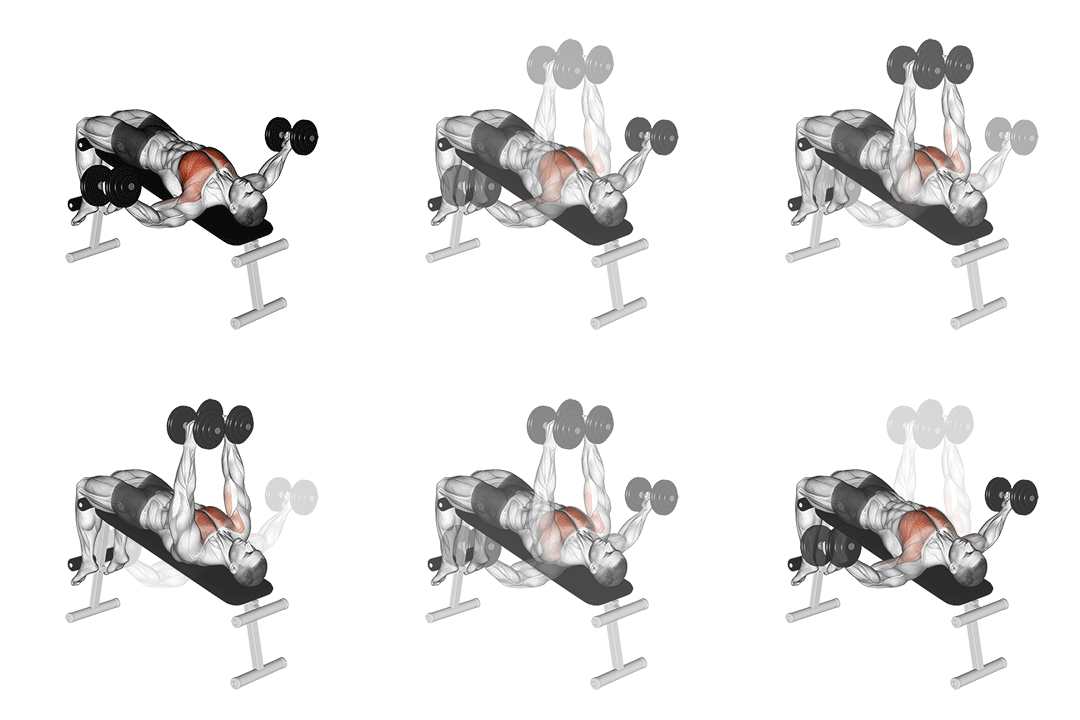
- Set a decline bench at a 30-45-degree angle.
- Lie on the bench with your head at the lower end.
- Hook your feet into the footpad or roller.
- Grab a dumbbell in each hand and lie on your back on a decline bench.
- Extend the dumbbells above your chest.
- Turn the palms to face each other and the dumbbells directly over your upper chest.
- Slowly lower the dumbbells down in a wide arc, keeping your elbows slightly bent until your arms are parallel to the floor.
- Pause briefly, then bring the dumbbells back up to the starting position.
- Do 8–12 reps and 3–4 sets.
Tips and Techniques
- Start with a light set of dumbbells if you’re a beginner, and slowly increase the amount of weight each week as you build strength.
- Don’t let the dumbbells touch as they meet at the top, holding for a second in the contracted position.
- Make sure you keep your elbows bent. You should never fully straighten your arms or lock them out, as this forces the weight you’re lifting onto the elbows and shoulder joints, which increases your chance of injury.
- Don’t let your elbows drop too far when you’re in the start position. They should remain in line with your torso while lying on the bench.
- Maintain control with a 4-second descent, slight pause, and contract with a reverse motion, hold, and repeat.
- Pick a weight that you can control, that’s not too light or too heavy — find what’s right for you.
- Exhale as you lower the dumbbells, and inhale as you bring them back up.
- Use different variations of the Decline Dumbbell Fly to add variety to your workout routine.
- Take a 60-90 second rest between sets to allow your muscles to recover.
Know More: 10 Best Chest Workout With Dumbbells
Decline Chest Fly Variations
There are several variations of the decline dumbbell fly that you can try to add variety and challenge to your workout routine.
Variations include:
- Single-arm decline dumbbell chest fly,
- The declined chest fly with a twist
- Decline dumbbell chest fly with a neutral grip,
It can help keep your workouts interesting and challenging while providing a full range of motion for your chest muscles.
Here are the best decline dumbbell chest fly exercise variations for building bigger and wider chests.
1. One Arm Dumbbell Decline Fly
The single-arm dumbbell decline fly is a unilateral variation of the decline dumbbell chest fly used to target the chest muscles.
It is used by those who want to focus on one side of their chest, working at a time.
When you do a one-arm dumbbell fly, starting with the weaker side of your chest is important.

How To Do It
- Grab a dumbbell in one hand and lie on your back on a decline bench.
- Hook your feet into the foot pad or roller.
- Extend the dumbbell above your chest.
- Slowly lower your arm to your side until your wrist reaches about shoulder level or slightly above.
- Always keep a slight bend in the elbows and never lower the weight to the point where you get any pain and pressure at the front of the shoulder joint.
- Bring your arm back toward the midline of your body.
2. Dumbbell Decline Twist Fly
The decline dumbbell twist fly is a slight variation of the decline dumbbell fly.
The movement targets the muscles of the chest, emphasizing the lower pecs. It also indirectly targets the muscles of the shoulder and triceps.
The slight added twist, the decline dumbbell twist fly, results in a greater chest contraction.

How To Do It
- Grab a dumbbell in each hand in each hand with a neutral grip and lie on a decline bench.
- Hold the weights above you at shoulder height.
- Slightly retract your shoulder blades, unlock your elbows, and slowly lower the dumbbells laterally.
- Once the dumbbells reach chest level, reverse the movement.
- As the dumbbells return to the starting position, twist the handles so that the bottom of the dumbbells almost touch.
- Start the next repetition without allowing the dumbbells to touch by untwisting the handles back to a neutral position.
- Avoid touching or banging the dumbbells together at the top of each repetition to keep constant tension.
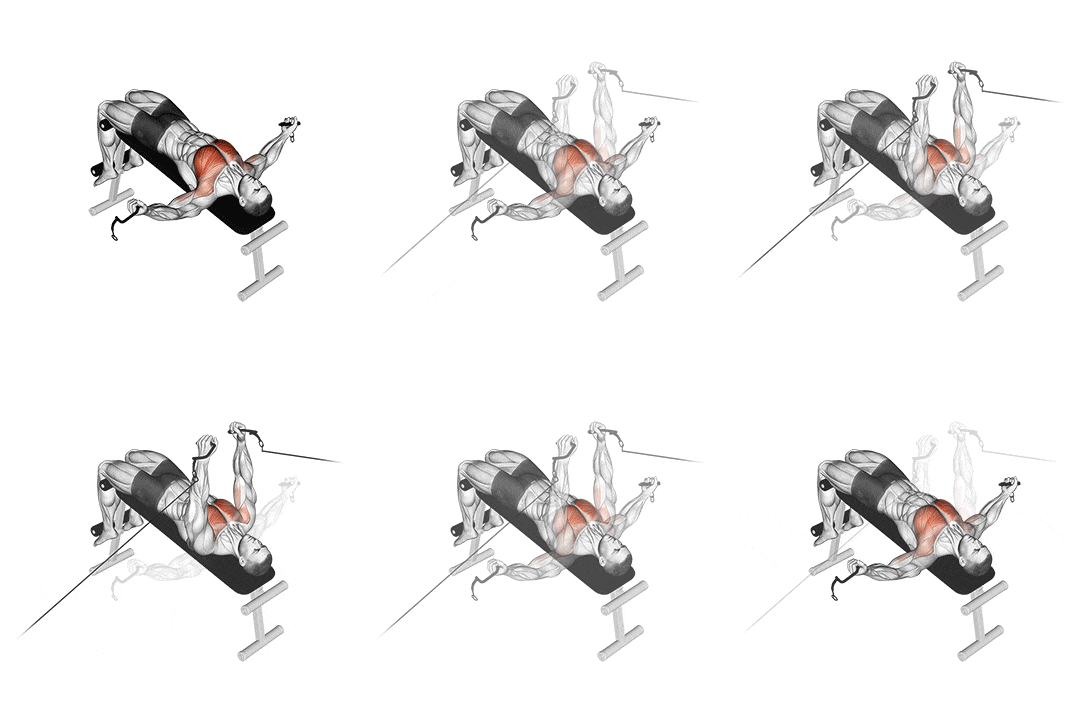
3. Decline Cable Fly
Decline Cable fly is one of the most suitable exercises for isolating the chest muscles.
Performing this exercise with cables instead of dumbbells allows for constant tension, which helps build lower Chest fibers.
How To Do It
- Set a Decline bench at a 30-degree angle. Lie on the bench with your feet flat on the foot pad or the roller.
- Lift your arms straight up from your shoulders and hold the cable handle directly over your chest.
- Slowly lower your arms to your sides until your wrists reach about shoulder level or slightly above.
- Bring your arms back toward the midline of your body, focusing on using your lower pec muscles to draw them back together.
- Maintain control with a 4-second descent, slight pause, and contract with a reverse motion, hold, and repeat.
How To Add Decline Chest Fly In Your Workout Routine
If you want to incorporate decline chest fly into your workout routine, here are some tips to help you get started.
1. Sets And Reps
| Category | Sets | Reps | Rest |
|---|---|---|---|
| Beginners | ~10 sets per week | 3 sets of 8–12 reps | 1–2 min between sets |
| Intermediate | ~15 sets per week | 3-4 sets of 8–12 reps | 1–2 min between sets |
| Advanced | ~20 sets per week | Varies based on goals | 1 min between sets |
2. Frequency
It can be performed 1–2 times weekly, depending on your overall workout schedule and goals.
3. Combining With Other Chest Exercises
Combined decline fly with other chest exercises, like bench press, push-ups, to make a good chest workout.
When combining exercises, be sure to vary the angles and resistance to target the chest muscles in different ways.
4. Used As A Finisher
Decline chest fly variations can be used as a finishing exercise at the end of your chest workout.
This helps to exhaust your chest muscles and increase blood flow, leading to greater muscle growth and definition.
FAQs
Is the decline chest fly suitable for beginners?
Yes, beginners can perform the decline chest fly exercise. Start with lighter weights and focus on maintaining proper form.
How to do a decline dumbbell fly without a bench?
A decline dumbbell fly can be performed without a bench by lying on the floor with your feet elevated on a stable platform.
Decline dumbbell floor fly variation is more challenging because you must maintain proper form and balance.
Is decline dumbbell fly good?
The decline dumbbell chest fly is a good and effective exercise. It mainly builds chest muscle and strength. The decline fly helps build bigger lifts, like the barbell bench press.
What does decline cable flys work?
A decline dumbbell fly works primarily on the lower pec muscle of your chest and the front of your shoulders.
What type of flys work lower chest?
Here are the best variations of the decline chest fly exercise, focusing on the lower chest.
- Decline Cable Fly
- Decline Dumbbell Fly,
- High Cable Fly (High To Low Cable Fly).
Does chest fly work lower chest?
Yes, you could try the cable chest fly, the decline dumbbell chest fly, or the high cable chest fly. These are all great exercises for the lower chest.
Thanks for reading.

Manish is a NASM-certified fitness and nutrition coach with over 10 years of experience in weight lifting and fat loss fitness coaching. He specializes in gym-based training and has a lot of knowledge about exercise, lifting technique, biomechanics, and more.
Through “Fit Life Regime,” he generously shares the insights he’s gained over a decade in the field. His goal is to equip others with the knowledge to start their own fitness journey.