
The single-arm lateral raise is a shoulder isolation exercise performed one arm at a time. It mainly targets the lateral deltoid, the middle part of the shoulder that helps create broader-looking shoulders.
Training one arm at a time can also help you notice left-right strength differences, improve control, and reduce the chance of one side doing more work than the other.
It does not automatically “fix” muscle imbalances, but it can make imbalances easier to identify and address through better technique and balanced programming.
You can perform single-arm lateral raises with a dumbbell, cable machine, or resistance band.
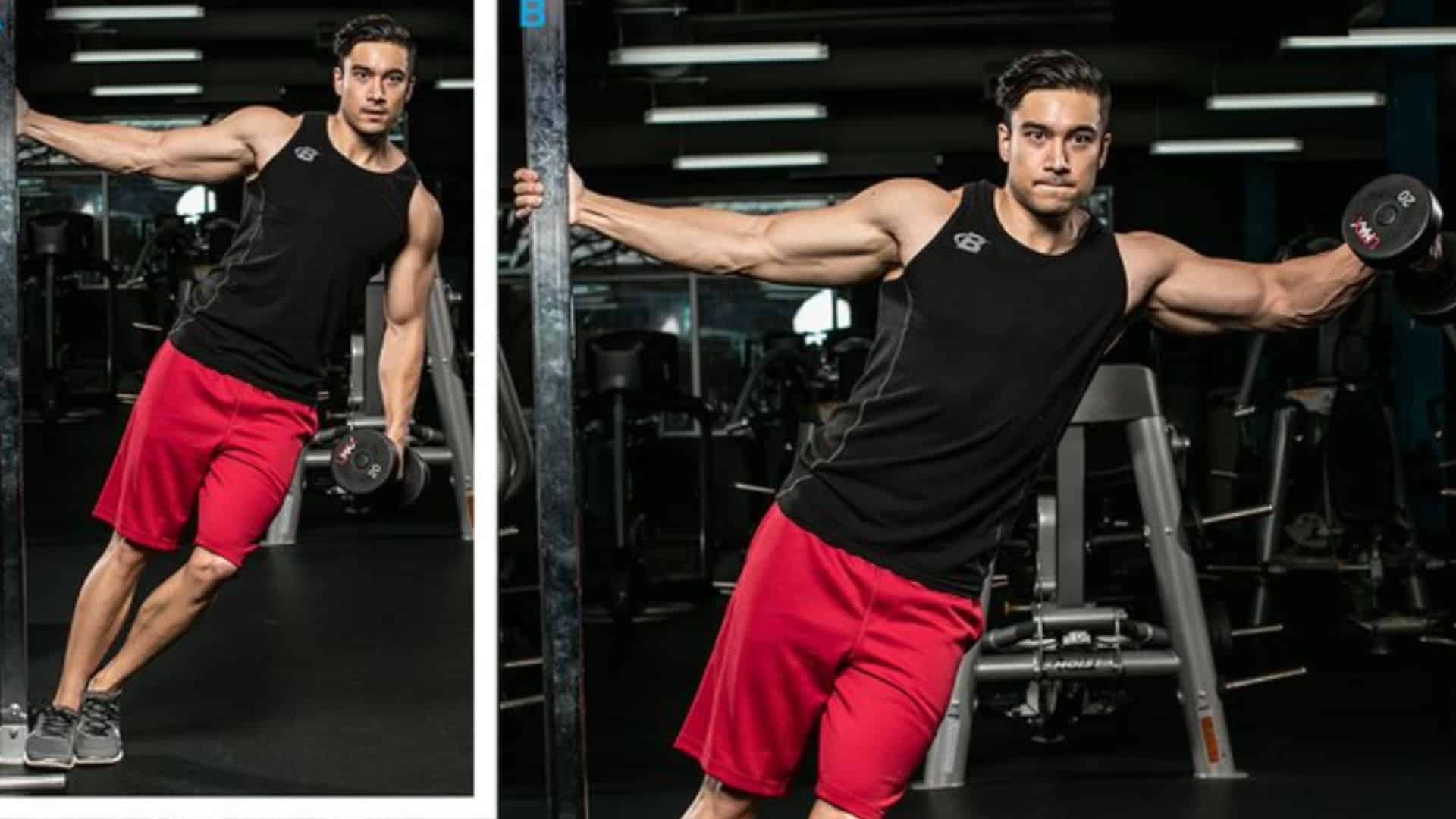
Single Arm Lateral Raise Muscles Worked
The main muscle worked during the single-arm lateral raise is the lateral deltoid, also called the middle deltoid.
Secondary Muscle Worked: The anterior deltoid, posterior deltoid, upper trap, supraspinatus (a rotator cuff muscle), and serratus anterior (muscles along your ribs under your armpit) also contribute to the movement.
A handful of other muscles worked or played the role of stabilizer muscles:
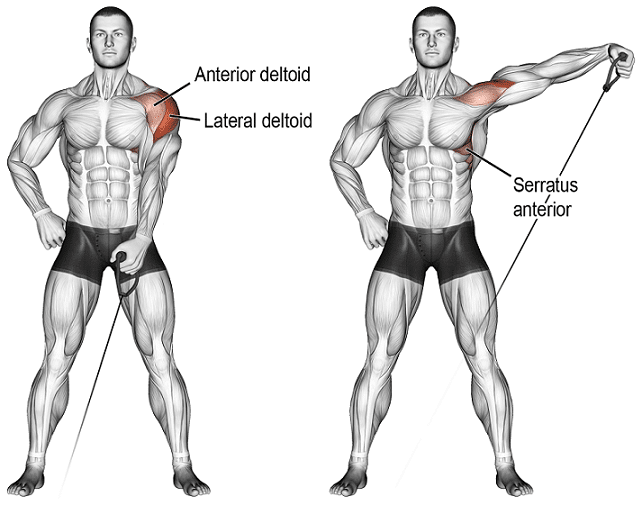
One Arm Dumbbell Lateral Raise
One-arm dumbbell lateral raises are a fantastic and widely accessible way to target your shoulder muscles. It is an excellent exercise to isolate one side at a time and build side deltoids.
Dumbbells offer a natural range of motion and greater freedom to adjust your hand position (neutral grip, thumb down, etc) compared to fixed cable machines.
Make it a part of your dumbbell shoulder workouts to strengthen the lateral side of the deltoid muscle.
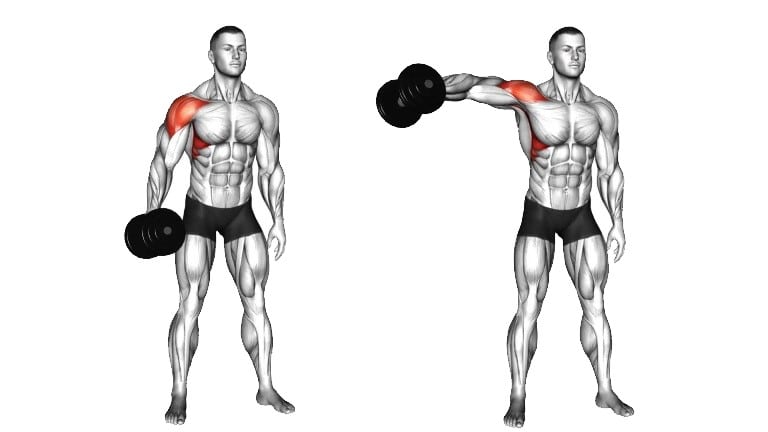
How To Do Dumbbell One-arm Lateral Raise
- Stand upright with a dumbbell in one hand. Keep the other hand free or on your hip.
- Your feet should be about shoulder-width apart with your back straight and core engaged.
- Now bend your elbow and raise the dumbbell to your side.
- Lift them to a point slightly higher than your shoulder.
- Now lower the dumbbell in a controlled manner back to the starting position.
- Perform all reps on one side and then repeat with the other arm.
Tips
- Keep your wrist neutral and your elbow slightly bent. ACE recommends keeping the torso stable, avoiding low-back arching, and raising the arms to about shoulder level
- Pause momentarily at the top before slowly lowering the dumbbell back to the starting position.
- Keep a controlled motion and avoid jerky movements.
- Avoid arching of the lower back.
One Arm Cable Lateral Raise
The one-arm cable lateral raise is a useful variation because the cable can provide tension through more of the range of motion than a dumbbell, depending on pulley height and body position.
A dumbbell is usually hardest near the top of the raise. A cable can be adjusted so the side delt is challenged more in the lower or lengthened part of the movement.
However, this does not mean cables are always better. Recent research found that both dumbbell and cable lateral raises can increase lateral deltoid muscle thickness, with similar hypertrophy outcomes in resistance-trained lifters over an 8-week interventio

How To Do One Arm Cable Lateral Raise
- Stand next to a cable pulley machine with your feet shoulder-width apart and the handle attachment adjusted to the lowest setting.
- To maintain good posture, push your chest forward and point your shoulders back while slightly bending both knees.
- Grab the handle and stand straight up with your arm fully extended and feet facing forward.
- Maintaining a slight bend in your working elbow, raise your arm up to shoulder height.
- Hold for a second, and then slowly lower the weight back to the starting position.
Tips
- Keep your torso still, your back straight, and your elbow slightly bent.
- Don’t just swing your arms. Keep controlled motion throughout the exercise.
- Always use weights that you can handle comfortably.
Know More: 14 Best Cable Chest Exercises and Workout Routine
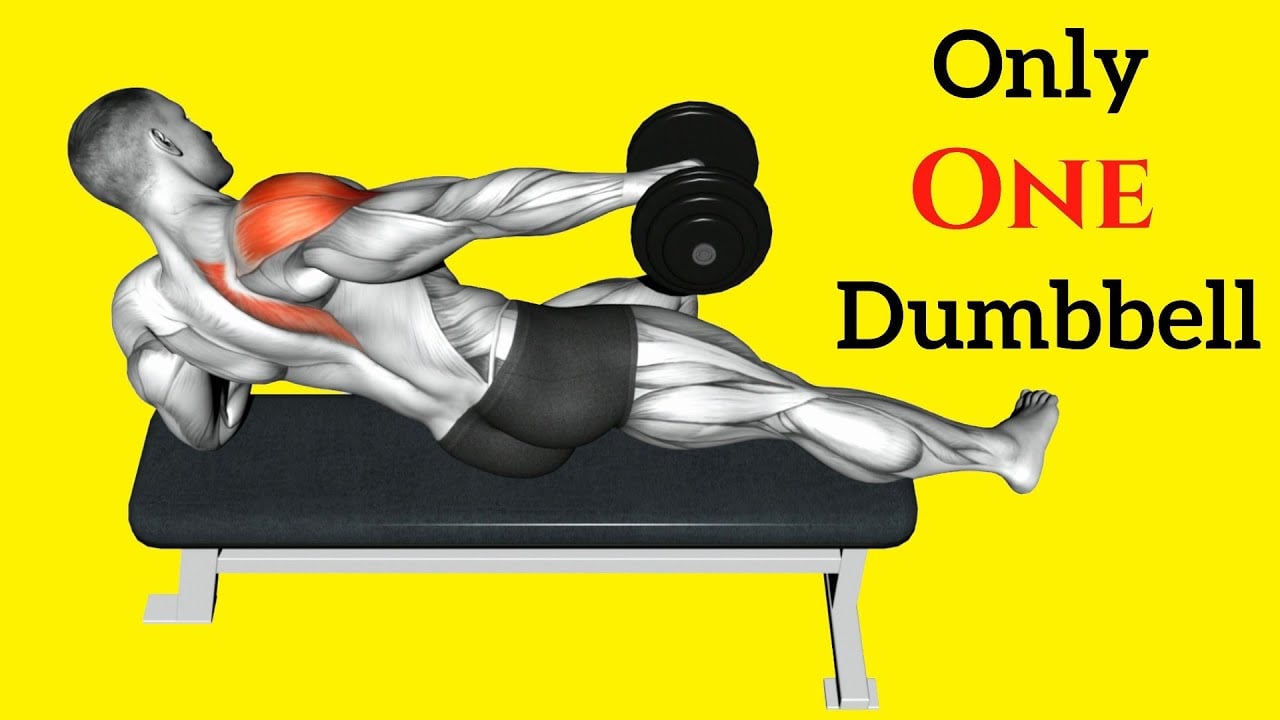
Lying One Arm Dumbbell Lateral Raise
This exercise isolates the lateral deltoid muscle, similar to the standing or seated versions.
Lying on a bench eliminates the possibility of using body sway or momentum to help with the lift. This forces the target lateral shoulder muscle to do nearly all the work.
Lying side laterals is perhaps difficult for beginners, but it is an interesting variation on conventional lateral raises.

How To Do Lying One Arm Lateral Raise
- Lie sideways on a flat bench, propping yourself up onto your elbow so it is perpendicular to the bench.
- Hold the dumbbells so that they rest sideways on your upper thigh
- Slowly lift the dumbbells up and out to the sides of your body, pulling through the rear delts and middle traps.
- Pause a moment at the top of the motion before slowly lowering the weights back down to the starting position.
Tips
- Do not lift backward or forward.
- Avoid using momentum. Focus on moving in a slow and controlled fashion.
- Your working elbow should be slightly bent during the lift.
Leaning Single Arm Dumbbell Lateral Raise
The leaning single-arm lateral raise changes the angle of your body and can make the exercise feel harder in a different part of the range of motion.
Compared with the dumbbell lateral raise, the leaning dumbbell lateral raise puts your lateral deltoid under tension through a greater portion of the range of motion, making each repetition more effective.
The leaning position creates leverage while maximizing the isolation of the shoulders throughout the movement. It also places greater overload at the top of the movement.
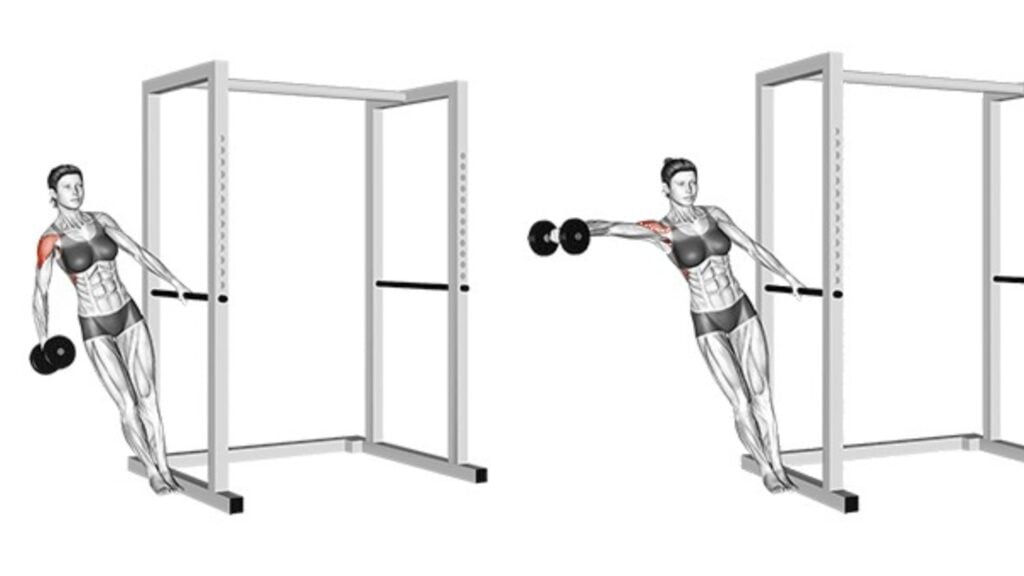
How To Do Leaning Single Arm Dumbbell Lateral Raise
- Stand holding a dumbbell with one hand. Feet are shoulder-width apart and knees are slightly bent.
- Now bend your elbow and raise the dumbbell to your side.
- Lift them to a point slightly higher than your shoulder.
- Now lower the dumbbell in a controlled manner back to the starting position.
- Perform all reps on one side and then repeat with the other arm.
Tips
- Keep a controlled motion and avoid jerky movements.
- Avoid arching of the lower back.
Incline One Arm Lateral Raise
The incline one-arm lateral raise is a useful variation on the traditional lateral raise, providing subtle muscle alterations and extra stability.
Adding this to your routine offers a fresh way to stimulate shoulder muscles, help fight off plateaus, and keep your shoulder workouts engaging.
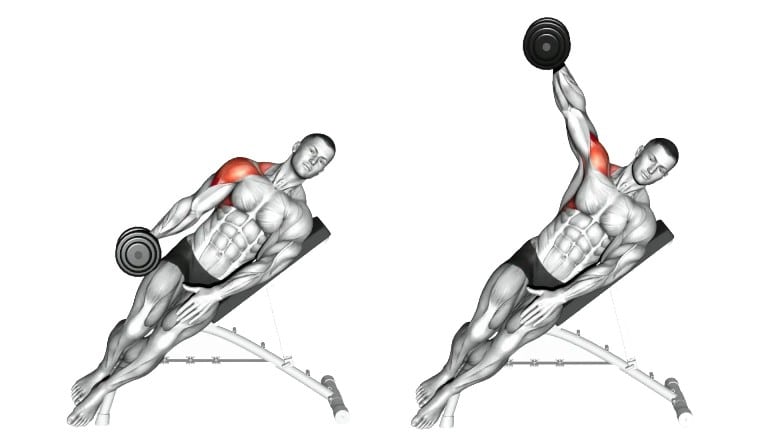
How To Do Incline Single Arm Lateral Raise
- Lie sideways on an incline bench, set at 55 degrees, with your armpit over the top of the bench.
- Hold the dumbbell so that it rests sideways on your upper thigh
- Keeping a slight bend in your elbow, raise the dumbbell out from your side until your elbow is in line with your shoulder.
- Pause a moment at the top of the motion before slowly lowering the weights back down to the starting position.
Tips
- Do not shrug your shoulders when raising the dumbbell.
- Avoid using momentum.
- Your working elbow should be slightly bent during the lift.
References:
- Coratella G, Tornatore G, Longo S, Esposito F, Cè E. An Electromyographic Analysis of Lateral Raise Variations and Frontal Raise in Competitive Bodybuilders. Int J Environ Res Public Health. 2020 Aug 19;17(17):6015. doi: 10.3390/ijerph17176015. PMID: 32824894; PMCID: PMC7503819.
- Larsen S, Wolf M, Schoenfeld BJ, et al. Dumbbell versus cable lateral raises for lateral deltoid hypertrophy: an experimental study. Frontiers in Physiology. 2025.

Manish is a NASM-certified fitness and nutrition coach with over 10 years of experience in weight lifting and fat loss fitness coaching. He specializes in gym-based training and has a lot of knowledge about exercise, lifting technique, biomechanics, and more.
Through “Fit Life Regime,” he generously shares the insights he’s gained over a decade in the field. His goal is to equip others with the knowledge to start their own fitness journey.