Calves have a reputation for being stubborn. The researchers behind one 2023 trial call them relatively unresponsive to resistance training, and bodyweight raises stop feeling hard quickly.
A calf machine lets you add weight in small steps while the machine handles your balance.
Below you’ll find the six machines you’re most likely to see, what each one is called, how to use it, what the research says about standing versus seated raises, and a simple weekly plan.

- Calf Machines at a Glance
- 6 Gym Machines for Calves and How to Use Them
- 1. Standing Calf Raise Machine
- 2. Seated Calf Raise Machine
- 3. Donkey Calf Raise Machine
- 4. Leg Press Calf Press
- 5. Hack Squat Calf Raise
- 6. Leverage Squat and Calf Machine
- Other Options: Smith Machine and Cable Calf Raises
- Smith Machine Standing Calf Raise
- Cable Standing Calf Raise
- Which Calf Machine Should You Use?
- A Simple Weekly Calf Plan
- Gastrocnemius and Soleus in Plain Terms
- What Matters on Any Calf Machine
- Calf Machine FAQs
- What is the calf machine called?
- Should I do standing or seated calf raises first?
- How often should I train calves on machines?
- Why are my calves slow to grow?
- Research Papers Referenced in This Guide
Calf Machines at a Glance
| Machine | Knee position | Good to know |
|---|---|---|
| 1. Standing calf raise machine (standing calf machine) | Straight | Grew the gastrocnemius far more than the seated version in one 12-week trial |
| 2. Seated calf raise machine (seated calf press) | Bent to about 90 degrees | The soleus grew about the same as with standing raises in that trial |
| 3. Donkey calf raise machine | Straight, hips bent | A straight-knee raise with the pad on your hips |
| 4. Leg press calf press | Straight | Uses a leg press you already have |
| 5. Hack squat calf raise | Straight | Your back is supported and the path is fixed |
| 6. Leverage squat and calf machine | Straight | Plate-loaded combo unit, for example the Body-Solid GSCL360 |
Names change from brand to brand. You may also see a rotary calf machine, a calf extension machine or a calf press.
They all have you push a footplate with the balls of your feet. If you can’t tell what you’re looking at, our gym machine names with images guide will help.
6 Gym Machines for Calves and How to Use Them
One caveat before the machines. Apart from standing versus seated, I couldn’t find trials comparing these machines with each other. The setup steps and the sets and reps below are standard coaching practice, not study results.
1. Standing Calf Raise Machine
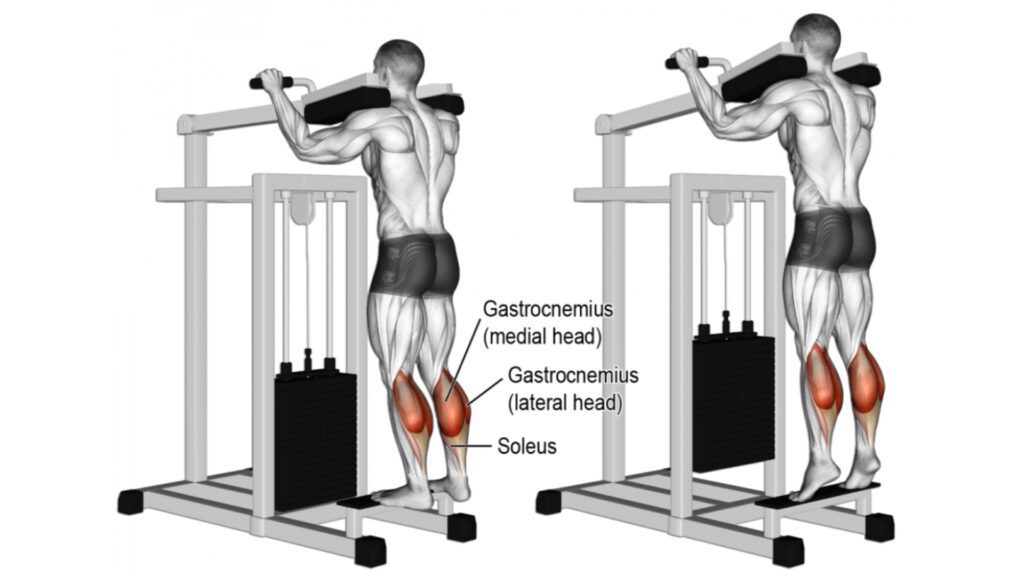
You stand with pads on your shoulders and push through the balls of your feet. Your knees stay straight, which is the position that grew the gastrocnemius most in the trial above. If your gym has one, start here.
How to Use the Standing Calf Raise Machine
- Set the pads so you can stand fully upright with them on your shoulders. Put the balls of your feet on the platform with your heels hanging off.
- Unhook the weight and straighten your legs.
- Lower your heels slowly until you feel a deep stretch in your calves, and pause for a second.
- Press up through the balls of your feet, big toe included, as high as you can.
- Squeeze briefly at the top, then lower under control.
What about foot position? Turning your toes in or out shifts the work between the two heads of the gastrocnemius in a lab EMG study of 20 adults, but the authors couldn’t say whether that changes growth (Riemann 2011).
I’d keep your feet roughly straight and put your effort into range and load.
2. Seated Calf Raise Machine
A pad sits across your thighs just above the knees. With your knee bent, the soleus takes a bigger share of the work.
There’s little load on your spine, so it’s also handy if standing under a loaded pad feels uncomfortable. Our seated machine calf raise guide goes into more detail.

How to Use the Seated Calf Raise Machine
- Sit down and set the thigh pad just above your knees, with your knees bent to about 90 degrees.
- Put the balls of your feet on the platform with your heels hanging off, then release the lever.
- Lower your heels slowly into a full stretch and pause.
- Press through the balls of your feet to lift your heels as high as you can, hold for a second, then lower slowly.
3. Donkey Calf Raise Machine
You lean forward at the hips with your forearms on a support and a pad across your lower back and hips. Your knees stay straight, so your calves are in the same position as in a standing raise.
The hip bend only changes where the weight sits, and plenty of people find it easy to sink into a deep stretch there.
I couldn’t find a trial comparing it with standing raises, so don’t expect it to beat them.

How to Use the Donkey Calf Raise Machine
- Adjust the hip pad and support so you can hinge forward with the pad across your lower back and hips.
- Put the balls of your feet on the platform about shoulder-width apart, with your legs straight and your back flat.
- Lower your heels as far as is comfortable and pause in the stretch.
- Press up through the balls of your feet as high as you can, hold for a second, then lower under control.
4. Leg Press Calf Press
No calf machine in your gym? The leg press does the job. You press the sled with only the balls of your feet, so your legs stay straight and your calves do the lifting.
The 8-week trial above used a leg press for its calf raises. Go much lighter than your normal leg press weight, because at the top your knees are holding the load.

How to Do a Calf Press on the Leg Press
- Sit with your back flat against the pad. Place the balls of your feet on the lower part of the footplate, hip-width apart, with your heels hanging off.
- Press the sled out until your legs are straight, then release the safety handles the way your machine’s instructions show. Keep your knees straight, but don’t let them snap back into lockout.
- Let the plate pull your toes back toward your shins until you feel a stretch in your calves, and pause for a second.
- Press the plate away using only your ankles, then squeeze briefly at the top.
- When you finish, re-engage the safeties before you bend your knees.
5. Hack Squat Calf Raise
Many people also use the hack squat machine for calf raises. The fixed path means you only have to think about your ankles. Platforms differ in size, so check that your heels can hang off the front safely. If you’re not sure, ask a member of staff.

How to Do a Calf Raise on the Hack Squat Machine
- Get into the machine as you would for a hack squat, with your back on the pad and your shoulders under the pads.
- Move your feet so only the balls of your feet are on the platform, heels hanging off the edge. Straighten your legs and release the safeties following your machine’s instructions.
- Lower your heels into a full stretch and pause, then press up through the balls of your feet. Keep your knees still.
- Re-engage the safeties when you finish.
6. Leverage Squat and Calf Machine
Some plate-loaded machines are sold as a squat and calf raise combo. The Body-Solid GSCL360 is one example.
Its manufacturer’s data sheet lists shoulder and back pads, a spring-loaded lockout handle and a foot platform set at 20 degrees. Setups differ between brands and models, so follow the instructions on your machine.

How to Do Calf Raises on the Leverage Squat Machine
- Load the plates evenly, step in, and set your shoulders under the pads.
- Put the balls of your feet on the part of the machine made for calf raises, with your heels hanging off. Stand up and release the lockout handle.
- Lower your heels into a full stretch and pause, then press up through the balls of your feet as high as you can.
- Squeeze at the top, lower under control, and re-engage the lockout handle before you step out.
Other Options: Smith Machine and Cable Calf Raises
Neither of these is a calf machine, but both work when the real ones are taken.
Smith Machine Standing Calf Raise
The bar slides on fixed rails, so you can stand on a block with the bar across your upper back and focus on the raise. Set the bar so you can unrack it by standing up straight, and keep your feet slightly in front of the bar (a common coaching cue).
Then do the same stretch, pause and press as on the standing machine. Our Smith machine calf raise guide has more variations, and our Smith machine leg exercises list covers the rest of your legs.

Cable Standing Calf Raise
Attach the cable to a dip belt (or hold a straight bar) on a low pulley. Stand on a step or bench with the balls of your feet on the edge, drop your heels into a stretch, then raise them as high as you can.
You’re limited by how much you can hold or attach, so it suits lighter work. More ideas are in our cable leg exercises guide.

One thing not to mix up: tibialis raises train the muscle at the front of your shin, not your calves, so they don’t count toward your calf sets.
Which Calf Machine Should You Use?
- Your gym has a standing calf machine: start there.
- You want more volume or variety: add the seated machine, a leg press calf press or the donkey raise.
- There’s no dedicated machine: use the leg press, hack squat or Smith machine for straight-knee raises.
- Weight on your shoulders is uncomfortable: the seated machine and the leg press calf press keep it off your shoulders.
New to machines in general? See our gym machines for beginners guide, or our gym machines for legs list for the rest of leg day.
A Simple Weekly Calf Plan
For a rough weekly target, the 2026 ACSM position stand on resistance training in healthy adults is a useful guide.
It found that training a muscle at least twice a week helps strength, and that around 10 or more hard sets per muscle group per week helps muscle size. It isn’t calf-specific. For reference, the two calf trials above used about 10 and about 9 sets a week (Currier 2026).
| Session | Exercise | Sets and reps |
|---|---|---|
| Day A | Standing calf raise machine | 3 sets of 8 to 12 |
| Day A | Seated calf raise machine | 2 sets of 12 to 15 |
| Day B | Leg press calf press, hack calf raise or donkey raise | 3 sets of 10 to 15 |
| Day B | Standing calf raise machine | 2 sets of 8 to 12 |
That’s 10 sets a week over two days, with a day or more between them. It’s a starting point, not a prescription from a study.
Take each set close to failure with a full stretch, and add a little weight once you hit the top of the rep range on every set. If you train at home, our calf exercises, bodyweight calf raises and standing dumbbell calf raise guides cover the options.
Gastrocnemius and Soleus in Plain Terms
Your calf is two main muscles that share the Achilles tendon. The gastrocnemius is the big, visible one, and it crosses both the knee and the ankle. The soleus sits underneath and only crosses the ankle.
Keep your knee straight and the gastrocnemius is stretched, so it does a lot of the work. Bend your knee to about 90 degrees and the gastrocnemius shortens, which leaves the soleus doing relatively more.
That’s why gyms have both a standing and a seated machine. In practice the split is less clean than it sounds. One study of 48 adults compared heel raises with a straight knee and with the knee bent to 45 degrees. Soleus activity was only about 4% higher with the knee bent, and gastrocnemius activity about 5% lower. The authors suggested a gap that small might not matter for results (Hébert-Losier 2012).
Growth is the better test, and a 2023 trial measured it. Fourteen untrained adults trained one leg with standing raises and the other with seated raises: 5 sets of 10 reps, twice a week, for 12 weeks, with MRI scans before and after.
The standing leg won. Whole-calf muscle volume rose 5.6% versus 2.1%, and the gastrocnemius muscles rose roughly 9 to 12% versus under 2%. The soleus grew about the same either way (2.1% standing, 2.9% seated) (Kinoshita 2023).
So make a straight-leg raise your main calf exercise, and treat seated raises as optional rather than essential. It’s one small trial in untrained people, so don’t take it as the final word.
What Matters on Any Calf Machine
- Get a full stretch, and pause in it. In an 8-week trial, 42 young women did calf raises on a leg press machine. The group that trained only the stretched half of the range grew the medial gastrocnemius most: +15.2%, versus +6.7% for full range and +3.4% for the top half. It’s one trial in young women, so I wouldn’t read it as “skip the top”. Read it as “never cut the bottom short” (Kassiano 2023).
- Move at the ankle only. Keep your knees straight and don’t bend and straighten them to shift the weight. This is standard coaching advice, not a cited finding.
- Don’t bounce. Pause for a second in the stretch, then press.
Calf Machine FAQs
What is the calf machine called?
Most gyms have a standing calf raise machine and a seated calf raise machine (also called a seated calf press). Some have a rotary calf or calf extension machine, and names vary by brand. Look for a footplate you push with the balls of your feet. If your gym has none of these, a leg press, hack squat machine or Smith machine can do the job.
Should I do standing or seated calf raises first?
Standing, if you only do one. In the 12-week trial, standing raises grew the gastrocnemius far more than seated ones, and the soleus grew about the same either way. It was a small trial in untrained adults, so I wouldn’t treat it as settled, but it’s the best direct comparison I could find.
How often should I train calves on machines?
Two sessions a week with about 10 hard sets in total is a sensible start. That matches the ACSM position stand for muscle groups in general and the two calf trials above, though none of them sets a calf-specific rule.
Why are my calves slow to grow?
Calves do tend to be stubborn. The authors of the standing versus seated trial call them relatively unresponsive to resistance training, and even the better leg gained only 5.6% muscle volume in 12 weeks, so slow progress is normal.
What you can control is a full stretch, straight-knee raises, enough weekly sets and time. How much of the rest comes down to the individual isn’t something I can tell you.
Research Papers Referenced in This Guide
- Kinoshita M, Maeo S, Kobayashi Y, et al. Triceps surae muscle hypertrophy is greater after standing versus seated calf-raise training. Front Physiol. 2023. PubMed
- Kassiano W, Costa B, Kunevaliki G, et al. Greater gastrocnemius muscle hypertrophy after partial range of motion training performed at long muscle lengths. J Strength Cond Res. 2023;37(9):1746-1753. PubMed
- Hébert-Losier K, Schneiders AG, García JA, et al. Influence of knee flexion angle and age on triceps surae muscle activity during heel raises. J Strength Cond Res. 2012. PubMed
- Riemann BL, Limbaugh GK, Eitner JD, LeFavi RG. Medial and lateral gastrocnemius activation differences during heel-raise exercise with three different foot positions. J Strength Cond Res. 2011. PubMed
- Currier BS, D’Souza AC, Singh MAF, et al. American College of Sports Medicine Position Stand. Resistance Training Prescription for Muscle Function, Hypertrophy, and Physical Performance in Healthy Adults: An Overview of Reviews. Med Sci Sports Exerc. 2026;58. PubMed

Manish is a NASM-certified fitness and nutrition coach with over 10 years of experience in weight lifting and fat loss fitness coaching. He specializes in gym-based training and has a lot of knowledge about exercise, lifting technique, biomechanics, and more.
Through “Fit Life Regime,” he generously shares the insights he’s gained over a decade in the field. His goal is to equip others with the knowledge to start their own fitness journey.