A barbell, some plates and a bench are enough to train most of your arm: the biceps, triceps and forearms. This guide covers 12 barbell exercises, how to do each one, and how to turn them into a weekly routine.
Where a study exists, I link it. Where something is standard coaching practice rather than research, I say so.

- Barbell Arm Exercises at a Glance
- How to Build Arms With a Barbell
- 12 Barbell Arm Exercises
- 1. Barbell Curl
- 2. Lying Barbell Triceps Extension
- 3. Barbell Preacher Curl
- 4. Overhead Barbell Triceps Extension
- 5. Barbell Spider Curl
- 6. Close-Grip Bench Press
- 7. EZ Bar Curl
- 8. Incline Barbell Triceps Extension
- 9. Barbell Reverse Curl
- 10. Reverse Grip Barbell Press
- 11. Barbell Wrist Curl
- 12. Barbell Reverse Wrist Curl Over Bench
- Barbell Arm Workout Routine
- Sets and Reps
- Barbell Arm Workout at Home
- Beginner Barbell Arm Workout
- Intermediate Barbell Arm Workout
- Muscles of the Arm
- Biceps Brachii
- Brachialis
- Brachioradialis
- Triceps Brachii
- Forearm Muscles
- Barbell Arm Workout FAQs
- Can you build bigger arms with just a barbell?
- How often should I train arms?
- Do I have to train to failure?
- Are barbells or dumbbells better for arms?
Barbell Arm Exercises at a Glance
| Exercise | Main muscles | Good to know |
|---|---|---|
| 1. Barbell curl | Biceps, brachialis | Underhand grip, no swinging |
| 2. Lying triceps extension | Triceps | The bar travels over your face, so use a spotter or an EZ bar when it gets heavy |
| 3. Preacher curl | Biceps, brachialis | The pad limits body swing |
| 4. Overhead triceps extension | Triceps | Overhead beat arms-by-your-side in one cable study |
| 5. Spider curl | Biceps, brachialis | Chest supported on an incline bench |
| 6. Close-grip bench press | Triceps, chest, front shoulder | Narrower grips raised triceps activity in studies |
| 7. EZ bar curl | Biceps, brachioradialis | Similar to a straight bar in one study, so comfort decides |
| 8. Incline triceps extension | Triceps | Same overhead logic as exercise 4 |
| 9. Barbell reverse curl | Brachialis, brachioradialis, biceps | Not shown to work the brachioradialis harder than a normal curl |
| 10. Reverse grip bench press | Upper chest, biceps, triceps | Underhand grip raised biceps and upper chest activity |
| 11. Barbell wrist curl | Wrist flexors | Light weight, full range of motion |
| 12. Reverse wrist curl | Wrist extensors | Light weight, full range of motion |
How to Build Arms With a Barbell
A barbell lets you add weight in small steps with small plates, and holding it with both hands makes heavy sets stable. That suits progressive overload, the idea behind every plan on this page: gradually do a bit more overtime. For barbell moves beyond the arms, see our barbell exercises list.
What I couldn’t find is a study showing that barbells build bigger arms than dumbbells or cables. The 2026 ACSM position stand found no consistent difference between free weights and machines for strength gains, so choose tools you can load progressively and use with good form.
If a straight bar bothers your wrists or elbows, an EZ bar or dumbbells are fine alternatives, and you can pair biceps and triceps exercises as supersets to save time.
12 Barbell Arm Exercises
1. Barbell Curl
The barbell curl is the standard elbow-flexion exercise for the biceps. The brachialis, which sits under the biceps, and the forearm muscles also bend the elbow, so they work too.

How to Do
- Stand holding a barbell at arm’s length with a shoulder-width underhand grip.
- Keep your elbows beside your ribs and curl the bar up toward your shoulders.
- Pause briefly at the top, then lower the bar slowly until your arms are straight again.
Tips
- Keep your torso still. If you need to swing your hips to lift it, the weight is too heavy.
- Let the movement come from the elbow, not the shoulder.
2. Lying Barbell Triceps Extension
Often called a skull crusher, this isolates the triceps. It is one of the best barbell triceps exercises, and you can use a straight bar or an EZ bar.

How to Do
- Lie on a flat bench with your feet on the floor and hold the bar over your chest with your arms straight.
- Keeping your upper arms still, bend your elbows to lower the bar toward your forehead.
- Straighten your elbows to press the bar back up without letting them flare out.
Tips
- Move at the elbows and keep shoulder movement small.
- Go slowly and stay in control. Because the bar passes over your face, use a spotter when the weight gets heavy (coaching advice, not from a study).
3. Barbell Preacher Curl
The preacher curl pad supports your upper arms, so it is harder to swing the weight. You will sometimes read that it targets a particular part of the biceps. I found no study showing that, so treat that claim with caution.

How to Do
- Sit at the preacher bench with your chest against the pad and your upper arms resting on it.
- Hold the bar with a shoulder-width underhand grip.
- Curl the bar up and squeeze at the top.
- Lower it slowly until your arms are nearly straight, then repeat.
Tips
- Lower the bar under control instead of letting it drop.
- Keep your upper arms on the pad throughout the set.
4. Overhead Barbell Triceps Extension
This one trains the triceps with your arms overhead, which stretches the long head. In a 12-week study of 21 adults, cable elbow extensions with the arms overhead grew the triceps more than the same exercise with the arms by the sides (whole triceps +19.9% vs +13.9%, long head +28.5% vs +19.6%), even with lighter weights.
It used a cable, not a barbell, but it is the best reason I know to include an overhead exercise.

How to Do
- Sit on a low-back bench and hold the bar overhead with a shoulder-width grip.
- Keep your upper arms close to your head and lower the bar behind it until your elbows are bent to about 90 degrees.
- Straighten your arms to bring the bar back overhead.
Tips
- Only your forearms should move. Keep your upper arms and torso still.
- An EZ bar is more comfortable for some lifters’ wrists.
5. Barbell Spider Curl
In the spider curl you lie chest-down on an incline bench with your arms hanging in front of you, so your elbows start ahead of your body. It takes away most of the swing. I found no research on spider curls specifically.

How to Do
- Set an incline bench to about 45 degrees. Lie face down on it with your chest supported and your feet braced on the floor.
- Let your arms hang straight down in front of you and hold the barbell, or have it set up in front of the bench.
- Curl the bar toward your shoulders and squeeze your biceps.
- Lower the bar slowly until your elbows are fully extended.
6. Close-Grip Bench Press
The close-grip bench press works the triceps, chest and front shoulders together. In a study of 12 men, narrower grips raised triceps activity, and in a 2021 study of 28 men, a wide grip gave lower triceps activity than medium or narrow grips, while the narrowest grip meant lifting lighter.
Both measured muscle activity, not growth. For more chest and shoulder work, see our chest, shoulder and triceps workout.

How to Do
- Lie flat on a bench with your feet flat on the floor and grip the bar overhand, about shoulder-width apart.
- Unrack the bar and lower it to your lower chest, keeping your elbows close to your sides.
- Press the bar back up to straight arms.
Tips
- Shoulder-width, or a little narrower, is a sensible starting point. Going much narrower can bother your wrists (coaching advice).
- Use a spotter or safety arms, especially when you are new to the lift.
7. EZ Bar Curl
The angled EZ bar lets your wrists sit in a more natural position than a straight bar. In a 2018 study of 12 participants, EZ bar curls gave higher biceps and brachioradialis activity than dumbbell curls, while the EZ bar and straight bar did not differ significantly. The authors concluded the choice between those two comes down to comfort.

How to Do
- Stand holding an EZ bar with an underhand grip on the inner bends, with the bar resting against your thighs.
- Keep your elbows by your sides and curl the bar up toward your shoulders.
- Hold for a second, then lower the bar slowly to the start.
Tips
- Keep your elbows pinned and your body still. Only your forearms should move.
8. Incline Barbell Triceps Extension
Lying back on an incline bench puts your arms in a more overhead position than a flat bench, so the same logic as exercise 4 applies. It is a barbell version of the incline triceps extension.
The overhead study above used cables, not this exercise, so I can’t say it grows the triceps more than the flat version.

How to Do
- Set a bench to a moderate incline and lie back with your feet planted on the floor.
- Hold the bar over your shoulders with your arms straight.
- Bend your elbows to lower the bar behind your head, keeping your upper arms still.
- Straighten your arms to bring the bar back up.
Tips
- Keep your elbows pointing at the ceiling instead of flaring out.
- Use a moderate weight. If your elbows ache, lower the load (coaching advice).
9. Barbell Reverse Curl
The reverse curl uses an overhand grip. It is often described as a builder for the brachioradialis, but the evidence doesn’t show that. In a study of 10 competitive bodybuilders, an underhand grip gave higher biceps and brachioradialis activity than an overhand or neutral grip on the way up.
The study did not measure the brachialis. So think of the reverse curl as a grip variation, not a stronger curl.

How to Do
- Stand holding the bar overhand with your hands about shoulder-width apart.
- Keep your elbows by your sides and curl the bar up to shoulder height.
- Lower it slowly until your arms are straight.
Tips
- Most people need a lighter bar than for a standard curl (coaching advice).
- Keep your wrists straight and your elbows close to your sides.
10. Reverse Grip Barbell Press
The reverse grip bench press is a bench press with an underhand grip. In the same 12-man grip study mentioned above, a supinated (underhand) grip raised biceps and upper chest activity, while the triceps increase from a narrower grip was not affected by the underhand grip.
So it mostly changes chest and biceps work. I found no evidence that it improves lockout strength or is easier on the shoulders, though some lifters find it more comfortable.

How to Do
- Lie flat on a bench with your feet flat on the floor and hold the bar underhand (palms facing you), about shoulder-width apart.
- Unrack the bar with a spotter and lower it to your lower chest, keeping your elbows close to your sides.
- Press the bar back up to straight arms.
Tips
- Start light and use a spotter. An underhand grip feels less stable on your wrists (coaching advice).
- Lower the bar slowly and keep the movement controlled.
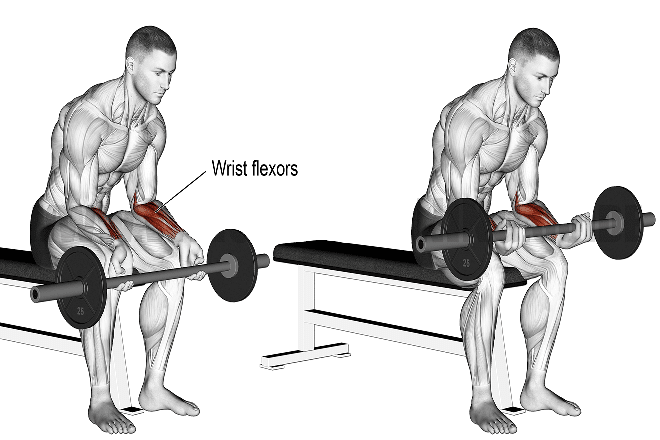
11. Barbell Wrist Curl
The wrist curl trains the wrist flexors on the palm side of your forearm. For other forearm work, see our grip strengthening exercises.
How to Do
- Sit on a bench and rest your forearms on your thighs with your palms facing up and your wrists just past your knees.
- Hold a light barbell underhand and let it lower by bending your wrists back, with control.
- Curl your wrists up, pause at the top, and lower slowly.
- Use a weight you can control through the full range of motion.
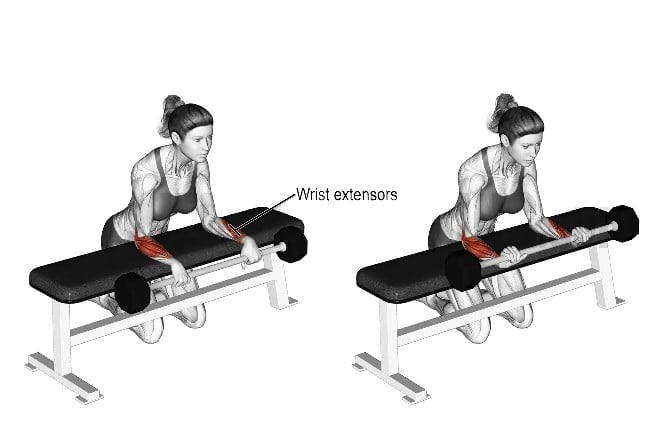
12. Barbell Reverse Wrist Curl Over Bench
This trains the wrist extensors on the back of your forearm. The brachioradialis is sometimes listed here, but it only crosses the elbow, not the wrist. For more ideas, see our barbell forearm exercises guide.
How to Do
- Kneel beside a bench and rest your forearms on it with your palms facing down and your hands past the edge.
- Hold a light barbell overhand and lower it by bending your wrists down, with control.
- Lift the bar by raising the backs of your hands toward your forearms, then lower slowly.
Tips
- Avoid momentum. Keep your forearms flat on the bench and let your wrists do the work.
Barbell Arm Workout Routine
Sets and Reps
I found no arm-specific research that sets rep and set targets. The 2026 ACSM position stand pooled 137 systematic reviews in healthy adults. Its findings are general, not arm-specific:
- Frequency: train all major muscle groups at least 2 days a week.
- Muscle size: more weekly volume helped, with at least 10 sets per muscle group per week doing better. I’m reading that as biceps and triceps counted separately, because the reviews don’t define it for arms. Light and heavy loads gave similar size gains, and so did training to failure or stopping short.
- Strength: heavier loads (80% of your one-rep max or more), 2 to 3 sets per session and a full range of motion worked best.
The routines below use 8 to 12 reps as a practical middle (my suggestion, not a study finding): heavy enough that the last reps are hard, light enough to keep good form. You don’t have to train to failure.
Barbell Arm Workout at Home
You don’t need a full gym, but you do need a few things:
- A barbell with plates and collars. An EZ bar is handy for exercises 7 and 8.
- A flat bench. An adjustable bench covers the incline exercises (5 and 8).
- A rack with safety arms, or a spotter, for the lying triceps extension and both bench presses. The bar moves over your face or chest (coaching advice, not from a study).
If you only have a barbell, plates and a flat bench, exercises 1, 7, 9, 11 and 12 need very little else.
Beginner Barbell Arm Workout
Here is a simple session (my suggestion, not from a study). Do it twice a week with a rest day or two between sessions. That adds up to 10 sets a week each for biceps and triceps.
| Exercise | Sets | Reps |
|---|---|---|
| Barbell curl | 3 | 8-12 |
| Lying barbell triceps extension | 3 | 8-12 |
| EZ bar curl | 2 | 8-12 |
| Overhead barbell triceps extension | 2 | 8-12 |
When you can finish every set at the top of the rep range with good form, add a little weight.
Intermediate Barbell Arm Workout
Once the beginner session feels easy, you could move to this one, again twice a week (my suggestion). That gives at least 12 sets a week each for biceps and triceps.
| Exercise | Sets | Reps |
|---|---|---|
| Barbell preacher curl | 3 | 8-12 |
| Barbell spider curl | 3 | 8-12 |
| Close-grip bench press | 3 | 8-10 |
| Incline barbell triceps extension | 3 | 10-12 |
| Barbell reverse curl | 2 | 8-10 |
These are examples, so swap in other exercises from this list. To train your forearms directly, add a wrist curl and a reverse wrist curl at the end.
Muscles of the Arm
Anatomy details below come from NCBI’s StatPearls anatomy pages.
Biceps Brachii
The biceps brachii has two heads at the shoulder, a short head and a long head, that join and attach to the radius in the forearm. It bends the elbow and turns the palm up (supination). See our guides to biceps exercises and long head biceps exercises.
Brachialis
The brachialis lies deeper than the biceps and bends the elbow whichever way your palm faces. It does not rotate the forearm. More in our brachialis exercises guide.
Brachioradialis
The brachioradialis is a forearm muscle that mainly bends the elbow, and it is active whether your palm faces up, down or sideways. It also helps bring the forearm back toward a thumbs-up position. It crosses only the elbow, not the wrist.

Triceps Brachii
The triceps brachii is the main elbow extensor, on the back of the upper arm. It has three heads: the long head, which starts on the shoulder blade, and the lateral head and medial head, which start on the upper arm bone. You will often see it called two thirds of your upper arm. I couldn’t find a primary source for that exact figure, so I don’t rely on it here.
Forearm Muscles
The forearm has two main groups for the wrist. The flexors, such as the flexor carpi radialis and flexor carpi ulnaris, sit on the palm side and bend the wrist. The extensors, such as the extensor carpi radialis longus, extensor carpi radialis brevis and extensor carpi ulnaris, sit on the back and extend it. Exercise 11 trains the flexors and exercise 12 the extensors. The pronator teres and supinator rotate the forearm. For bodyweight options, see bodyweight forearm exercises.
Barbell Arm Workout FAQs
Can you build bigger arms with just a barbell?
Yes. All 12 exercises here use a barbell, and between them they train your biceps, triceps and forearms. What matters is that you gradually increase the load or reps over time (progressive overload).
I found no study showing a barbell beats dumbbells or cables for arm size, so it is a loading and convenience choice, not a magic one.
How often should I train arms?
ACSM’s 2026 position stand says to train all major muscle groups at least 2 days a week. It also found size gains were similar for training 1 day a week versus more than 5 days a week when total weekly volume was equal. Two arm sessions a week is a practical starting point (my suggestion, not from a study).
Do I have to train to failure?
No. The same position stand found no consistent difference in size or strength gains between training to failure and stopping short. Pick a weight where the last reps are hard but your form holds.
Are barbells or dumbbells better for arms?
I found no study comparing them for arm size. In the small EMG study mentioned under exercise 7, EZ bar curls produced more biceps activity than dumbbell curls, but that measures muscle activity, not growth.
In practice, dumbbells let each arm work on its own and let your wrists turn freely, while a barbell lets you add weight in small steps. Our barbell vs dumbbell vs cable curl guide compares them, and using both is perfectly fine.

Manish is a NASM-certified fitness and nutrition coach with over 10 years of experience in weight lifting and fat loss fitness coaching. He specializes in gym-based training and has a lot of knowledge about exercise, lifting technique, biomechanics, and more.
Through “Fit Life Regime,” he generously shares the insights he’s gained over a decade in the field. His goal is to equip others with the knowledge to start their own fitness journey.