Machines make it easy to load your glutes without balancing a barbell or learning a technical lift. That is their real advantage. They are not automatically better than free weights, and a few machines people call “glute machines” train other muscles first.
This guide covers eight machines (counting the cable station and Smith machine as one), how to use each, and what the research does and doesn’t say. Where a study exists, I link it. Where only coaches describe a technique, I say so.
Updated November 2026.

- Glute Machines at a Glance
- Glute Anatomy in 30 Seconds
- Are Machines Good for Building Glutes?
- 8 Gym Machines for Glutes
- 1. Hip Thrust Machine
- 2. Glute Kickback Machine
- 3. Hip Abductor Machine
- 4. Leg Press
- 5. Reverse Hyperextension
- 6. 45-Degree Back Extension (Hyperextension Bench)
- 7. Glute-Ham Developer (GHD)
- 8. Cable Station and Smith Machine
- Sets, Reps and Progression
- Glute Machine FAQ
- What are the names of the glute machines at the gym?
- What is the best gym machine for glutes?
- What is the best machine for the gluteus medius?
- Are machines better than free weights for glutes?
- Which cardio machine is best for glutes?
- How often should I train glutes on machines?
- Related Guides
Glute Machines at a Glance
| Machine | Main muscles trained | Good to know |
|---|---|---|
| 1. Hip thrust machine | Gluteus maximus, hamstrings | The research is on the barbell hip thrust, not the machine |
| 2. Glute kickback machine | Gluteus maximus | One leg at a time. Glute activity similar to the leg press in one small study |
| 3. Hip abductor machine | Gluteus medius and minimus | Medius activity similar to clamshells, with a better medius-to-TFL ratio |
| 4. Leg press | Quads, glutes, hamstrings | Less glute activity than a squat. Feet high may help |
| 5. Reverse hyperextension | Gluteus maximus, hamstrings | Needs control. Mixed results against the back extension |
| 6. 45-degree back extension | Glutes, hamstrings, lower back | More glute activity than a seated back extension machine |
| 7. Glute-ham developer | Hamstrings first, glutes assist | Hard to do well. Mainly a hamstring exercise |
| 8. Cable station and Smith machine | Depends on the exercise | Pull-throughs, kickbacks and Smith hip thrusts |
Glute Anatomy in 30 Seconds
- Gluteus maximus: the largest and most superficial of the three. It extends the thigh (standing up from a chair, climbing stairs) and rotates it outward (StatPearls).
- Gluteus medius: sits under the maximus on the side of the hip. It moves the leg out to the side and keeps your pelvis level when you stand on one leg (StatPearls).
- Gluteus minimus: the smallest and deepest. It works with the medius (StatPearls).
That is why hip extension exercises (hip thrusts, kickbacks, back extensions) mainly train the maximus, while abduction exercises train the medius and minimus.

Are Machines Good for Building Glutes?
Yes, with caveats. Machines give you a fixed path, a pad to brace against and an easy way to add weight in small steps. That makes it easier to train hard with decent form, especially if you are new. What I couldn’t find is any study showing that machines build more glute muscle than free weights.
Here is what the research does show. In 13 trained women, the barbell hip thrust produced much higher gluteus maximus activity than the back squat at an estimated 10-rep max. A 2025 meta-analysis found that several hip extension exercises grew the gluteus maximus, including the barbell hip thrust, back squats, leg presses and kneeling hip extensions. It suggested prioritizing the barbell hip thrust if glute size is your main goal.
Two caveats. Muscle activity (EMG) is not the same as growth, and most of this research used free weights, not the machines below. So use machines where they make an exercise easier to do well and easier to progress.
You will often see the hip abductor and adductor machines side by side. Only the abductor is covered here. The adductor trains your inner thigh, not your glutes.
8 Gym Machines for Glutes
1. Hip Thrust Machine
Designs vary. Some have a loaded lever or belt across your hips, others use a weight stack. You lean back against a pad and push your hips up. Check the placard on your machine, because the setup differs from brand to brand.
It trains mainly the gluteus maximus, with the hamstrings helping. I found no study of hip thrust machines specifically. The barbell hip thrust research above is the closest evidence, and it is not confirmed for machines.
What a machine does change is practical: there is no barbell to roll into position, and a pad or belt can feel better across the hips than a bare bar.

How to Use the Hip Thrust Machine
- Adjust the machine so your upper back is supported and the pad or belt sits across your hips, not your stomach.
- Place your feet flat, about hip-width apart, far enough forward that your shins are roughly vertical at the top.
- Brace your core and push through your feet to lift your hips until your torso and thighs form a straight line.
- Squeeze your glutes at the top without arching your lower back, then lower slowly.
Foot position changes the exercise. In a small study of seven men, cueing the feet to rotate outward raised gluteus maximus activity during barbell hip thrusts, as noted in this review. Small foot adjustments are worth trying.
2. Glute Kickback Machine
You brace against pads and drive one leg back, so hip extension does the work. Designs differ: some have you standing, some leaning forward over a chest pad, some kneeling. It trains the gluteus maximus.
In a study of 15 trained men using a standing kickback machine, gluteus maximus activity was similar to the leg press, and the kickback gave higher hamstring (biceps femoris) activity. So it is a reasonable glute option, though it did not beat the leg press. The steps below are coaching advice. A cable with an ankle strap works the same way if your gym has no dedicated machine.

How to Use the Glute Kickback Machine
- Adjust the pads and footplate so you can brace with your hands or chest and your working foot sits flat on the pad.
- Keep your torso still and your working leg long, with only a slight bend in the knee.
- Drive your foot back until you feel the glute squeeze fully. Don’t arch your lower back to get extra height.
- Lower slowly, finish your reps, then switch legs.
3. Hip Abductor Machine
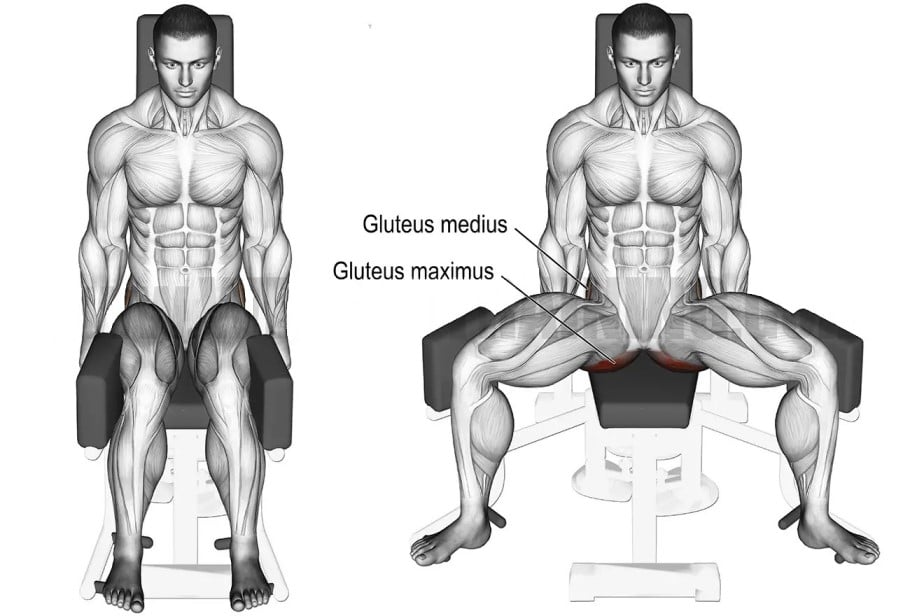
This is the machine to choose for the side of your hips. In a 2022 EMG study of 11 men, gluteus medius activity on the hip abductor machine was similar to clamshells and side-lying hip abduction.
The machine had the best ratio of gluteus medius to tensor fasciae latae (TFL, a hip muscle at the front and side of the hip) activity, so it is a good pick if you want to hit the medius while limiting the TFL. The study measured muscle activity, not growth. For a full guide, see our hip abduction machine article.
How to Use the Hip Abductor Machine
- Sit with your back against the pad, feet on the footrests, and the pads against the outside of your thighs or knees (check which your machine uses).
- Push your legs apart in a smooth, controlled motion.
- Pause briefly at the widest point, then bring the pads back together slowly instead of letting the stack drop.
4. Leg Press
The leg press is a quad-heavy machine, but it also trains the glutes, and it takes very little skill to learn. Two findings are worth knowing. In a small ACE-commissioned study of 12 people, squats produced more gluteus maximus activity than horizontal and vertical leg presses.
And in a study of 14 women, gluteus maximus activity was higher with the feet high on the platform than low. It is one small study, so treat feet-high as a sensible option rather than a rule.
In the 2025 meta-analysis above, most of the leg press trials found the gluteus maximus grew, but one did not reach significance. More detail is in our leg press for glutes guide.
How to Do the Leg Press for Glutes
- Sit with your back and hips flat against the pad. Place your feet high on the platform, about hip-width or a little wider.
- Release the safeties and lower the platform until your knees are bent to about 90 degrees, or stop earlier if your hips start to lift or tuck off the seat.
- Press through your whole foot without locking your knees hard at the top.
5. Reverse Hyperextension
On a reverse hyper, your upper body stays fixed and your legs do the moving. You swing them up by extending your hips, which works the glutes and hamstrings. Research on its glute activity is small and mixed. In a study of 10 people, the reverse hyper produced higher gluteus maximus activity than the 45-degree back extension, but in a study of 20 people the back extension produced more. In another study of 20 people, glute activity was higher at a load equal to bodyweight than at half bodyweight, with few differences at 1.5 times bodyweight. The steps below are coaching advice.
The common mistakes are swinging and using your lower back to lift your legs. One coach (Squat University) warns that letting the lower back move can load the spine in a way that may aggravate back pain in some people, so stop if it irritates yours.

How to Do the Reverse Hyperextension
- Lie face down with your hips just past the edge of the pad so your legs can swing freely. Hold the handles.
- If your machine has a lever with ankle pads, secure your ankles. Otherwise let your legs hang and use only your body weight to begin with.
- Brace your core, then lift your legs by squeezing your glutes until they are in line with your torso. Going higher mostly shifts the work to your lower back.
- Pause, then lower your legs slowly.
6. 45-Degree Back Extension (Hyperextension Bench)
This is the opposite of the reverse hyper: your legs are fixed and your torso moves. Done as a hip hinge, it trains the glutes, hamstrings and lower back.
In a study of 15 resistance-trained women, the 45-degree bench activated the gluteus maximus more than a seated back extension machine, about as much as a Romanian deadlift, and it gave the highest hamstring activity of the three. The point is to hinge at the hips, not to bend through your lower back.

How to Do the 45-Degree Back Extension
- Set the pad just below your hips so you can fold at the hips. Secure your feet on the platform.
- Cross your arms over your chest and keep your body in a straight line from head to heels.
- Hinge forward at the hips with a flat back until you feel a stretch in your hamstrings.
- Squeeze your glutes to return until your body is in line again. Don’t lean back past that point.
7. Glute-Ham Developer (GHD)
The glute-ham raise is mainly a hamstring exercise. In a study of 12 men, hamstring activity was highest in the glute-ham raise and the Romanian deadlift.
The glutes help extend the hip, but I found no study ranking it as a glute exercise, so use it as a hamstring and posterior chain move that also involves the glutes. It is hard, and it is easy to do badly, so don’t start here if you are a beginner. For more hamstring options, see our guide to gym machines for hamstrings.

How to Do the Glute-Ham Raise
- Set the footplate and pad so your feet are braced against the plate and your knees sit just behind the pad.
- Start upright with your body straight from knees to head and your arms across your chest.
- Lower your body forward by straightening your knees until your torso is roughly parallel to the floor.
- Pull yourself back up by squeezing your glutes and hamstrings, extending your hips and bending your knees. If full reps are too hard, push off the floor or a bench in front of you with your hands (a common coaching tip).
8. Cable Station and Smith Machine
These are not glute-specific machines, but they cover two useful exercises: the cable pull-through and the Smith machine hip thrust. The cable station also gives you ankle-strap kickbacks and hip abduction. For more cable ideas, see our cable machine exercises guide.
How to Do the Cable Pull-Through
A hip hinge that works the glutes and hamstrings. It looks odd the first time because the rope runs between your legs, but the setup is simple.

- Attach a rope to a low pulley. Stand facing away from the machine with the rope between your legs and hold it with both hands.
- Walk forward until the cable is under tension and set your feet about shoulder-width apart, with a slight bend in your knees.
- Push your hips back and let your torso lean forward with a flat back until you feel a stretch in your hamstrings.
- Drive your hips forward to stand tall and squeeze your glutes at the top. Keep your arms straight so your hips, not your arms, move the weight.
How to Do the Smith Machine Hip Thrust
The fixed bar path means you don’t have to balance the weight. Use a bar pad, and see our full Smith machine hip thrust guide for details.
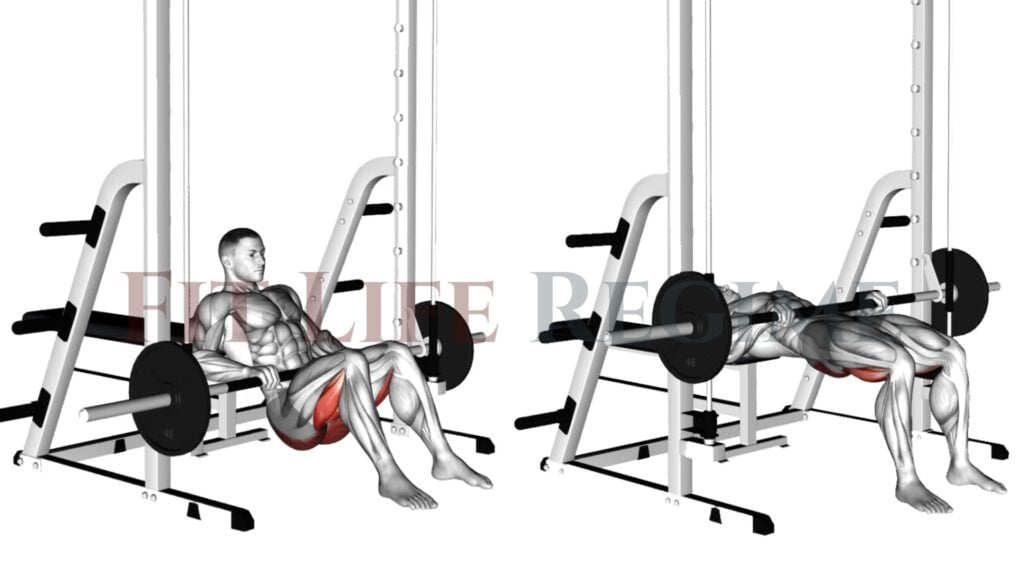
- Place a bench behind you and set the bar low enough to roll over your hips while you sit on the floor.
- Sit with your upper back against the edge of the bench, the bar across your hips, and your feet flat on the floor, about shoulder-width apart.
- Rotate the hooks to unrack the bar, then drive through your feet to lift your hips until your torso is parallel to the floor.
- Lower under control. When you finish, rotate the hooks to rack the bar before you move.
Sets, Reps and Progression
I found no study that gives set and rep targets for these specific machines. The American College of Sports Medicine (ACSM) published an updated resistance training position stand in 2026, replacing its 2009 one. It reviewed 137 systematic reviews in healthy adults. The findings below are general, not glute-specific:
- Frequency: train all major muscle groups at least 2 days a week. This is for your whole body, not glutes alone.
- Muscle size: more weekly volume helped, with at least 10 sets per muscle group per week. The reviews did not test this for glutes specifically. Light and heavy loads gave similar size gains, and so did training to failure or stopping short.
- Strength: heavier loads (80% of your one-rep max or more), 2 to 3 sets per session, and a full range of motion worked best.
- Equipment: free weights versus machines made no consistent difference to strength gains.
As a starting point (my suggestion, not from a study), you could try this session and add weight when you reach the top of the rep range on every set:
| Exercise | Sets and reps |
|---|---|
| Hip thrust machine or Smith hip thrust | 3 sets of 8 to 12 |
| Leg press, feet high | 3 sets of 8 to 12 |
| 45-degree back extension | 2 sets of 8 to 12 |
| Hip abductor machine | 2 sets of 8 to 12 |
Glute Machine FAQ
What are the names of the glute machines at the gym?
The common ones are the hip thrust machine, glute kickback machine, hip abductor machine, leg press, reverse hyperextension, 45-degree back extension (hyperextension bench) and glute-ham developer. The cable station and Smith machine are also used for glute exercises. Names vary between brands, so ask staff if you can’t find one.
What is the best gym machine for glutes?
No study ranks them. The strongest evidence is for the barbell hip thrust, which suggests the hip thrust machine or Smith hip thrust is a good place to start, though that has not been tested on machines directly. Pick one you can load progressively with good form.
What is the best machine for the gluteus medius?
The hip abductor machine. It gave similar gluteus medius activity to clamshells and side-lying abduction, and a better medius-to-TFL ratio (see machine 3).
Are machines better than free weights for glutes?
I found no study showing that for glutes. ACSM’s 2026 position stand found no consistent difference in strength gains between free weights and machines. In the glute research above, the barbell hip thrust beat the squat for gluteus maximus activity, and several free-weight and machine exercises grew the muscle. Use machines where they help you train with good form, and free weights where you can.
Which cardio machine is best for glutes?
In a small conference abstract of eight adults, recumbent cycling produced the least gluteal muscle activity, and jogging and the elliptical produced the most.
In another abstract of 20 people testing the ArcTrainer, stair stepper and treadmill, the authors concluded the gluteus maximus did not get enough load to produce a strengthening effect. Both are short abstracts, so treat them as hints. Cardio machines are a bonus, not your main glute builder.
How often should I train glutes on machines?
ACSM’s 2026 position stand says to train all major muscle groups at least 2 days a week, and that is for your whole body. I found no study on glute-specific frequency.
It did find that size gains were similar for training 1 day a week versus more than 5 days a week when total weekly volume was equal, so spread your sets however you can recover from and keep up. One or two glute sessions a week is a reasonable starting point (my suggestion, not from a study).
Related Guides
- 10 Best Resistance Band Glute Exercises
- 10 Best Gym Machines To Build Bigger Legs
- Best Gym Machines For Beginners

Manish is a NASM-certified fitness and nutrition coach with over 10 years of experience in weight lifting and fat loss fitness coaching. He specializes in gym-based training and has a lot of knowledge about exercise, lifting technique, biomechanics, and more.
Through “Fit Life Regime,” he generously shares the insights he’s gained over a decade in the field. His goal is to equip others with the knowledge to start their own fitness journey.
At least half of these machines, maybe more are not at my gym, which gyms have these machines?