The landmine squat is a squat where you hold the free end of an anchored barbell against your chest. Because the other end is pinned, the bar swings in a fixed arc and you lean slightly into it as you go down.
Only one lab study I could find has tested it directly, so this guide keeps what was measured separate from what is just reasonable to expect.

- The Short Version
- What Is a Landmine Squat?
- Landmine Squat Muscles Worked
- What the research measured
- What is reasonable to expect (not measured)
- Benefits and Limitations
- What it has going for it
- What to keep in mind
- How to Do a Landmine Squat
- Set up the bar
- The squat
- Form notes
- Common mistakes
- How Much Weight Should You Use?
- Landmine Squat vs Goblet Squat vs Hack Squat Machine
- Landmine Squat Variations
- 1. Landmine Sumo Squat
- 2. Landmine Hack Squat (Reverse Landmine Squat)
- 3. Landmine Split Squat (Single-Leg Variation)
- Related Movement: Landmine Squat to Press
- Landmine Squat Alternatives
- FAQs
- Are landmine squats good for beginners?
- Are landmine squats easier on the knees or back?
- Do landmine squats work the glutes?
- Do I need a landmine attachment?
The Short Version
- Measured: the quadriceps work at about 70% of their maximum voluntary activation in the landmine squat. At the same bar load, that was lower than in a goblet squat (about 84% to 89%), and the vertical force on the lifter was lower too.
- Not measured: glutes, adductors, trunk muscles, and knee or back loads. Anything said about those is an inference.
- How it fits: a guided, chest-loaded squat option. No study I found compares it with heavier squats such as the back squat.
What Is a Landmine Squat?
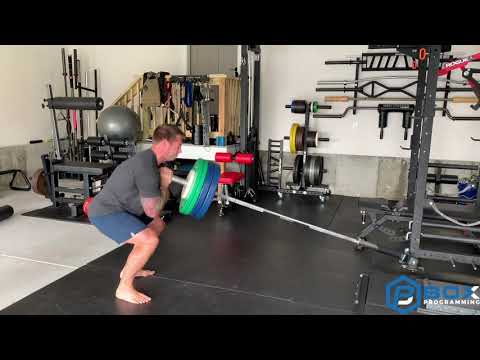
One end of a barbell sits in a landmine attachment, a floor pivot, or a padded corner. You stand at the loose end, hold it against your chest the way you would hold a goblet squat, and squat while the bar swings around the anchor.
The authors of the main study (Collins et al., 2021) say the arc makes you settle backward, and they suggest this may help people learning squat progressions. That is their idea, not something they tested.

Landmine Squat Muscles Worked
What the research measured
Collins et al. (2021) had 32 healthy, recreationally active adults (16 men, 16 women, aged 18 to 30) do goblet squats and landmine squats to parallel depth. Both used the same total load, set at 30% of each person’s body mass.
The researchers recorded muscle activity at the thigh (as a percentage of each person’s maximal voluntary contraction) and the forces through the feet.
- Quadriceps: about 70% (vastus medialis) and 71% (vastus lateralis) in the landmine squat, versus about 84% and 89% in the goblet squat.
- Hamstrings: low in both squats. The semitendinosus was lower in the landmine squat (about 11.5% versus 15.4%); the biceps femoris was not significantly different.
- Forces: peak vertical force was lower in the landmine squat (about 13.2 versus 14.9 N/kg of body mass). There was also more backward-directed horizontal force at the start of the descent (about 1.5 versus 0.2 N/kg), which the authors link to the forward lean.
The authors suggest the landmine squat may suit situations that call for a more balanced quad-to-hamstring response, and that the goblet squat may suit a focus on quad development.
They did not measure the glutes, adductors, trunk muscles, or knee and hip joint loads. It is one session in young, healthy people at a light load, so treat it as a starting point.
What is reasonable to expect (not measured)
- Glutes and hip extensors: any squat to depth uses them. A related study (Lynn and Noffal, 2012) had people swing dumbbells out in front of them during a squat. That counterbalanced squat produced more glute activity and less quadriceps activity than a regular squat. The landmine squat also loads you out in front, so a similar hip-biased effect is plausible, but it has not been tested.
- Core, spinal erectors, and upper back: they have to hold your torso steady against the bar. This follows from the position and was not measured.
- Adductors and calves: assist the hips and ankles in any squat.

Benefits and Limitations
What it has going for it
- A guided bar path. The anchor decides where the bar goes, so there is less to balance than with a free weight.
- Lower vertical force at the same bar load. That is what Collins et al. measured. It does not tell us anything about knee or back loads, so it cannot show the exercise is easier on them.
- Possibly more loading than a goblet squat. Because the anchor carries part of the bar’s weight, the authors suggest you may be able to hold more. They did not test that.
- Minimal equipment. One barbell and an attachment or a padded corner is enough.
What to keep in mind
- Less quad activation than a goblet squat at the same bar load. Muscle activity is not the same as muscle growth, so this does not prove the goblet squat builds more muscle. It does mean the landmine squat is not an obvious pick if quad work is your priority.
- The forward lean is part of the movement. It is not a perfectly upright squat.
- You still have to hold the bar. The Collins authors note that arm strength can limit how much you can hold in front-loaded squats.
- Thin evidence. Claims about injury prevention, knee health, or long-term muscle gain from the landmine squat specifically have not been tested.
Know More: 20 Best Landmine Exercises For Building Muscle And Strength
How to Do a Landmine Squat
Set up the bar
- Put one end of the barbell in a landmine attachment. No attachment? Wedge the end into a corner with a towel or pad around it, and check it cannot slide before you add plates.
- Start with the bar alone or very light plates on the free end.
- Stand at the loose end with your feet about shoulder-width apart. In the study, the lifters placed their toes about an inch past the free end of the bar when it rested on the floor. Use that as a starting point and adjust so the bar clears your legs.
The squat
- Lift the free end to your chest and hold it with both hands, elbows in close.
- Brace your midsection and breathe in as you start down.
- Bend your knees and send your hips back and down, leaning slightly into the bar. Keep the bar against your chest.
- Lower until your thighs are about parallel to the floor, or as deep as you can go with your heels down and your spine neutral.
- Push through your whole foot to stand, breathing out as you rise.
Form notes
- Breathing: the old rule is to breathe in as you lower and out as you stand. An NSCA excerpt from the book Developing the Core points out that real breathing under load rarely follows such a neat pattern, and says coaches should have athletes breathe freely while keeping the core braced (NSCA). The same source says holding your breath against a closed airway (the Valsalva maneuver) can help spinal stability in maximal lifts for healthy people, but not for people with conditions such as high blood pressure. If that applies to you, check with your doctor before lifting heavy.
- Depth: the study had lifters go to parallel. NSCA technique guidance describes the same target and notes that your flexibility decides how deep you can actually go.
- Knees and toes: some technique guides say to keep your knees behind your toes. A small study of seven weight-trained men (barbell squat) found that forcing this lowered knee torque (about 150 to 117 N·m) but raised hip torque from about 28 to 303 N·m and increased forward lean. The authors concluded that good joint loading may require the knees to move slightly past the toes (Fry et al., 2003). So do not force a vertical shin; just keep your heels down.
Common mistakes
- Heels lifting. Sit back and keep your whole foot on the floor. If your heels still lift, stop at a depth where they stay down.
- Folding over the bar. A slight lean is part of the movement. If your chest collapses or your back rounds, the weight is too heavy.
- Letting the bar drift away from your chest. Keep your elbows in and the bar close.
- Knees caving in. Push them out in line with your toes.
- Judging the weight by the plates. See the next section.
How Much Weight Should You Use?
The weight in your hands is not the plate total. The anchor carries part of the load, and the share you hold changes as the bar rises and falls.
The Collins authors describe it as lighter near the top and heavier as the bar lowers, though they call this an observation and did not measure how much the anchor carries. It also depends on the bar angle, which changes with your height and where you stand.
That means there is no reliable way to convert a landmine squat weight into a goblet or back squat weight. Instead, write down your setup (bar, plates, where you stand) and progress on that same setup, adding reps first and then small amounts of weight.
I did not find sets-and-reps research specific to the landmine squat. For general guidance, the American College of Sports Medicine’s 2026 position stand reviewed 137 systematic reviews and found that few training variables mattered much for muscle size. Higher volumes (10 or more sets per week) and eccentric overload enhanced muscle growth, and training to failure did not consistently change results.
Read More: 15 Best Leg Exercises And Workout For Muscle & Strength
Landmine Squat vs Goblet Squat vs Hack Squat Machine
| Feature | Landmine Squat | Goblet Squat | Hack Squat Machine |
|---|---|---|---|
| Equipment | Barbell plus an attachment or corner | One dumbbell or kettlebell | A specific machine, less common in home gyms |
| Path of the weight | Fixed arc around the anchor | Free | Fixed by the machine |
| Quadriceps activity | Lower than goblet at the same load (Collins et al.) | Higher than landmine at the same load (Collins et al.) | Not compared with the landmine squat in the research I found |
| What limits the weight | What you can hold at your chest, with the anchor carrying part of the load | What you can hold at your chest | The machine supports the weight, so holding it is not the limit |
Landmine Squat Variations
None of these have been studied on their own, so I will not claim they hit specific muscles harder. They are simply different ways to set up the same movement.
1. Landmine Sumo Squat
A wider stance with the toes turned out. Some people find it more comfortable if a shoulder-width stance feels cramped at the hips.
A review of loaded back squat research found that stance width and hip rotation did not significantly change muscle activation (Clark et al., 2012), and it has not been tested in the landmine squat, so treat this as a comfort option.

- Set your feet wider than shoulder-width, toes turned out as far as is comfortable.
- Hold the free end of the bar with both hands, at your chest or low in front of your hips, whichever keeps the bar close to you.
- Keep your chest tall and your knees tracking over your toes as you squat to about parallel.
- Push through your feet to stand.
2. Landmine Hack Squat (Reverse Landmine Squat)
You face away from the anchor and rest the free end of the bar on one shoulder. Some guides use it as a stand-in for a hack squat machine, but it is a different movement, and I found no research on it. Pad the bar, because it can dig into your shoulder as the weight goes up.

- Anchor one end of the bar and load the other end lightly.
- Face away from the anchor and rest the free end on one shoulder, holding it with one or both hands.
- Squat down with your chest up, your back neutral, and your heels on the floor.
- Stand up, and switch shoulders between sets.
Keep your core braced and your knees in line with your toes. For more barbell leg options, see these barbell leg exercises.
3. Landmine Split Squat (Single-Leg Variation)
One foot forward, the other behind, with the bar held in front of you. Each leg takes a larger share of the load, which is why people use it for one-leg-at-a-time work.
It is often called a single-leg landmine squat, but the back foot stays on the floor, so it is not a true single-leg squat.
- Hold the free end of the bar at your chest with both hands, or in one hand at shoulder height.
- Step one foot back into a staggered stance, back heel raised and front foot flat.
- Lower straight down until your front thigh is about parallel to the floor.
- Push through the front foot to stand. Finish your reps, then switch legs.
Keep your front knee in line with your toes and most of the work in the front leg. See also the barbell reverse lunge.
Related Movement: Landmine Squat to Press
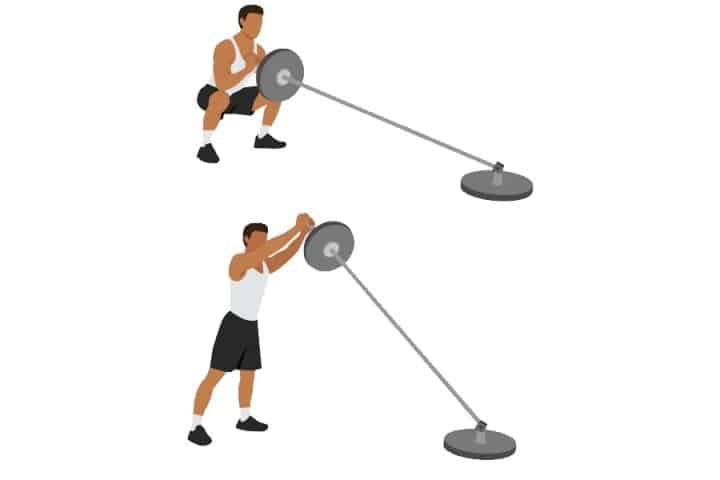
The squat to press (often called a thruster) is a squat followed by a press as you stand. It is a squat-and-press combination rather than a squat variation, and the press brings in the shoulders and triceps. Since you have to press the weight, you will likely use less than you do for a plain squat.
For more on pressing, see the landmine press guide and the full list of landmine exercises.
Landmine Squat Alternatives
- Goblet squat: the closest alternative, and the one with higher quad activity in the study.
- Back squat or front squat: when you want to load the squat with more weight than you can hold in front of you.
- Hack squat machine: a fixed path with the weight supported by the machine.
- Bulgarian split squat, lunges, and step-ups: for working one leg at a time.
- Leg press: a supported option when balance is a limit.
- Box squat: gives you a target for depth.
- Zercher squat: a barbell held in the crook of the elbows.
- No barbell? Try these bodyweight quad exercises.
If you like the landmine setup but want a hip hinge instead of a squat, try the landmine deadlift.
FAQs
Are landmine squats good for beginners?
Possibly. There is no research on beginners, since the study used recreationally active young adults. The Collins authors suggest the arc may help people learn squat progressions, and the guided path does mean one less thing to balance. Start with the bar alone and focus on bracing, keeping your heels down, and leaning slightly into the bar.
Are landmine squats easier on the knees or back?
Nobody has measured it. The lab study found lower vertical force than the goblet squat at the same bar load, but it did not measure knee or back loads. If you have pain or an injury, check with a clinician before changing your squat.
Do landmine squats work the glutes?
Squatting to depth uses the glutes, and the front-loaded position makes a hip-biased effect plausible (see the counterbalanced squat study above). But glute activity has not been measured in the landmine squat, so how it compares with other squats is unknown.
Do I need a landmine attachment?
No. A barbell wedged into a padded corner works, as long as it cannot slide. An attachment is quicker to set up, protects your walls and floor, and lets the bar pivot freely.
References
- Collins KS, Klawitter LA, Waldera RW, Mahoney SJ, Christensen BK. Differences in muscle activity and kinetics between the goblet squat and landmine squat in men and women. J Strength Cond Res. 2021;35(10):2661-2668. PubMed
- Lynn SK, Noffal GJ. Lower extremity biomechanics during a regular and counterbalanced squat. J Strength Cond Res. 2012;26(9):2417-2425. PubMed
- Fry AC, Smith JC, Schilling BK. Effect of knee position on hip and knee torques during the barbell squat. J Strength Cond Res. 2003;17(4):629-633. PubMed
- Clark DR, Lambert MI, Hunter AM. Muscle activation in the loaded free barbell squat: a brief review. J Strength Cond Res. 2012;26(4):1169-1178. PubMed
- Currier BS, D’Souza AC, Singh MAF, et al. American College of Sports Medicine Position Stand. Resistance training prescription for muscle function, hypertrophy, and physical performance in healthy adults: an overview of reviews. Med Sci Sports Exerc. 2026;58(4):851-872. PubMed
- NSCA. Anatomical Core: Neural Integration (excerpt from Developing the Core, Kinetic Select, June 2017). nsca.com. Also NSCA Strength and Conditioning Journal, October 2011: Exercise Technique: Dumbbell Squat, Dumbbell Split Squat, and Barbell Box Step-up (journal page).

Manish is a NASM-certified fitness and nutrition coach with over 10 years of experience in weight lifting and fat loss fitness coaching. He specializes in gym-based training and has a lot of knowledge about exercise, lifting technique, biomechanics, and more.
Through “Fit Life Regime,” he generously shares the insights he’s gained over a decade in the field. His goal is to equip others with the knowledge to start their own fitness journey.