
Leg Press Weight Calculator
Calculate effective weight, convert plates, and estimate your 1RM based on machine angle and physics
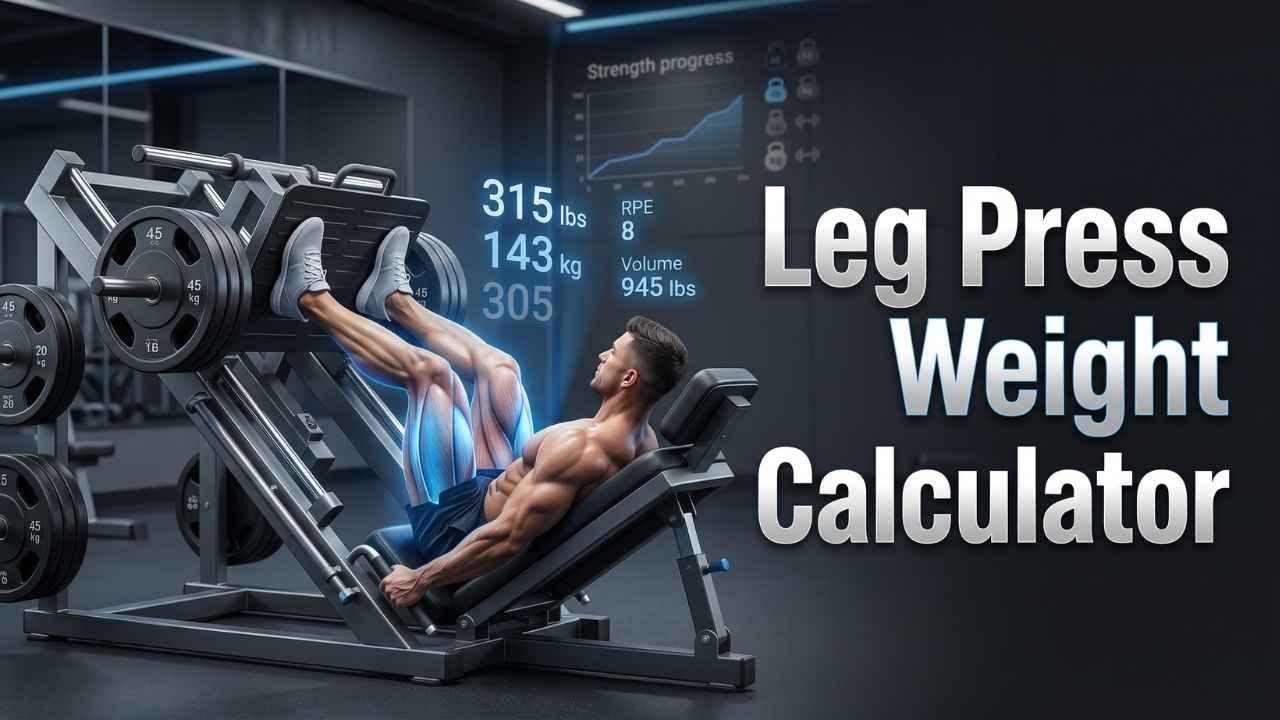
Understanding Leg Press Effective Weight
The leg press machine uses an inclined sled that reduces the effective weight you lift compared to free-weight exercises like squats. This happens because gravity pulls straight down, but the sled moves at an angle. The steeper the angle, the more weight you actually lift.
Understanding this relationship helps you accurately compare leg press performance to other exercises and set appropriate training loads. For example, pressing 400 lbs on a 45° leg press equals roughly 283 lbs of effective weight—much closer to what you might squat. Learn more about leg machines.
Why Does Machine Angle Matter?
On an inclined leg press, only a portion of the loaded weight works against gravity in the direction of movement. A 45° machine means you’re pushing against about 70.7% of the loaded weight. A vertical (90°) leg press makes you lift 100% of the weight—the same as a squat.
This is why leg press numbers are typically much higher than squat numbers. Someone who squats 300 lbs might leg press 500+ lbs on a standard 45° machine. The calculator accounts for these physics to give you accurate comparisons for your leg training program.
The Physics Formula
Effective Weight by Machine Angle
| Machine Angle | Sin Value | % of Loaded Weight | Example (500 lbs loaded) | Common Machine Type |
|---|---|---|---|---|
| 30° | 0.500 | 50.0% | 250 lbs effective | Low-angle leg press |
| 45° | 0.707 | 70.7% | 354 lbs effective | Standard 45° sled |
| 50° | 0.766 | 76.6% | 383 lbs effective | Some commercial models |
| 55° | 0.819 | 81.9% | 410 lbs effective | Steeper angle machines |
| 60° | 0.866 | 86.6% | 433 lbs effective | High-angle leg press |
| 90° | 1.000 | 100.0% | 500 lbs effective | Vertical leg press |
Note: Most commercial gyms use 45° leg press machines. Always check your machine’s angle for accurate calculations. Some machines also have a weighted sled (typically 45-125 lbs) that adds to the total load.
Leg Press vs. Squat Comparison
🦵 Why Leg Press Numbers Are Higher
Reduced Effective Load: At 45°, you lift only ~71% of loaded weight
Stable Position: Back support removes balance requirements
Shortened Range: Many people use partial range of motion
No Core Demand: Machine handles stabilization
A general rule: Your leg press should be roughly 1.5-2× your squat weight when comparing
effective loads. If you squat 300 lbs, expect to leg press 450-600 lbs on a 45° machine.
📊 Converting Between Exercises
Leg Press to Squat Estimate:
Squat ≈ Leg Press Effective Weight × 0.6-0.8
Example: 500 lbs on 45° leg press = 354 lbs effective
Estimated squat: 354 × 0.7 = ~248 lbs
This accounts for the stability, balance, and core demands that squats require but leg press doesn’t.
Use these estimates for programming your
barbell leg workouts.
Training Tips for Leg Press
✅ Proper Form Guidelines
Foot Placement: Shoulder-width apart, toes slightly outward
Back Position: Keep lower back pressed against pad throughout
Knee Tracking: Knees should follow toe direction, not cave inward
Range of Motion: Lower until thighs are parallel or slightly below
Don’t Lock Out: Keep slight bend at top to maintain tension
Proper form ensures maximum muscle engagement and reduces strain on joints.
Learn about leg press for glutes.
🎯 Programming Recommendations
Strength (3-6 reps): 80-90% of 1RM, 3-5 sets
Hypertrophy (8-12 reps): 65-80% of 1RM, 3-4 sets
Endurance (15-20 reps): 50-65% of 1RM, 2-3 sets
Use the 1RM calculator above to determine your working weights.
Combine leg press with dumbbell leg exercises
for complete development.
Frequently Asked Questions
How much does the leg press sled weigh?
Most leg press sleds weigh between 45-125 lbs (20-57 kg), depending on the manufacturer and model. Commercial gym sleds typically weigh 75-100 lbs. Check with your gym or the machine’s specifications. This weight should be added to your plate total for accurate calculations.
Why can I leg press so much more than I squat?
Three main reasons: (1) The inclined angle reduces effective weight by 25-50%, (2) the machine provides stability so you don’t need to balance, and (3) your core doesn’t have to work to stabilize the load. It’s normal to leg press 1.5-3× your squat weight.
Is leg press effective for building muscle?
Yes, leg press is excellent for building quadriceps, glutes, and hamstring mass. The stable position allows you to safely push heavier loads and achieve high training volumes. It’s particularly useful for targeting specific leg muscles through foot placement variations.
What angle is best for leg press?
The standard 45° angle offers a good balance of safety and effectiveness. Steeper angles (60-90°) increase difficulty and more closely mimic squat mechanics. Lower angles (30°) reduce stress but also reduce training stimulus. Choose based on your goals and any joint considerations.
How accurate is the 1RM estimation?
1RM formulas are most accurate with 1-10 rep sets, typically within 5-10% of actual max. Higher rep sets (15+) become less reliable. The Epley and Brzycki formulas are well-validated for strength training purposes. Always test actual 1RM with proper warm-up and spotters.
⚠️ Important Notice
This calculator provides estimates based on physics principles and established strength training formulas. Actual effective weight may vary based on machine friction, sled weight, and individual biomechanics. Always warm up properly before heavy lifting and use appropriate safety measures. Consult with fitness professionals for personalized training advice. These calculations are for general fitness and educational purposes only.

Manish is a NASM-certified fitness and nutrition coach with over 10 years of experience in weight lifting and fat loss fitness coaching. He specializes in gym-based training and has a lot of knowledge about exercise, lifting technique, biomechanics, and more.
Through “Fit Life Regime,” he generously shares the insights he’s gained over a decade in the field. His goal is to equip others with the knowledge to start their own fitness journey.