
The one arm cable row, also called the single-arm cable row, is a back exercise where you pull a single handle toward your ribs with one arm at a time.
It mainly works your latissimus dorsi (lats), the muscles around your shoulder blades such as the middle and lower trapezius and rhomboids, and your rear deltoids, with your biceps and forearm muscles helping bend the elbow.
Rowing one side at a time also changes what your trunk has to do because the cable pulls you off-centre.
This guide covers the muscles worked, step-by-step form for the seated version, whether to keep your shoulder blade fixed or moving, five variations, and how to set your sets and reps. If you prefer to train both arms together, see the two-arm cable row.

- One Arm Cable Row Muscles Worked
- Lats, Traps, Rhomboids and Rear Delts
- Biceps, Brachialis and Forearms
- Trunk Muscles: Why One Arm Is Different
- How To Do the Seated One-Arm Cable Row
- Form Tips and Common Mistakes
- One Arm Cable Row Variations
- 1. Kneeling One-Arm Cable Row (Half-Kneeling)
- 2. Standing Low-Pulley One-Arm Cable Row
- 3. Standing High-Pulley One-Arm Cable Row
- 4. Standing Twisting One-Arm Cable Row
- 5. Seated Twisting One-Arm Cable Row (on the Floor)
- Which Version Should You Choose?
- One Arm Cable Row vs Free-Weight Row
- Sets and Reps for the One Arm Cable Row
- One Arm Cable Row FAQ
- What muscles does the one-arm cable row work?
- Is the one-arm cable row better than the two-arm row?
- Can the one-arm cable row fix muscle imbalances?
- Is the one-arm cable row safe for a bad back?
- References
One Arm Cable Row Muscles Worked
The row is a compound movement: your shoulder, shoulder blade and elbow all move, so several muscles share the work.
A 2026 review of electromyography (EMG) research describes the seated row as a pulling exercise for the lats, trapezius and posterior deltoid (Di Fonza et al., 2026).
Lats, Traps, Rhomboids and Rear Delts
The lats pull your upper arm down and back. The middle and lower trapezius and the rhomboids pull your shoulder blade toward your spine, and the rear deltoid helps swing the arm backward.
The infraspinatus, teres major and teres minor, smaller muscles around the shoulder blade and upper arm, also contribute, as the muscle diagram below shows.
In one lab test, researchers recorded activity from the upper, middle and lower trapezius, lats, posterior deltoid, biceps, triceps and erector spinae during a seated row (Padovan et al., 2025). For more exercises aimed at these muscles, see the guides to lat exercises and rhomboid exercises.
Biceps, Brachialis and Forearms
Bending your elbow as you pull uses the biceps brachii, the brachialis underneath it and the brachioradialis in your forearm. If your arms tire before your back does, try driving the elbow back instead of curling the handle toward you.
Trunk Muscles: Why One Arm Is Different
Researchers compared a bent-over free-weight row, a seated cable row and a machine row, each done with one arm and with both arms at matched effort in 15 resistance-trained men.
All three rows worked the external obliques (the muscles on the sides of your waist) much harder when done one-handed: in two-arm rows, oblique activity was only 37% to 41% of the one-arm value.
The erector spinae and multifidus along the spine worked less in one-arm cable and machine rows, at about 60% to 63% and 74% to 78% of the two-arm values (Saeterbakken et al., 2015).
In practice, the one arm cable row adds work for the sides of your waist that a two-arm row does not, while asking somewhat less of your lower back muscles.

How To Do the Seated One-Arm Cable Row
An article in ACSM’s Health & Fitness Journal describes the seated cable row as a basic multijoint exercise for the back, the muscles behind the shoulder and the elbow flexors (Ronai, 2019).
- Attach a single D-handle to the low pulley of a seated cable row station and choose a light weight to start.
- Sit with your feet on the foot plates, knees slightly bent and your torso upright. Rest your free hand on your thigh.
- Hold the handle with a neutral grip (palm facing inward) and straighten your arm so the handle sits between knee and shoulder height.
- Exhale and pull the handle toward your lower ribs or upper abdomen by driving your elbow back and drawing your shoulder blade toward your spine. Take about 1 to 2 seconds.
- Pause for about 1 second with the handle at your side.
- Straighten your arm slowly and fully, then repeat. Finish all reps on one side before switching.

Form Tips and Common Mistakes
- Keep your torso still: the common errors in the seated cable row are jerking the handle back with momentum from your torso and lower back, leaning forward or backward, and rounding the upper back. If you have to swing to move the weight, it is too heavy.
- Sit tall with a neutral spine: keep your chest up and your head in line with your spine, with hips and knees slightly bent.
- Stop the elbow at your ribs: the upper arm should not travel behind the back of your rib cage, which places extra stress on the front of the shoulder joint.
- Do not shrug: keep your shoulder down and away from your ear so the pull comes from your back, not your neck and upper traps.
- Resist the twist: a one-arm cable pulls one side of your body forward, so brace your abs and keep your shoulders square to the machine.
- Finish with a full stretch: straighten the arm at the end of each rep rather than stopping short.
- Exhale on the pull: do not hold your breath while pulling or pausing.
One Arm Cable Row Variations
The variations below change your body position or the pulley height. They train the same muscles, but each changes how you stay balanced, so pick the one that suits the equipment and space you have.
1. Kneeling One-Arm Cable Row (Half-Kneeling)
Kneeling on one knee takes the bench and foot plates out of the picture, so there is nothing to brace against. It is a good way to practice staying tall without leaning.
- Set the pulley at a medium to high height and attach a single handle.
- Kneel on one knee with the other foot flat on the floor, facing the machine a few feet away.
- Hold the handle in one hand with your palm facing in and straighten your arm.
- Pull the handle toward your waist, keeping your elbow close to your side, and squeeze your shoulder blade back at the end.
- Lower the handle slowly until your arm is straight.

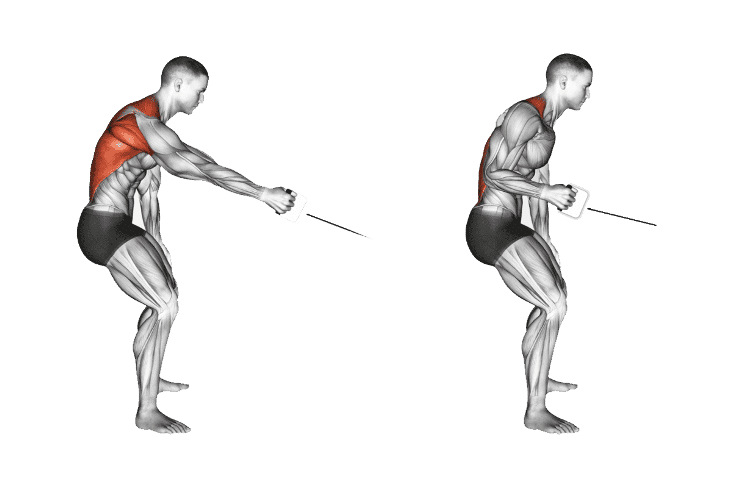
2. Standing Low-Pulley One-Arm Cable Row
With the pulley set low, you pull from the floor up toward your ribs, so the handle travels along a low-to-high line. You stand, so your legs and hips hold the position while your back does the pulling. If you also train with both hands on a single bar, see the low cable row.
- Attach a single handle to the low pulley and take a step back so the cable is under tension.
- Stand with your feet about shoulder-width apart, knees bent and hips pushed back slightly. Rest your free hand on your thigh.
- Pull the handle toward your upper abdomen, keeping your elbow close to your body.
- Lower the handle slowly until your arm is straight.
- Complete all reps on one side, then switch.
3. Standing High-Pulley One-Arm Cable Row
With the pulley set around head height or higher, you start with your arm reaching up and forward and pull the handle down and back toward your ribs.
The staggered stance helps you stay balanced as the cable pulls from above. You can find more cable back exercises in the cable back workout guide.
- Attach a single handle to a high pulley and take a step back.
- Stand in a staggered stance with knees slightly bent, and reach the handle arm up and forward.
- Pull the handle down and back toward your waist, turning your torso slightly to the same side as you pull.
- Pause for a moment, then return slowly to the start.
- Complete all reps on one side, then switch.

4. Standing Twisting One-Arm Cable Row
This version adds a deliberate turn of your torso as you pull. Because your trunk is moving as well as your arm, use a lighter weight than you would for a strict row and control the rotation on the way back.
- Attach a single handle to a pulley at about chest height or slightly higher.
- Hold the handle with your right hand and step forward with your right foot into a staggered stance, with your elbow close to your side.
- Pull the handle toward your lower chest or ribs and turn your torso to the right.
- Return to the start slowly, then switch sides.

5. Seated Twisting One-Arm Cable Row (on the Floor)
Sitting on the floor with your legs out front gives you a stable base while you add the same torso turn. Keep the load light and keep your lower back long.
- Attach a single handle to a low pulley and sit on the floor with your legs extended straight out in front of you.
- Sit tall with your back long and hold the handle in one hand.
- Pull the handle toward your torso, turning slightly toward the working side.
- Return to the start slowly, keeping your back long, then switch sides.

Which Version Should You Choose?
| Version | Position | What holds you steady | Notes |
|---|---|---|---|
| Seated one-arm row | Seated, feet on foot plates | Bench and foot plates | Closest to the seated cable row in the ACSM article |
| Kneeling one-arm row | Half-kneeling | Your legs and hips, with no bench | Nothing to brace against, so stay tall |
| Standing low-pulley row | Standing, slight hip hinge | Your legs and hips | Needs no seat, and works when the seated station is taken |
| Standing high-pulley row | Staggered stance | Your legs and hips | Angled pull from above |
| Twisting rows (standing or seated on the floor) | Staggered stance or sitting on the floor | Varies | Your torso moves, so use lighter loads |
If you’re new to rowing, start with the seated version. Add the others once you can keep your torso still through every rep.
One Arm Cable Row vs Free-Weight Row
In the same EMG comparison above, one-arm cable and machine rows produced about 50% to 57% of the external oblique activity and 70% to 73% of the multifidus activity of the free-weight row (Saeterbakken et al., 2015).
So the free-weight row asked more of those trunk muscles than the cable row did, which has a more stable seated base. If you want more trunk demand, a free-weight option such as the one-arm dumbbell row fits better. If you want a simple seated set-up with an easily adjusted load, choose the cable row. You can also use both.
Sets and Reps for the One Arm Cable Row
The American College of Sports Medicine’s 2026 position stand reviewed the resistance training research (Currier et al., 2026). What it found depends on your goal:
- Strength: heavier loads (80% of your one-rep max or more), a full range of motion, 2 to 3 sets, early in the session, and at least 2 sessions a week produced more strength.
- Muscle size: at least 10 sets per muscle group per week produced more growth than lower volumes. Light and heavy loads (about 30% to 100% of your one-rep max) gave similar growth, and training to failure was not necessary.
A practical starting point is 3 sets of 8 to 12 reps per arm, twice a week, with a weight that lets you stop a rep or two before your form breaks. Do the same number of reps on both sides, and start with your weaker side if one feels clearly weaker. For the 10-set weekly target, count your other back work too, such as pulldowns and rows. The pulley exercise guide and the cable machine exercise guide have more options.
One Arm Cable Row FAQ
What muscles does the one-arm cable row work?
The lats, middle and lower trapezius, rhomboids and rear deltoids do most of the pulling, with the biceps, brachialis and forearm muscles helping at the elbow. One-armed rows also work the external obliques and the muscles along your spine.
Is the one-arm cable row better than the two-arm row?
Neither is clearly better, but they differ. In the EMG comparison, one-arm rows worked the external obliques much harder, while two-arm rows worked the erector spinae and multifidus more. If you want side-of-the-waist work, one arm fits well. If you want more load on the spinal muscles, the two-arm row does that better.
Can the one-arm cable row fix muscle imbalances?
It lets you train each side on its own and see whether one side is weaker, which a two-arm row can hide. It does not guarantee that the sides become equal, and small differences between sides are normal. Match the reps on both sides, and let the weaker side set the weight if you cannot match the stronger one.
Is the one-arm cable row safe for a bad back?
The Health & Fitness Journal article on the seated cable row notes that it uses a three-point base (feet on the plates and your hips on the bench), which is thought to put less compression and shear load on parts of the lumbar spine than a barbell row.
However, it advises that people with a history of back pain consider an alternative exercise (Ronai), 2019). It also mentions the chest-supported seated machine row as a lower-load option. If you have ongoing back pain, check with a physiotherapist or doctor before adding rows.
References
- Currier BS, D’Souza AC, Singh MAF, et al. American College of Sports Medicine Position Stand. Resistance training prescription for muscle function, hypertrophy, and physical performance in healthy adults: an overview of reviews. Med Sci Sports Exerc. 2026;58(4):851-872. PubMed
- Di Fonza D, Di Claudio G, Colantuono G, et al. Electromyographic analysis of latissimus dorsi activation during common resistance training exercises: a narrative review. J Funct Morphol Kinesiol. 2026;11(3). PubMed
- Padovan R, Ce E, Longo S, et al. High-density surface electromyography excitation of prime movers across scapular positions in the seated row. J Funct Morphol Kinesiol. 2025;11(1):6. PubMed
- Ronai P. Do it right: the seated cable row exercise. ACSMs Health Fit J. 2019;23(4):32-37. DOI
- Saeterbakken A, Andersen V, Brudeseth A, Lund H, Fimland MS. The effect of performing bi- and unilateral row exercises on core muscle activation. Int J Sports Med. 2015;36(11):900-905. PubMed

Manish is a NASM-certified fitness and nutrition coach with over 10 years of experience in weight lifting and fat loss fitness coaching. He specializes in gym-based training and has a lot of knowledge about exercise, lifting technique, biomechanics, and more.
Through “Fit Life Regime,” he generously shares the insights he’s gained over a decade in the field. His goal is to equip others with the knowledge to start their own fitness journey.
Hi
The images and ther descriptions don’t match. 😉