
A pulley system is the cable setup behind most gym machines: a weight stack, a cable running over one or more pulleys, and an attachment you hold.
Because you can move the pulley up or down and swap the attachment, one station can train your chest, back, shoulders, arms, legs and core. In the gym people call the same setup a cable machine, and the cable machine exercise guide has the longer list.
The small over-the-door pulleys used in shoulder rehabilitation are a different tool and are not covered here.

- Pulley System Setup: Heights, Attachments and Home Options
- Pulley Height
- Attachments
- Home Options
- How Cables Compare With Machines
- 12 Pulley System Exercises
- 1. Standing Cable Chest Press
- 2. Cable Crossover
- 3. Cable Shoulder Press
- 4. One-Arm Cable Lateral Raise
- 5. Single-Arm Cable Front Raise
- 6. Cable Face Pull
- 7. Lat Pulldown
- 8. Straight-Arm Lat Pulldown
- 9. Triceps Pushdown
- 10. Cable Biceps Curl
- 11. Cable Squat
- 12. Pallof Press
- Why There Is No Cable Upright Row Here
- Sets and Reps for Pulley Exercises
- Pulley System Workout Routines
- Beginner Full-Body Routine
- Upper-Body Routine
- Pulley System Exercise FAQ
- Can you do a full-body workout on a pulley system?
- What is the difference between a pulley system and a cable machine?
- Are pulley exercises better than free weights?
- How much weight should I start with?
- Can you do pulley exercises at home?
- References
Pulley System Setup: Heights, Attachments and Home Options
Pulley Height
The pulley height decides the direction the cable pulls on your arm, so it changes which way you push or pull against the weight. These settings are standard gym practice:
- Low pulley (near the floor): curls, front raises, lateral raises, shoulder presses and squats.
- Mid pulley (around chest height): chest presses, rows and the Pallof press.
- High pulley (above your head): pulldowns, triceps pushdowns, crossovers and face pulls.
Attachments
- Straight bar: pushdowns, curls and straight-arm pulldowns.
- Rope: pushdowns, face pulls and straight-arm pulldowns where you want your hands to come apart.
- Long lat bar: lat pulldowns.
- Single handle: one-arm presses, raises and rows.
Researchers who compared a standard handle with two ball-handle set-ups in the triceps pushdown found similar triceps activity with each, although forearm muscle activity differed (Rendos et al., 2016). So pick the attachment that feels best on your wrists.
Home Options
A home pulley system can be a dual adjustable pulley (often sold as a functional trainer) with two independent cables, a single-stack cable station, or a cable attachment fitted to a power rack.
Two independent cables let each arm work on its own, which suits crossovers and presses. A single stack usually takes less space, but you work one pulley position at a time. Before you buy, check how high and low the pulleys go and the maximum weight the stack allows.
How Cables Compare With Machines
In a lab comparison of cable and selectorized machines, the cable machine allowed a greater range of motion overall. I
t also produced higher activity in some muscles, such as the biceps, front shoulder and external obliques during the chest press (Signorile et al., 2017).
The study had 15 participants and compared cables with machines, not with barbells or dumbbells.
12 Pulley System Exercises
1. Standing Cable Chest Press
Standing means your legs and trunk have to hold you steady while your arms press, which is the main difference from a seated chest press machine.
The cable chest press was one of the exercises in the cable versus machine comparison above. The cable chest guide and the upper chest cable exercises have more variations.

- Set both pulleys to about chest height and hold a handle in each hand. Step forward into a split stance with your back to the stack.
- Start with your hands beside your chest and your elbows slightly below shoulder height.
- Press the handles forward until your arms are straight, without leaning forward.
- Bring the handles back slowly to the start.
2. Cable Crossover
In a dumbbell fly, the load fades as your arms come together over your chest. With cables, the resistance follows the cable, so you can keep tension on your chest at the end of the move.
The cable crossover guide and the cable fly guide cover variations.

- Set both pulleys high and hold a handle in each hand. Stand in a split stance with a slight forward lean.
- Start with your arms out to the sides and a slight bend in your elbows.
- Sweep your hands down and together in front of your hips, keeping the elbow bend the same.
- Open your arms again until you feel a stretch across your chest.
3. Cable Shoulder Press
With the pulleys low, the cable pulls down and back toward the stack, so you press up and slightly forward against it.
In the cable versus machine comparison, the cable overhead press produced higher biceps and external oblique activity than the selectorized shoulder press. The cable shoulder guide covers more shoulder exercises.

- Set both pulleys low and hold a handle in each hand at shoulder height, palms facing forward or in. Sit on a bench or stand in a split stance, facing away from the stack.
- Brace your core and keep your ribs down.
- Press the handles up until your arms are straight above your shoulders.
- Lower them under control back to shoulder height.
4. One-Arm Cable Lateral Raise
The side of the shoulder (the lateral deltoid) raises your arm out to the side. A dumbbell lateral raise is easiest at the bottom of the lift, but a low pulley pulls across your body so the muscle works from the first inch.
The one-arm cable lateral raise guide has more detail.

- Set the pulley low and stand side-on to the stack. Hold the handle with the hand farthest from the stack, so the cable crosses in front of your body.
- Keep your elbow slightly bent and your wrist in line with your forearm.
- Raise your arm out to the side until your hand is about shoulder height.
- Lower slowly, then repeat before switching sides.
5. Single-Arm Cable Front Raise
The front raise works the front of the shoulder, and doing it one arm at a time lets you watch each side separately. See the front deltoid guide for alternatives.

- Set the pulley low and face away from the stack, holding the handle in one hand between your legs or at your side.
- Stand tall with your ribs down and your elbow slightly bent.
- Raise your arm straight in front of you to shoulder height.
- Lower slowly without leaning back.
6. Cable Face Pull
The face pull pulls the rope toward your face with your elbows high, and it is mostly used to train the rear shoulders and upper back. Use a light weight and slow control.
A heavy yank turns it into a lean-back. The rear delt cable fly guide covers a similar movement.

- Set a rope attachment on a high pulley, around face height or a little above, and step back until the weight is lifted.
- Hold the rope with your palms facing each other and your arms straight in front of you.
- Pull the rope toward your face, with your elbows high and out to the sides, until your hands are beside your ears.
- Pause briefly, then return slowly to straight arms.
7. Lat Pulldown
The lat pulldown trains the lats, the muscles that pull your arm down toward your body. In a lab comparison of four grips, an overhand (pronated) grip produced more lat activity than an underhand grip, whether the grip was wide or narrow (Lusk et al., 2010).
A 2026 review reached a similar conclusion about the bar path: pulling the bar down in front of your face was the setup most consistently linked with higher lat activity, while grip width was inconsistent (Di Fonza et al., 2026). The lat pulldown guide has more form detail.
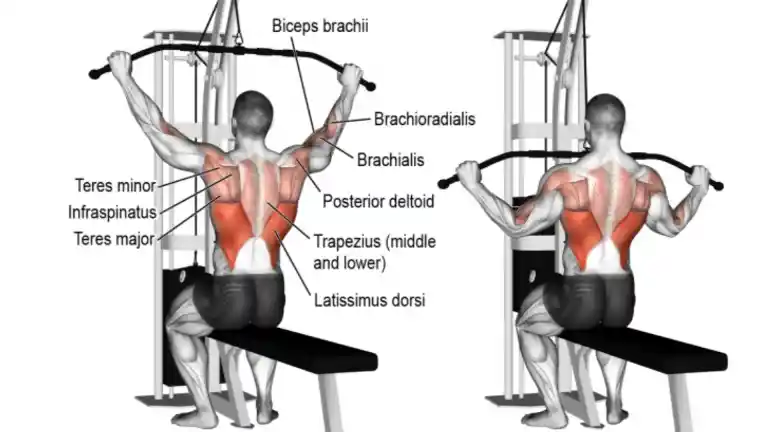
- Attach a long bar to a high pulley. Sit with your thighs under the pad and take an overhand grip a little wider than your shoulders.
- Lean back slightly and look straight ahead.
- Pull the bar down in front of your face to your upper chest, driving your elbows down toward your sides.
- Let the bar rise slowly until your arms are straight again.
8. Straight-Arm Lat Pulldown
Your elbows stay nearly straight, so this is mostly a shoulder movement: the lats pull your arm down and back, and your elbows do very little.
The 2026 EMG review lists shoulder extension as one of the lats’ main jobs (Di Fonza et al., 2026). The cable back guide has more back exercises.
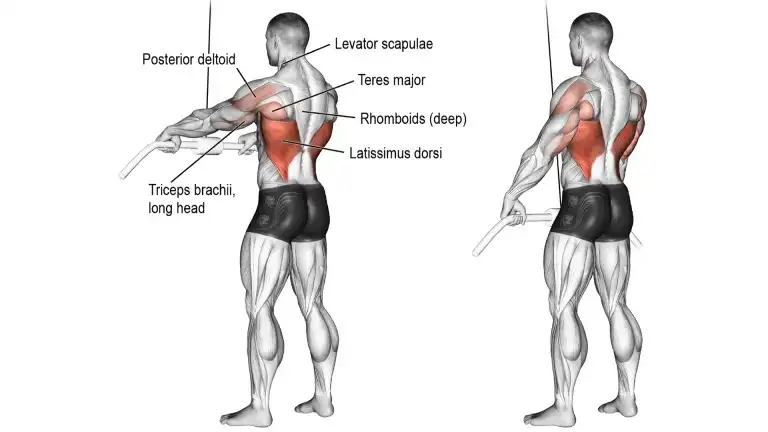
- Attach a straight bar or rope to a high pulley and stand facing the stack, a step or two back.
- Hold the attachment with your arms straight in front of you and hinge forward slightly at your hips.
- Keeping your elbows nearly straight, sweep the attachment down to your thighs.
- Let your arms rise slowly back to the start, until you feel your lats stretch.
9. Triceps Pushdown
The pushdown straightens your elbow against the cable, which is the triceps’ job. Use whichever bar or rope is comfortable on your wrists, and keep your upper arms still so the triceps do the work.
The triceps pushdown guide and the cable triceps exercises have more detail.

- Attach a bar or rope to a high pulley and stand close to the stack with your feet hip-width apart.
- Hold the attachment at chest height with your elbows pinned to your sides.
- Push the attachment down until your arms are straight, keeping your upper arms still.
- Let your hands rise slowly until your forearms are just past level.
10. Cable Biceps Curl
With a low pulley, the cable still pulls on your forearm at the bottom of the curl, where a dumbbell puts little load on the biceps. That is the practical difference.
In one small comparison of 11 people, a dumbbell curl produced higher biceps activity than a Bayesian cable curl (a cable curl performed with the arm behind the body) when each was lifted at 80% of its own one-rep max (Parpa et al., 2025).
Treat cables and dumbbells as two useful options. The biceps cable guide has more curl variations.

- Attach a straight bar or rope to a low pulley and stand facing the stack with your feet hip-width apart.
- Hold the attachment with your arms down and your elbows by your sides.
- Curl the attachment up toward your shoulders without moving your elbows forward.
- Lower slowly until your arms are straight.
11. Cable Squat
The cable squat is a light leg exercise. It is easy to set up, but you are limited by how much weight you can hold in front of your chest.
That weight also makes you sit back as you squat, which is a good cue. For heavy leg work, pair it with a barbell squat or leg press from the leg exercise guide, or see the cable leg guide.

- Attach a rope or handle to a low pulley and stand facing the stack, a step or two back. Hold the attachment against your chest with both hands.
- Stand with your feet about shoulder-width apart and your toes slightly out.
- Sit your hips back and down until your thighs are about parallel to the floor, keeping your chest up.
- Push through your whole foot to stand up.
12. Pallof Press
The Pallof press is an anti-rotation exercise: the cable tries to twist your torso toward the stack, and your trunk muscles work to keep you facing forward. The abs and oblique cable guide has more core exercises.

- Set a handle on a mid pulley and stand side-on to the stack, a step or two away. Hold the handle with both hands at your chest.
- Stand with your feet hip-width apart and your knees slightly bent.
- Press the handle straight out in front of you until your arms are straight, and hold for a second or two without turning toward the stack.
- Bring the handle back to your chest and repeat, then switch sides.
Why There Is No Cable Upright Row Here
The cable upright row is a common pulley exercise, but it asks you to lift your arms above shoulder height while they are rotated inward.
A strength and conditioning journal article on the exercise says that this position may contribute to subacromial impingement. It suggests lifting only to just below shoulder height if your shoulders are healthy and staying in a pain-free range if you have shoulder pain (Schoenfeld et al., 2011).
If you want to do it, the cable upright row guide explains the form, and the face pull above is a simpler way to train the upper back and rear shoulders.
Sets and Reps for Pulley Exercises
The American College of Sports Medicine’s 2026 position stand reviewed the resistance-training research (Currier et al., 2026). For muscle growth it reported that:
- At least 10 sets per muscle group per week produced more growth than lower volumes.
- Light and heavy loads (30% to 100% of your one-rep max) produced similar growth, and training to failure was not necessary.
- Training a muscle once a week or more than five times a week gave similar growth when weekly volume was equal.
Within that range, 8 to 15 reps per set is a practical choice for cable work, because the weight is easy to adjust between sets. When you can finish every set at the top of the range with controlled form, move the pin to the next heavier plate.
Pulley System Workout Routines
Beginner Full-Body Routine
Do this twice a week with at least a day between sessions. It gives you about 6 sets a week for your back and chest. That is below the 10-set figure above, so add a set or two to the main exercises over a few weeks.
| Exercise | Sets | Reps |
|---|---|---|
| Lat pulldown | 3 | 8-12 |
| Standing cable chest press | 3 | 8-12 |
| Cable shoulder press | 2 | 10-12 |
| Cable face pull | 2 | 12-15 |
| Triceps pushdown | 2 | 10-15 |
| Cable biceps curl | 2 | 10-15 |
| Cable squat | 2 | 10-15 |
Upper-Body Routine
Do this twice a week, with a day or two between sessions. Chest and lats each get 10 sets a week, in line with the position stand figure.
| Exercise | Sets | Reps |
|---|---|---|
| Lat pulldown | 3 | 8-12 |
| Standing cable chest press | 3 | 8-12 |
| Cable crossover | 2 | 10-15 |
| Straight-arm lat pulldown | 2 | 10-15 |
| One-arm cable lateral raise | 3 | 12-15 per side |
| Cable face pull | 2 | 12-15 |
| Triceps pushdown | 3 | 10-15 |
| Cable biceps curl | 3 | 10-15 |
To train your core and legs, add the Pallof press (2 to 3 sets of 10 per side) and the cable squat (2 to 3 sets of 10 to 15) to either session.
Pulley System Exercise FAQ
Can you do a full-body workout on a pulley system?
Yes. The 12 exercises above cover your chest, back, shoulders, arms, legs and core. The main limit is leg work, because heavy squats and deadlifts need more load than many cable stacks give, so add a barbell or machine for your legs if you want to train them hard.
What is the difference between a pulley system and a cable machine?
In practice, people use the two terms for the same gym setup: a weight stack with cables and adjustable pulleys. Some home equipment is also sold as a pulley system, such as wall-mounted or rack-mounted cables with a small weight stack.
Are pulley exercises better than free weights?
Neither is clearly better. Researchers have compared cables with selectorized machines and with dumbbells, and the results differ by exercise and by muscle, as the biceps curl and chest press examples above show. The practical difference is that cables let you change the direction of the resistance by moving the pulley.
How much weight should I start with?
Start with a weight you can lift for the whole rep range with steady form, where the last few reps are hard but your body position does not change.
Can you do pulley exercises at home?
Yes, with a home dual-pulley station, a single-stack cable station or a rack-mounted cable attachment, and the same exercises and routines apply. Check the pulley heights and maximum weight before you buy.
References
- Currier BS, D’Souza AC, Singh MAF, et al. American College of Sports Medicine Position Stand. Resistance training prescription for muscle function, hypertrophy, and physical performance in healthy adults: an overview of reviews. Med Sci Sports Exerc. 2026;58(4):851-872. PubMed
- Di Fonza D, Di Claudio G, Colantuono G, et al. Electromyographic analysis of latissimus dorsi activation during common resistance training exercises: a narrative review. J Funct Morphol Kinesiol. 2026;11(3):315. PubMed
- Lusk SJ, Hale BD, Russell DM. Grip width and forearm orientation effects on muscle activity during the lat pull-down. J Strength Cond Res. 2010;24(7):1895-1900. PubMed
- Parpa K, Vasiliou A, Michaelides M, et al. An exploratory study of biceps brachii electromyographic activity during traditional dumbbell versus Bayesian cable curls. Muscles. 2025;4(4):45. PubMed
- Rendos NK, Heredia Vargas HM, Alipio TC, et al. Differences in muscle activity during cable resistance training are influenced by variations in handle types. J Strength Cond Res. 2016;30(7):2001-2009. PubMed
- Schoenfeld B, Kolber MJ, Haimes JE. The upright row: implications for preventing subacromial impingement. Strength Cond J. 2011;33(5):25-28. DOI
- Signorile JF, Rendos NK, Heredia Vargas HH, et al. Differences in muscle activation and kinematics between cable-based and selectorized weight training. J Strength Cond Res. 2017;31(2):313-322. PubMed

Manish is a NASM-certified fitness and nutrition coach with over 10 years of experience in weight lifting and fat loss fitness coaching. He specializes in gym-based training and has a lot of knowledge about exercise, lifting technique, biomechanics, and more.
Through “Fit Life Regime,” he generously shares the insights he’s gained over a decade in the field. His goal is to equip others with the knowledge to start their own fitness journey.