Upper-body machines are an easy place to start lifting. The seat and the fixed path decide how the weight moves, so you can concentrate on pushing or pulling hard.
Below are the eight machines you’re most likely to see in a gym: what each one is called, what it works, how to set it up and use it, and a simple two-day plan that ties them together.

- Upper Body Machines at a Glance
- Are Machines Good Enough for Upper Body Muscle?
- 8 Gym Machines for Your Upper Body and How to Use Them
- 1. Chest Press Machine
- 2. Shoulder Press Machine
- 3. Lat Pulldown Machine
- 4. Seated Row Machine
- 5. Pec Deck (Chest Fly) and Reverse Pec Deck
- 6. Assisted Pull-Up or Dip Machine
- 7. Preacher Curl Machine
- 8. Triceps Extension or Dip Machine
- Other Options: Smith Machine and Cable Exercises
- Smith Machine Presses and Rows
- Cable Machine Exercises
- Which Upper Body Machine Should You Start With?
- A Simple Two-Day Upper Body Machine Plan
- Upper Body Machine FAQs
- Which machine works the most upper-body muscles?
- Are machines as good as free weights for upper body?
- Which upper body machine is best for beginners?
- How many upper body machines should I use per workout?
- How often should I train my upper body on machines?
- Research Papers Referenced in This Guide
Upper Body Machines at a Glance
| Machine | Main muscles | Good to know |
|---|---|---|
| 1. Chest press machine | Chest, front shoulders, triceps | Stable path, easy to push hard |
| 2. Shoulder press machine | Shoulders, triceps | Seat height sets your start position |
| 3. Lat pulldown machine | Lats, biceps | A good step toward pull-ups |
| 4. Seated row machine | Mid-back, lats, rear shoulders | Chest pad supports your torso |
| 5. Pec deck (and reverse pec deck) | Chest, or rear shoulders and upper back | One machine, two jobs on many models |
| 6. Assisted pull-up or dip machine | Lats, biceps (dips: chest, triceps) | The stack takes weight off you |
| 7. Preacher curl machine | Biceps, brachialis | Pad keeps your upper arms still |
| 8. Triceps extension or dip machine | Triceps | Arms stay in front of or beside you |
Names vary by brand, so the machine in your gym may be labelled differently.
If you’re unsure what you’re looking at, check the muscle diagram on the machine or our gym machine names with images guide.
Are Machines Good Enough for Upper Body Muscle?
Yes. A 2023 meta-analysis pooled 13 trials and 1,016 adults who trained for at least six weeks with free weights or machines. Five of those trials measured muscle growth, and it didn’t differ between the two.
Strength gains were tied to the equipment people trained on: free-weight training improved free-weight tests more, and machine training tended to improve machine tests more (Haugen 2023). The 2026 ACSM position stand on resistance training reached a similar view, finding that equipment type did not consistently affect results (Currier 2026).
In practice, the best machine is the one you can load progressively and keep using. The chest press section below covers one difference between machines and free weights that’s worth knowing.
8 Gym Machines for Your Upper Body and How to Use Them
A quick note before the machines. Apart from the studies cited below, I couldn’t find trials comparing these machines head to head, so the setup steps, sets and reps are standard coaching practice rather than study results. Start light, learn the movement, then add weight in small steps.
1. Chest Press Machine
You sit with your back on a pad and push two handles forward, working your chest, front shoulders and triceps. The machine guides the weight, so you generally don’t need a spotter and can push a set hard.
The machine isn’t identical to a barbell bench, though. In a lab study, 10 competitive bodybuilders did a chest press machine and flat, incline and decline bench presses at 80% of their one-rep max while the researchers recorded muscle electrical activity.
The machine worked the main (sternocostal) part of the chest about as much as the flat bench. It excited the upper (clavicular) chest less than the other lifts, the triceps less than the flat and decline benches, and the side shoulders less than all three bench presses (Coratella 2020).
That’s activity over a few reps, not growth, but it’s a fair reason to add a free-weight or Smith machine press if you want more triceps and shoulder work.

How to Use the Chest Press Machine
- Set the seat so the handles line up with the middle of your chest. Sit back with your feet flat on the floor.
- Hold the handles and pull your shoulder blades back and down against the pad.
- Press the handles forward until your arms are almost straight, without snapping your elbows into lockout.
- Return slowly until you feel a stretch across your chest, keeping your shoulders on the pad.
More chest options are in our chest exercises list.
2. Shoulder Press Machine
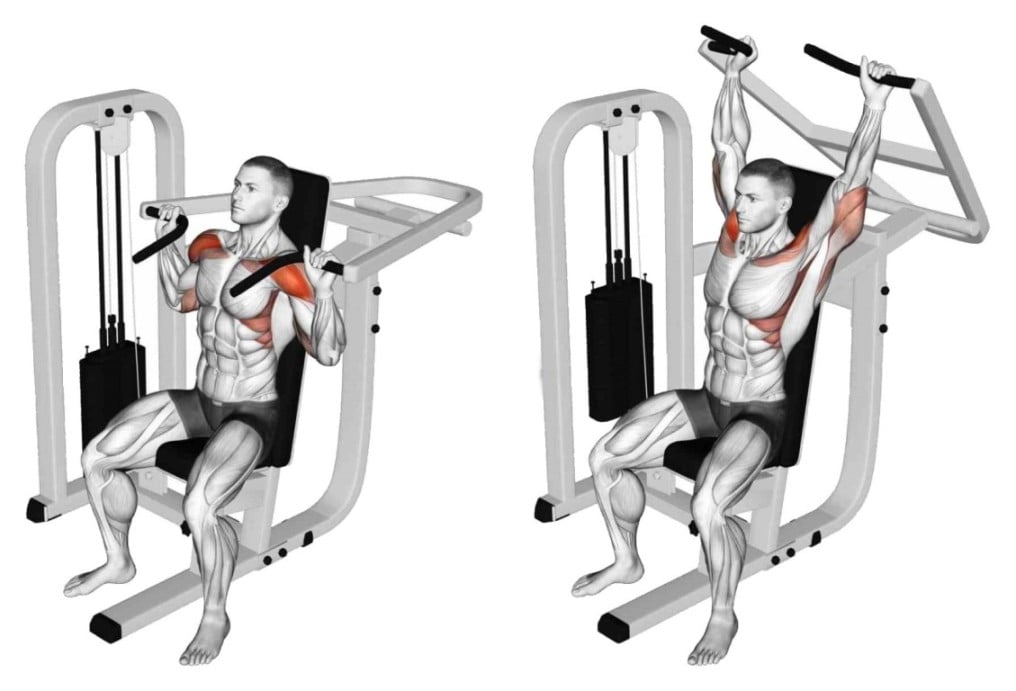
You press two handles overhead from a seated position. It works mostly your shoulders and triceps, and the back pad stops you leaning back to cheat the weight up. Think of it as the stable, easy-to-load version of a dumbbell or barbell shoulder press.
How to Use the Shoulder Press Machine
- Adjust the seat so the handles start at about shoulder height, with your forearms roughly vertical.
- Sit with your back flat on the pad and your feet planted.
- Press up until your arms are nearly straight, keeping your ribs down rather than arching your lower back.
- Lower under control until the handles are back at shoulder height.
If the starting position pinches your shoulders, lower the seat or choose the neutral-grip handles if your machine has them. For more shoulder work, see our delt exercises and Smith machine shoulder exercises.
3. Lat Pulldown Machine
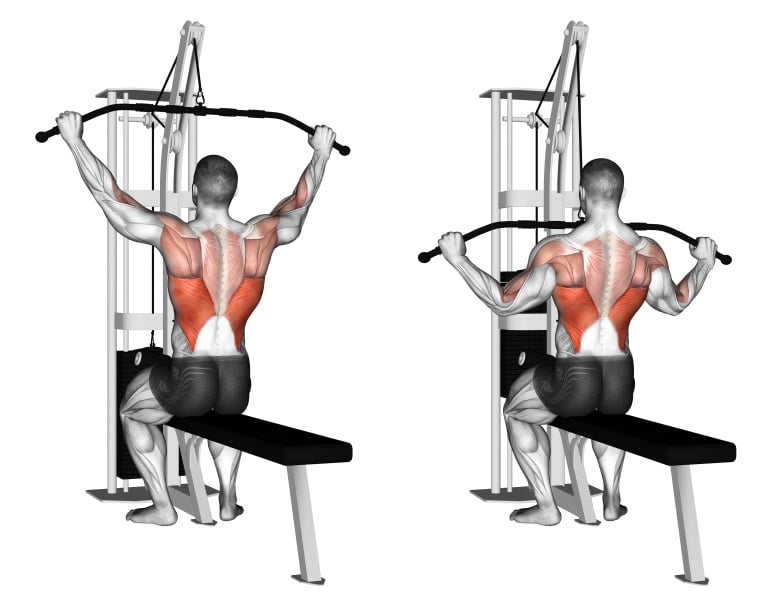
You sit under a high pulley and pull a bar down to your upper chest. It works your lats and biceps, and it’s the usual stepping stone toward pull-ups.
Grip width gets a lot of attention, but the research doesn’t show a big difference. In a study of 15 men, overall lat activity was similar with grips 1, 1.5 and 2 times shoulder width, though they could lift slightly less with the widest grip (77 kg versus about 80 kg for six reps).
The authors suggested anything from 1 to 2 times shoulder width should give similar results (Andersen 2014). In another study of 12 men, a palms-forward (pronated) grip gave more lat activity than palms-toward-you, wide or narrow (Lusk 2010). Both measured muscle activity, not growth, so pick the grip that feels best on your shoulders and elbows.
How to Use the Lat Pulldown Machine
- Adjust the thigh pad so your legs are held snugly under it, then stand to take the bar.
- Hold the bar with a pronated grip, a little wider than your shoulders.
- Sit with a slight lean back and your chest up. Pull the bar toward your upper chest by driving your elbows down and back. Don’t pull it behind your neck.
- Let the bar rise slowly until your arms are straight and you feel a stretch through your lats.
Try the wide grip, close grip, reverse grip or V-bar versions, or read which muscles the lat pulldown works.
4. Seated Row Machine
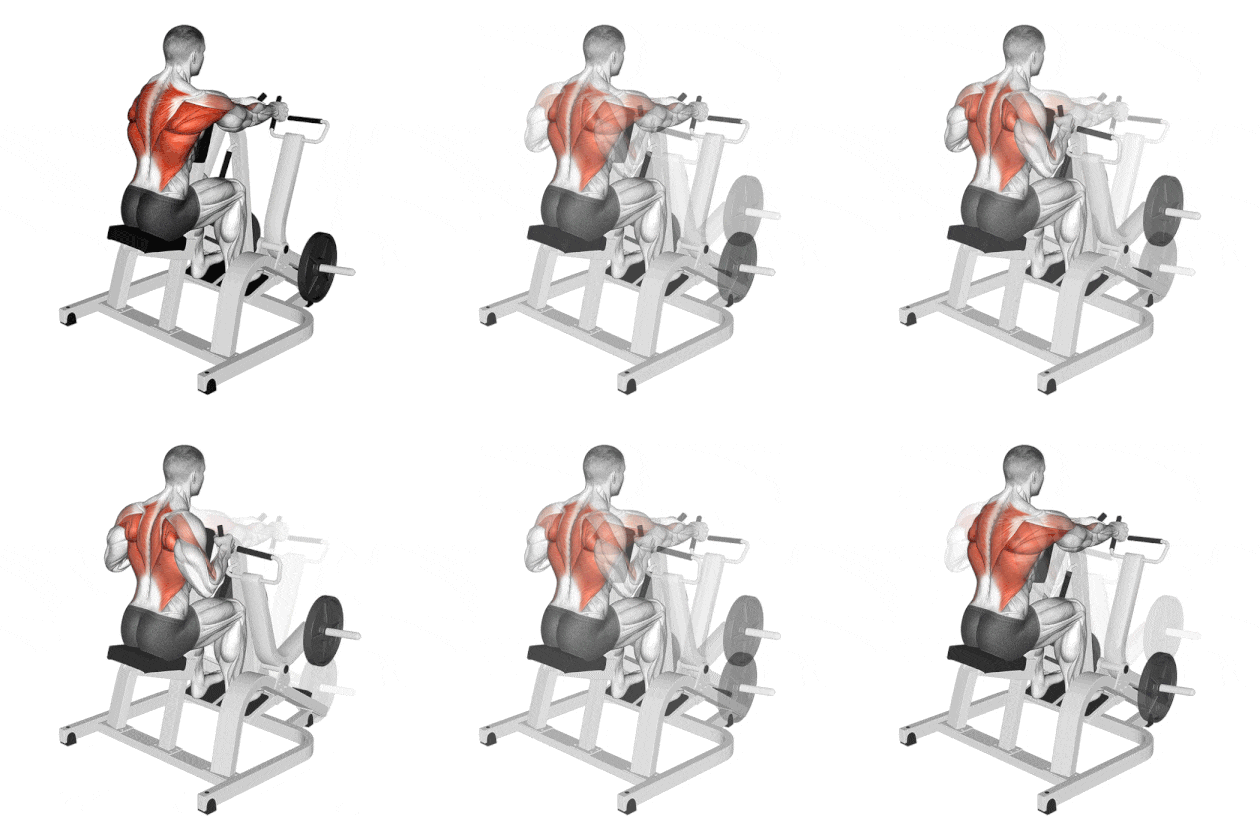
You sit with your chest against a pad and pull handles toward your torso. It works your mid-back, lats and rear shoulders, with your biceps helping. The chest pad holds you in place, so your lower back doesn’t have to stabilise you the way it does in a bent-over row.
How to Use the Seated Row Machine
- Set the seat and chest pad so you can reach the handles with your arms fully extended while your chest stays on the pad.
- Sit tall and take the handles. Start with your shoulder blades stretched slightly forward.
- Pull the handles toward your ribs by driving your elbows back, and squeeze your shoulder blades together.
- Hold for a second, then return slowly to the stretched position without letting the stack touch down.
If your gym has a cable stack instead, our cable row guide covers the same movement.
5. Pec Deck (Chest Fly) and Reverse Pec Deck
The pec deck is a fly rather than a press. Your arms sweep in an arc, so your chest does most of the work and your triceps do far less than on the chest press. Many pec decks also work in reverse.
Face the pad, or set the arms to the rear position, and the same machine trains your rear shoulders and upper back, which pressing doesn’t target directly.

How to Use the Pec Deck for Chest
- Set the seat so the handles or pads are level with your chest. Sit back against the pad.
- Place your forearms or hands on the pads with a slight bend in your elbows.
- Bring the pads together in front of your chest in a smooth arc.
- Open slowly until you feel a stretch across your chest, but don’t let the weight pull your shoulders behind your body.

How to Use the Reverse Pec Deck for Rear Shoulders
- Face the pad (or switch the arms to the rear position) and set the seat so the handles are at shoulder height.
- Hold the handles with a slight bend in your elbows and your chest on the pad.
- Sweep your arms back and out until they’re in line with your shoulders, squeezing your upper back lightly.
- Return slowly. Use a light weight so you don’t shrug or swing.
Our machine chest fly guide covers more form detail.
6. Assisted Pull-Up or Dip Machine
On most assisted machines you kneel or stand on a platform that the weight stack lifts for you. The number you select is the help, not the load, so a heavier setting makes the movement easier.
Use it to practise pull-ups and dips with your own body weight before you can do them unassisted. Many units do both, with pull-up handles on top and dip handles lower down.

How to Use the Assisted Pull-Up Machine
- Choose a weight that lets you do 6 to 8 clean reps. Put the pin in the stack.
- Step onto the platform or kneel on the pad and take the handles. Many machines have wide handles for pull-ups and narrower, palms-facing handles for chin-ups.
- Pull your chest toward the handles by driving your elbows down until your chin is above the bar.
- Lower slowly to a full hang. Once you can do 10 clean reps, drop the assistance by one plate.
For dips, use the lower handles in the same way: pick an assisting weight, lower until your upper arms are about parallel to the floor, then press back up. More options are in our guide to pull-up and chin-up variations.
7. Preacher Curl Machine
Your upper arms rest on an angled pad while you curl two handles up. The pad stops you swinging your body, so your biceps and the deeper brachialis muscle do the lifting.
One recent trial compared incline dumbbell curls with preacher dumbbell curls. Twenty-one untrained adults trained one arm each way, 5 sets of 10, twice a week for 12 weeks.
Biceps growth was a bit larger with incline curls (+22.1% versus +18.9%), while the brachialis and brachioradialis grew more with preacher curls. Total elbow flexor growth didn’t differ (Kobayashi 2026). The trial used dumbbells, not a preacher machine, but it’s a good sign that the preacher curl isn’t the lesser option.

How to Use the Preacher Curl Machine
- Adjust the seat so your armpits are snug against the top of the pad and your upper arms rest flat on it.
- Hold the handles with your palms facing up.
- Curl the handles toward your shoulders, then squeeze your biceps briefly.
- Lower slowly until your arms are almost straight, controlling the last few degrees instead of letting the stack drop.
More on the exercise is in our preacher curl guide, and the rest of the arm machines are in gym machines for an arm workout.
8. Triceps Extension or Dip Machine
Triceps machines come in two forms. A seated extension machine has you press handles down against a pad. A seated dip machine has you press handles down by your sides. Both isolate your triceps and take your balance out of the equation.
The research here is about cables rather than machines. In a 12-week trial of 21 adults, each person trained one arm with cable elbow extensions in the overhead position and the other in a neutral arm position.
The overhead arm gained more triceps muscle (+19.9% versus +13.9%), even with lighter weights (Maeo 2023). I couldn’t find a trial on seated triceps machines, so if your gym has a cable stack, add an overhead rope extension to your machine work.

How to Use the Triceps Extension Machine
- Adjust the seat so your elbows line up with the machine’s pivot and your upper arms rest on the pad.
- Hold the handles, then press until your arms are straight.
- Squeeze your triceps briefly at the bottom.
- Let the handles return slowly until your elbows are bent about 90 degrees or a bit further, if that’s comfortable.
On the dip machine, keep your torso upright and elbows close to your body as you press down. Our triceps exercises list has more options.
Other Options: Smith Machine and Cable Exercises
Neither of these is a dedicated upper-body machine, but both are useful when the real ones are busy or you want more variety.
Smith Machine Presses and Rows
The bar slides on fixed rails, so it feels more stable than a barbell while still letting you load heavy. Common upper-body choices are the bench press, shoulder press and upright row.
In an 8-week trial, 37 sport-science students trained the bench press and squat on either a Smith machine or with free weights. Chest and thigh muscle size improved about equally in both groups, and the strength measures improved most when the test used the same equipment as the training (Marcos-Frutos 2025). On that evidence, pick whichever you prefer.

Cable Machine Exercises
A cable stack lets you press, row, fly and raise from almost any angle, which is useful for the overhead triceps position mentioned above. Our cable machine exercises guide has the full list, and cable lateral raises are a good way to add side-shoulder work, which no machine on this list targets directly.

Which Upper Body Machine Should You Start With?
- You’re new to the gym: start with the chest press, lat pulldown and seated row. They’re easy to set up and cover your main pushing and pulling.
- You want a bigger chest: use the chest press first and add the pec deck.
- You want a stronger back: use the lat pulldown and seated row, and add the reverse pec deck for your rear shoulders.
- You’re working toward pull-ups: use the assisted pull-up machine and the lat pulldown, and lower the assistance over time.
- You want arm size: add the preacher curl and a triceps machine at the end of the session.
New to machines in general? See our gym machines for beginners guide, or our gym machines for legs list for the other half of your week.
A Simple Two-Day Upper Body Machine Plan
For a rough weekly target, the 2026 ACSM position stand is a useful guide. It found that training a muscle at least twice a week helps strength, and that around 10 or more hard sets per muscle group per week helps muscle size. It isn’t specific to these machines (Currier 2026).
| Exercise | Sets and reps | Main focus |
|---|---|---|
| Chest press machine | 3 sets of 8 to 12 | Chest |
| Pec deck | 2 sets of 10 to 15 | Chest |
| Lat pulldown | 3 sets of 8 to 12 | Lats |
| Seated row machine | 2 sets of 8 to 12 | Mid-back |
| Shoulder press machine | 2 sets of 8 to 12 | Shoulders |
| Reverse pec deck | 2 sets of 12 to 15 | Rear shoulders |
| Preacher curl machine | 2 sets of 10 to 15 | Biceps |
| Triceps machine | 2 sets of 10 to 15 | Triceps |
Do this twice a week with at least a day between sessions. That adds up to 10 weekly sets for the chest and 10 for the back, and fewer direct sets for shoulders and arms, which also get work from the presses and pulls.
It’s a starting point, not a prescription from a study. If 18 sets feels like too much at first, drop to one set per exercise and build up over a few weeks. Finish each set with a rep or two in the tank until you know the machine, and add a little weight once you hit the top of the rep range on every set. For ideas beyond the gym, see our back exercises and shoulder exercises lists.
Upper Body Machine FAQs
Which machine works the most upper-body muscles?
The multi-joint machines: the chest press, shoulder press, lat pulldown and seated row. Each moves your shoulder and elbow together, so several muscles share the work. Single-joint machines like the pec deck, preacher curl and triceps extension isolate one muscle group.
Are machines as good as free weights for upper body?
For muscle growth, the evidence says they’re about equal. A 2023 meta-analysis found no difference in hypertrophy between free-weight and machine training. Strength tends to be specific to the equipment you practise on, so mix both if you also want strength on free-weight lifts (Haugen 2023).
Which upper body machine is best for beginners?
The chest press, lat pulldown and seated row. The path is fixed, you generally don’t need a spotter, and the weight is easy to adjust. That’s a practical recommendation rather than a research finding.
How many upper body machines should I use per workout?
Four to eight is plenty. The plan above uses eight, with 2 or 3 sets each. A beginner can start with the first four machines in the table and add the rest over a few weeks.
How often should I train my upper body on machines?
Twice a week is a sensible start. The ACSM position stand found that at least two sessions a week improved strength and at least 10 hard sets per muscle group per week improved muscle size (Currier 2026).
Research Papers Referenced in This Guide
- Currier BS, D’Souza AC, Singh MAF, et al. American College of Sports Medicine Position Stand. Resistance Training Prescription for Muscle Function, Hypertrophy, and Physical Performance in Healthy Adults: An Overview of Reviews. Med Sci Sports Exerc. 2026;58(4):851-872. PubMed
- Haugen ME, Vårvik FT, Larsen S, Haugen AS. Effect of free-weight vs. machine-based strength training on maximal strength, hypertrophy and jump performance: a systematic review and meta-analysis. BMC Sports Sci Med Rehabil. 2023;15(1):103. PubMed
- Coratella G, Tornatore G, Longo S, Esposito F. Specific prime movers’ excitation during free-weight bench press variations and chest press machine in competitive bodybuilders. Eur J Sport Sci. 2020;20(5):571-579. PubMed
- Andersen V, Fimland MS, Wiik E, Skoglund A. Effects of grip width on muscle strength and activation in the lat pull-down. J Strength Cond Res. 2014;28(4):1135-1142. PubMed
- Lusk SJ, Hale BD, Russell DM. Grip width and forearm orientation effects on muscle activity during the lat pull-down. J Strength Cond Res. 2010;24(7):1895-1900. PubMed
- Kobayashi Y, Maeo S, Eihara Y, Ono M. Exercise-specific preferential hypertrophy of individual elbow flexor muscles after incline versus preacher dumbbell curl training. J Sports Sci. 2026. PubMed
- Marcos-Frutos D, Miras-Moreno S, Márquez G, García-Ramos A. Comparative effects of the free weights and Smith machine squat and bench press: the important role of specificity for strength adaptations. Int J Sports Physiol Perform. 2025;20:292-300. PubMed
- Maeo S, Wu Y, Huang M, Sakurai H. Triceps brachii hypertrophy is substantially greater after elbow extension training performed in the overhead versus neutral arm position. Eur J Sport Sci. 2023;23(7):1240-1250. PubMed

Manish is a NASM-certified fitness and nutrition coach with over 10 years of experience in weight lifting and fat loss fitness coaching. He specializes in gym-based training and has a lot of knowledge about exercise, lifting technique, biomechanics, and more.
Through “Fit Life Regime,” he generously shares the insights he’s gained over a decade in the field. His goal is to equip others with the knowledge to start their own fitness journey.