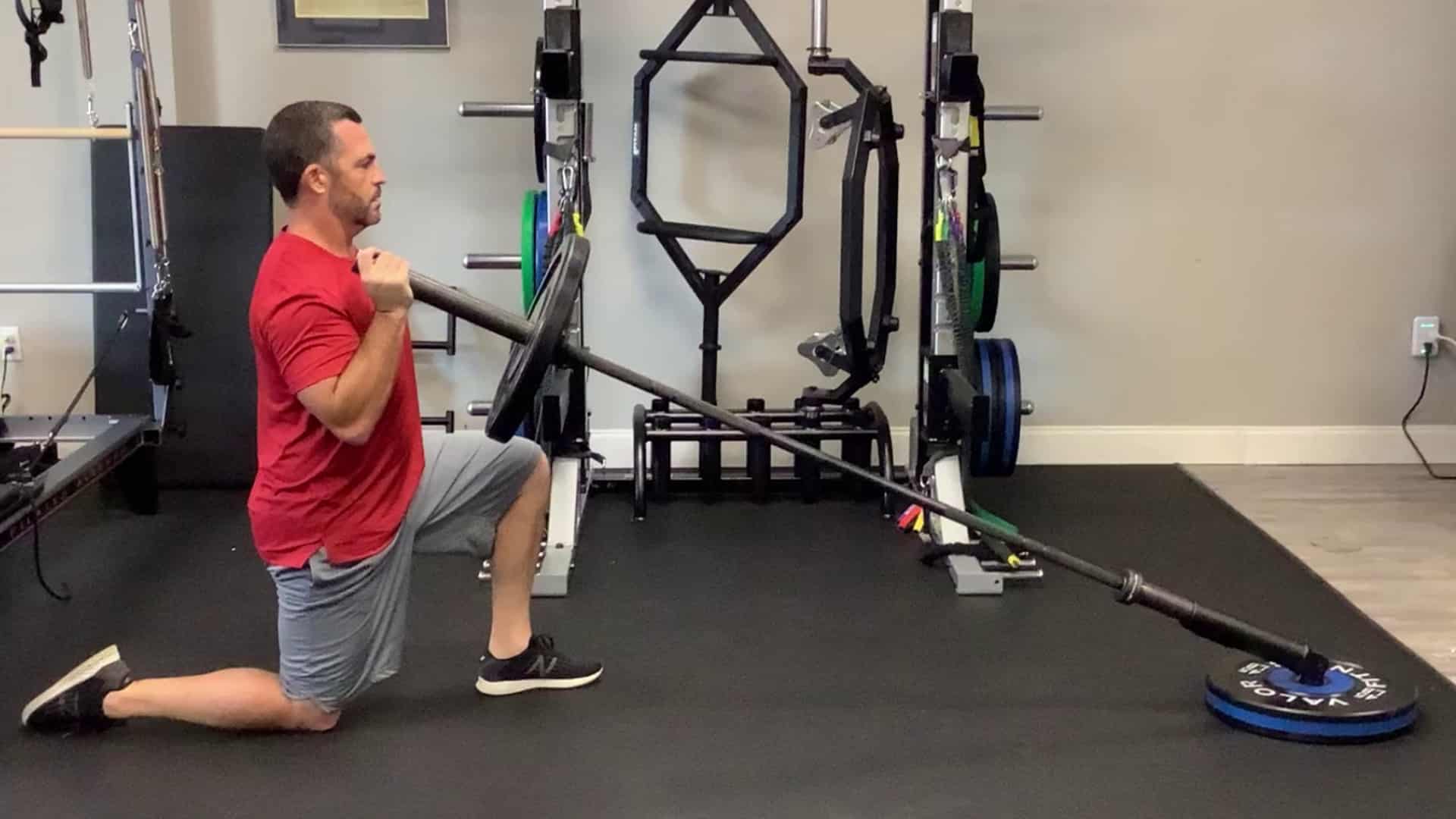
The landmine press is a pressing exercise where one end of a barbell is anchored and you press the free end up and forward along a fixed arc. It is usually done with one arm, kneeling or standing, and coaching sources generally treat it as a shoulder exercise first (Human Kinetics, BarBend).
One thing to know up front: as of October 2026, a PubMed search turns up no study that measured muscle activity, joint stress or injury rates in the landmine press itself. So below I separate what comes from basic anatomy, what comes from studies of similar presses, and what is just coaching practice.
I started using it when barbell shoulder presses were bothering my shoulder, and it felt better for me. That is one person’s experience, not evidence that it is easier on the joint. If a press hurts, get it checked rather than looking for a workaround.
- The Short Version
- What Is a Landmine Press?
- Landmine Press Muscles Worked
- What the research can and cannot tell us
- Benefits and Limitations
- What it has going for it
- What to keep in mind
- How to Set Up a Landmine Press
- How to Do the Landmine Press
- Half-kneeling
- Standing
- Breathing
- Common mistakes
- How Much Weight, and How Many Reps?
- Landmine Press vs Overhead Press and Other Presses
- Landmine Press Variations
- 1. Two-hand landmine press
- 2. Side-to-side press
- 3. Banded landmine press
- 4. One-arm floor press
- Related movements
- Landmine Press Alternatives
- FAQs
- Is the landmine press good for your shoulders?
- Is the landmine press a chest exercise?
- Do I need a landmine attachment?
- Should I start half-kneeling or standing?
- Can I use the landmine press instead of the overhead press?
The Short Version
- What it trains: mainly the front of the shoulder and the triceps, with the upper chest helping, the muscles around the shoulder blade assisting, and the core resisting arching and twisting. This is based on how the movement works, not on landmine-specific research.
- Shoulder-friendly? Many lifters find the angled path more comfortable than pressing straight overhead. Comfortable is not the same as safer, and no study compares the two.
- One arm or two? This guide covers the one-arm press. The two-hand, chest-focused version has its own guide, linked in the variations section.
What Is a Landmine Press?
One end of a barbell sits in a landmine attachment or a padded corner. You load the other end, hold it at your shoulder, and press it away from you. Because the bar pivots around the anchor, it travels in an arc, up and forward, instead of straight overhead. Human Kinetics describes it as a middle ground between a horizontal press like the bench press and a vertical press like the overhead press.
It is one of several landmine exercises you can do with the same setup, including the landmine squat, landmine row and landmine deadlift.
Landmine Press Muscles Worked
These roles follow from the movement itself (raising the arm forward and up, then straightening the elbow) and from what coaching sources describe. They are not landmine press measurements.
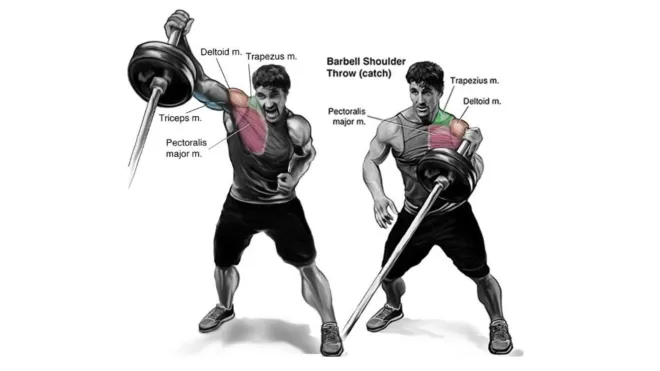
- Main movers: the front of the shoulder (anterior deltoid) does most of the pressing, and the triceps straighten the elbow. The upper part of the chest (the clavicular head of the pectoralis major) also helps raise the arm.
- Around the shoulder blade: the serratus anterior and trapezius help the shoulder blade turn upward and move forward as the arm rises. BarBend notes the landmine press lets the shoulder blade move more freely than some traditional presses.
- Stabilizers: the rotator cuff keeps the shoulder joint centered. It works to hold the joint steady rather than to move the bar.
- Core and lower body: your abs, obliques and back muscles resist arching and, with one arm, twisting. Standing, your legs and glutes also form the base.
What the research can and cannot tell us
- The landmine press itself: no study found. Be cautious with any guide that quotes exact muscle-activation percentages for it.
- One arm vs two arms: in 15 healthy men doing dumbbell shoulder presses at 80% of their one-rep max, external oblique activity was higher pressing one arm at a time than two, both seated and standing (Saeterbakken and Fimland, 2012). That suggests one-arm pressing challenges the core more, but it was not a landmine study.
- Upper chest: in 15 men bench pressing at 70% of their one-rep max, the upper (clavicular) part of the chest was more active at 44 and 56 degrees of incline than on a flat bench (Trebs et al., 2010). A later study of 14 men found no difference in upper-chest activity across the whole lift, only at some points during the middle of it (Lauver et al., 2016). The landmine press travels on an angled path, so some upper-chest involvement is plausible, but it has not been measured.
Benefits and Limitations
What it has going for it
- A guided path. The anchor sets the bar’s arc, so there is less to steer than with a free barbell.
- An angle many lifters find comfortable. You press up and forward instead of straight overhead. BarBend and other coaching sources suggest it can suit people who find straight overhead pressing uncomfortable. That is coaching experience, not proven protection.
- A core challenge with one arm. The dumbbell press study above is the closest evidence, and it points the same way.
- Small load jumps. You add weight in plates, so progress can be gradual.
What to keep in mind
- No proof it is safer or builds more muscle than other presses, and no proof it prevents injuries or fixes imbalances.
- The arc is fixed. Where it feels right depends on your height, stance and where the anchor sits.
- Loading has limits. Big plates can get in the way, and you are holding the bar by the sleeve.
- It is not automatically fine with shoulder pain. If you have pain or an injury, get it assessed before choosing your pressing exercises.
Know More: 20 Best Landmine Exercises For Building Muscle And Strength
How to Set Up a Landmine Press
- Attachment or corner. Slot one end of the bar into a landmine attachment. No attachment? BarBend suggests wedging the end into a corner with a towel between the bar and the wall. Check that it cannot slide before you add plates. An attachment is steadier, so I would keep corner setups for lighter loads.
- Clear space. The free end sweeps an arc, so keep people and equipment out of the way. Run the arc once with an empty bar.
- Plates. Coach Eric Cressey says 45 lb (about 20 kg) plates tend to get in the way and suggests plates smaller than 25 lb (about 11 kg). Use collars so the plates cannot slide off.
- Distance. For the half-kneeling version, BarBend suggests the sleeve sits about six to eight inches (15 to 20 cm) in front of your knee. Treat that as a starting point and adjust to your height.
- Unloading. Lower the loaded end gently to the floor, then take the plates off.
How to Do the Landmine Press
Half-kneeling
- Kneel on the knee on the same side as your pressing arm, with your other foot flat on the floor in front of you.
- Bring the end of the bar to shoulder height with your hand cupped around the sleeve, wrist straight.
- Brace your core, squeeze the glute on the kneeling side, and keep your ribs down so your lower back does not arch.
- Press the bar up and forward on a slight diagonal until your elbow is almost straight. Press straight out from the shoulder, not across your body.
- Lower the bar under control back to your shoulder. Do not let your elbow drift behind your torso.
- Finish your reps, then switch sides.
These cues come from Human Kinetics, Eric Cressey and BarBend. They are coaching guidance, not research findings.
Standing
Stand with your feet staggered or about hip-width apart, whichever feels steadier, and follow the same steps. BarBend notes that standing lets you use your lower body for stability and that lifters can often press heavier this way than in the kneeling versions.
Breathing
The old rule is to breathe in as you lower and out as you press. An NSCA excerpt from the book Developing the Core points out that real lifting rarely follows such a neat pattern, and says coaches should have athletes breathe freely while keeping the core braced (NSCA). The same source says holding your breath against a closed airway (the Valsalva maneuver) can help spinal stability in maximal lifts for healthy people, but not for people with conditions such as high blood pressure. If that applies to you, check with your doctor before lifting heavy.
Common mistakes
- Leaning back or flaring the ribs to finish the rep. BarBend warns this can over-arch the spine. If you need it to finish the rep, the weight is probably more than you can control.
- Shrugging. BarBend suggests pressing without shrugging your shoulder up toward your ear.
- A bent-back wrist. Gripping with the palm facing up can force the wrist back. Keep it straight, with the sleeve resting in your lower palm.
- The wrong bar path. Pressing straight up or only out loses the arc. BarBend describes the right path as up and out at roughly 45 degrees.
- Twisting the torso. Keep your chest facing forward and let your core resist the rotation.
- Letting the elbow travel behind the body. Cressey cautions against this on the way down. Stop when your hand reaches your shoulder.
- An unsecured anchor. Check the setup before every set.
How Much Weight, and How Many Reps?
The weight in your hand is not the plate total. The anchor takes part of the load, and the closer the bar is to horizontal, the more of it you have to hold. Coach Ben Bruno also points out that the arc makes the press get easier toward lockout, and more so for taller lifters because the press becomes more horizontal (Bruno).
So do not try to convert landmine weights to dumbbell or barbell press weights. Note your setup (plates, distance, position) and progress within it: add reps first, then small amounts of weight.
I found no sets-and-reps research specific to the landmine press, so these are starting points, not research-derived prescriptions. Per arm:
- Muscle size: 2 to 4 sets of about 8 to 15 reps, stopping a few reps short of failure.
- Strength: heavier sets of roughly 3 to 6 reps, as long as your form holds and you can load the bar safely.
- Endurance: lighter sets of about 15 or more reps.
- Rest: about 1 to 3 minutes. A 2024 meta-analysis found a small hypertrophy benefit from resting longer than 60 seconds and no clear difference beyond about 90 seconds (Singer et al.).
Muscle can grow across a wide range of loads, so the rep ranges above are not rules (Schoenfeld et al., 2021). On proximity to failure, the evidence is mixed: one meta-regression found muscle growth improved as sets ended closer to failure, while strength gains were similar across a wide range (Robinson et al., 2024), but the American College of Sports Medicine’s 2026 position stand, an overview of 137 systematic reviews, did not find that training to failure consistently changed results. The same position stand found that few training variables mattered much overall, and that higher volumes (10 or more sets per week) enhanced muscle growth.
Landmine Press vs Overhead Press and Other Presses
- Overhead press: a straight overhead press needs enough shoulder and upper-back mobility to get the bar overhead. BarBend notes the landmine press changes the angle from directly overhead to a diagonal and is used by people who have limits pressing overhead. No study has compared shoulder stress or injury risk between them. See the guide to the best shoulder exercises for other options.
- Dumbbell shoulder press: each arm moves on its own free path. Here is a list of dumbbell shoulder exercises.
- Incline bench press: a barbell press at an angle, with more chest involvement than a straight overhead press. See the incline press angle guide.
None of these is clearly better. Choose based on your goal, your equipment, and what you can do without pain.
Landmine Press Variations
None of these has been studied on its own, so this guide does not claim any of them hits a specific muscle harder. They are different ways to set up or load the same press.
1. Two-hand landmine press
Both hands hold the sleeve and you press from the chest, kneeling or standing. Ben Bruno describes the regular two-hand landmine press as “more of a standing incline press to target the upper chest and shoulders”. That is his description, not a research finding. It has its own guide: landmine chest press.
2. Side-to-side press
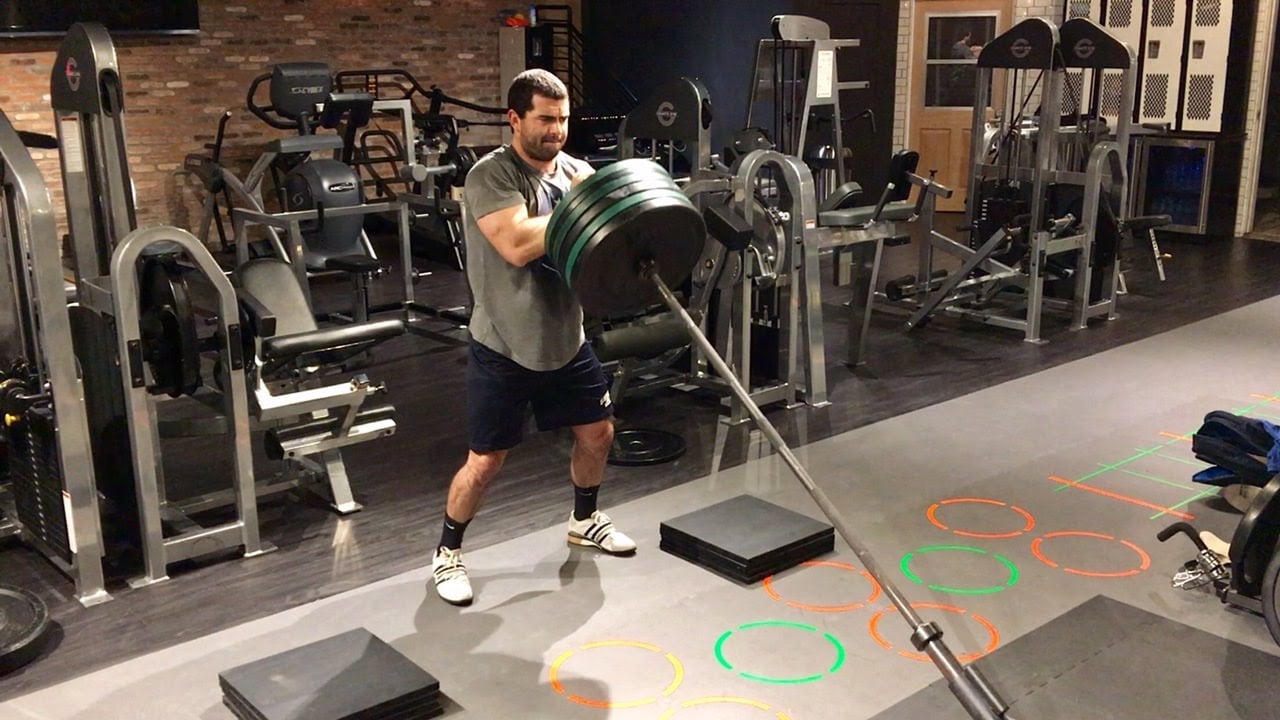
A two-hand press where you lower the bar toward one side, press, and lower it to the other side on the next rep. Bruno, who demonstrates it below, says that because both arms still move the load you can use more weight than with a single-arm press, and that lowering to one side challenges the core to resist side bending. BarBend makes a similar point about heavier loading. These are coaching descriptions, not research findings.
3. Banded landmine press
A looped band goes under your foot and around the bar, so resistance builds as you press. BarBend says the band creates tension through the whole movement. Bruno adds that because the press gets easier near lockout, the rising band tension evens out the resistance. Both are coaching explanations, and I found no research on the banded version.
4. One-arm floor press
You lie on your back with your knees bent and press the bar end up with one hand. The floor stops the movement when your upper arm touches it. Because lying down can bring the bar closer to horizontal, it may feel heavier than a standing press with the same plates.
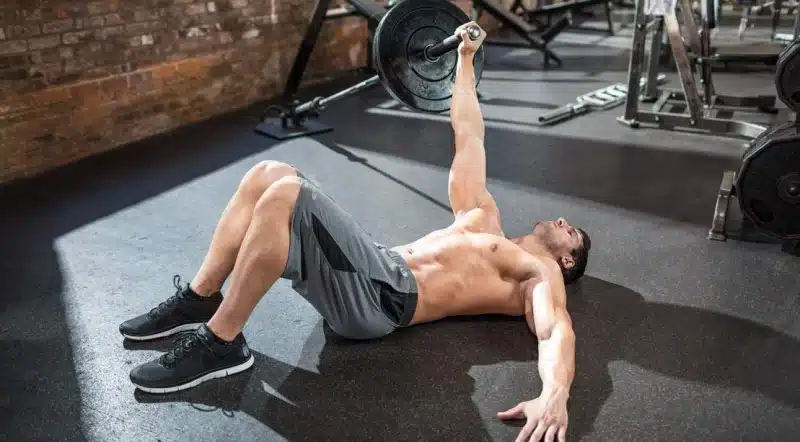
- Lie flat with your knees bent and your feet on the floor.
- Hold the end of the bar above your chest in one hand and press it up until your arm is nearly straight.
- Lower it under control until your upper arm lightly touches the floor. Do not bounce it.
- Press back up, keeping your lower back from arching, and switch arms after your reps.
Related movements
These use the same setup but are not presses in the usual sense.
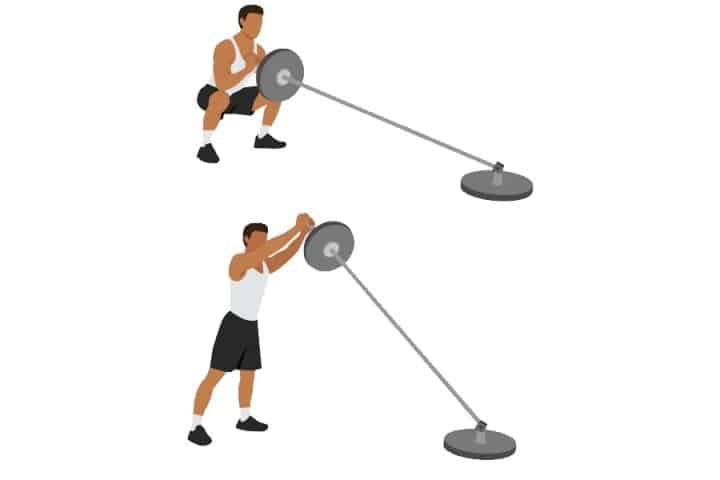
- Squat to press: a squat followed by a press as you stand, covered in the landmine squat guide. You will likely press a lighter weight than in a plain press.
- Landmine twist: a rotation exercise for the trunk, covered in the landmine twist guide.
Landmine Press Alternatives
- Dumbbell or kettlebell shoulder press: a free-path press for your shoulders.
- Incline dumbbell or barbell press: an angled press with more chest involvement.
- Smith machine shoulder press: a fixed path that does not need an anchor.
- Z press: a seated press with your legs out in front, so you cannot lean back. BarBend lists it as a landmine press alternative.
FAQs
Is the landmine press good for your shoulders?
It trains the shoulder muscles, and many lifters find the angled path comfortable. Whether it is easier on the shoulder joint has not been tested. If your shoulder hurts, get it checked and stay in a pain-free range.
Is the landmine press a chest exercise?
Coaching sources mostly describe the one-arm press as shoulder-first. Ben Bruno compares the two-hand version to a standing incline press. Neither has been measured, so how much chest you get is unknown. For the chest-focused version, see the landmine chest press.
Do I need a landmine attachment?
No. A padded corner works if the bar cannot slide, ideally with lighter loads. An attachment is steadier and protects your walls.
Should I start half-kneeling or standing?
Either works. Human Kinetics and Cressey both teach the half-kneeling version, and Cressey says that because the load is held on one side it makes the core resist both arching and rotation. BarBend notes that standing lets you use your legs for stability and that lifters can often press heavier that way. Pick the one where you can keep your ribs down and the bar moving smoothly.
Can I use the landmine press instead of the overhead press?
You can, and many lifters do. They are different exercises, so strength from one will not transfer perfectly to the other. No research shows which is better for a specific goal.
References
- Saeterbakken AH, Fimland MS. Muscle activity of the core during bilateral, unilateral, seated and standing resistance exercise. Eur J Appl Physiol. 2012;112(5):1671-1678. PubMed
- Trebs AA, Brandenburg JP, Pitney WA. An electromyography analysis of 3 muscles surrounding the shoulder joint during the performance of a chest press exercise at several angles. J Strength Cond Res. 2010;24(7):1925-1930. PubMed
- Lauver JD, Cayot TE, Scheuermann BW. Influence of bench angle on upper extremity muscular activation during bench press exercise. Eur J Sport Sci. 2016;16(3):309-316. PubMed
- Robinson ZP, Pelland JC, Remmert JF, et al. Exploring the dose-response relationship between estimated resistance training proximity to failure, strength gain, and muscle hypertrophy: a series of meta-regressions. Sports Med. 2024;54(9):2209-2231. PubMed
- Singer A, Wolf M, Generoso L, et al. Give it a rest: a systematic review with Bayesian meta-analysis on the effect of inter-set rest interval duration on muscle hypertrophy. Front Sports Act Living. 2024;6:1429789. PubMed
- Schoenfeld BJ, Grgic J, Van Every DW, Plotkin DL. Loading recommendations for muscle strength, hypertrophy, and local endurance: a re-examination of the repetition continuum. Sports (Basel). 2021;9(2):32. PubMed
- Currier BS, D’Souza AC, Singh MAF, et al. American College of Sports Medicine Position Stand. Resistance training prescription for muscle function, hypertrophy, and physical performance in healthy adults: an overview of reviews. Med Sci Sports Exerc. 2026;58(4):851-872. PubMed
- NSCA. Anatomical Core: Neural Integration (excerpt from Developing the Core, Kinetic Select, June 2017). nsca.com
- Coaching sources (practice-based, not research): Human Kinetics, Half-kneeling landmine one-arm press; Eric Cressey, Half-kneeling 1-arm landmine press; BarBend, How to do the landmine press; Ben Bruno, 6 upper body landmine exercises.

Manish is a NASM-certified fitness and nutrition coach with over 10 years of experience in weight lifting and fat loss fitness coaching. He specializes in gym-based training and has a lot of knowledge about exercise, lifting technique, biomechanics, and more.
Through “Fit Life Regime,” he generously shares the insights he’s gained over a decade in the field. His goal is to equip others with the knowledge to start their own fitness journey.