
A landmine is a barbell with one end anchored to the floor, so the other end swings in an arc. That lets you press, row, squat and rotate with a single bar.
Below are 20 landmine exercises for legs, chest, back, shoulders and core, with form steps for each, three simple workouts, and a straight look at what the research does and doesn’t show.
First, a caveat: the landmine-specific research is thin. I found one study comparing the landmine squat with the goblet squat and one 16-week trial in 18 volleyball players, and nothing that measured muscle size after landmine training.
So the exercise steps below are practical coaching, not research results, and I flag where the evidence stops.

- Do Landmine Exercises Build Muscle and Strength?
- Landmine Exercises for Legs and Glutes
- 1. Landmine Squat to Press
- 2. Landmine Squat
- 3. Landmine Reverse Lunge
- 4. Landmine Lateral Lunge
- 5. Landmine Romanian Deadlift
- 6. Landmine Single-Leg Romanian Deadlift
- 7. Landmine Reverse Lunge to Knee Drive
- 8. Landmine Deadlift
- Landmine Exercises for the Chest
- 9. Landmine Chest Press
- 10. One-Arm Floor Landmine Press
- 11. Landmine Chest Fly
- Landmine Exercises for the Back
- 12. Landmine Single-Arm Bent-Over Row
- 13. Meadows Row
- 14. Landmine T-Bar Row
- Landmine Exercises for the Shoulders
- 15. One-Arm Landmine Shoulder Press
- 16. Kneeling Alternate Landmine Press
- 17. Landmine Lateral Raise
- 18. Landmine Rear Delt Raise
- Landmine Exercises for the Core
- 19. Landmine Twist
- 20. Landmine Hip Rotation
- How Many Sets and Reps?
- Three Simple Landmine Workouts
- Full-Body Workout for Beginners
- Upper-Body Workout
- Lower-Body Workout
- Landmine Safety and Set-Up Tips
- FAQs
- Do landmine exercises build muscle?
- Can I do landmine exercises without an attachment?
- Are landmine exercises good for beginners?
- Is the landmine squat better than the goblet squat?
- Go Deeper on One Exercise
- References
Do Landmine Exercises Build Muscle and Strength?
They load your muscles against resistance, and the general resistance-training evidence says that builds muscle and strength. The landmine-specific evidence is small, though. Here is what I found.
Collins 2021 had 16 men and 16 women do goblet squats and landmine squats loaded at 30% of their body mass. The landmine squat reduced activity in the quadriceps (vastus medialis and vastus lateralis) and reduced vertical force, while increasing the backward horizontal force. T
he authors suggested the landmine squat may help balance hamstring and quadriceps activity, and that the goblet squat is better for targeting the quadriceps. So if you want to train your quads, the landmine squat isn’t clearly better than a goblet squat. The load was light, so the study doesn’t tell us how heavy landmine squats behave.
Park 2025 followed 18 professional female volleyball players for 16 weeks. Nine did weight training and nine did weight training plus landmine exercises.
Both groups improved their deadlift, back squat, push-ups, countermovement jump and sit-ups. The countermovement jump showed a group-by-time interaction in favour of the landmine group. That is a small trial in one team and one sport, and the abstract doesn’t report muscle size.
Other landmine papers I found measure performance rather than training effects, such as the reliability of a landmine punch-throw test in boxers (Omcirk 2024) and a camera system for tracking landmine press speed (Zhao 2026). They show landmine movements can be used as tests. They don’t show what landmine training does to your body.
For the general rules, the 2026 ACSM position stand (Currier 2026) is the best source I could check. It found that muscle growth was enhanced by higher weekly volume (10 or more sets per muscle group per week), and found no difference in growth between low loads (30% of your one-repetition maximum) and high loads (100%).
For strength it found gains were enhanced by heavier loads (80% of your one-repetition maximum or more), a full range of motion, 2 to 3 sets per exercise, and training at least twice a week. That review covers resistance training as a whole, not landmine exercises specifically.
Landmine Exercises for Legs and Glutes
These eight moves cover squatting, lunging and hinging. Where we have a full guide on one of them, it’s linked.
1. Landmine Squat to Press
The squat to press (sometimes called a landmine thruster) joins a squat and a press into one rep, so it works your legs and shoulders together. Because both movements share one weight, the load is limited by whichever part is harder for you.

- Hold the end of the bar at chest height with both hands and your elbows tucked in.
- Squat down as far as you can with good form.
- Stand up and, as you rise, press the bar up and forward until your arms are straight.
- Lower the bar back to your chest and go into the next squat.
Tip: let your legs start the press, and keep the movement smooth rather than jerky.
2. Landmine Squat
In the landmine squat you hold the end of the bar against your chest and squat while the bar pivots in front of you.
In the research above, it reduced quadriceps activity compared with the goblet squat, so choose it for variety, not because it beats other squats for the quads. Our landmine squat guide covers set-up and loading in more detail.

- Hold the end of the bar against your upper chest with both hands and your elbows tucked.
- Brace your core, push your hips back and bend your knees.
- Lower until your thighs are about parallel to the floor, or as deep as you can go with good form.
- Push through your whole foot to stand up.
Tip: keep your chest up and your ribs down, and don’t let the bar pull you forward.
3. Landmine Reverse Lunge
The reverse lunge trains one leg at a time, which makes it a good way to build balance and leg strength. For another loaded version, see our barbell reverse lunge guide.

- Hold the end of the bar at shoulder height and stand with your feet about hip-width apart.
- Step one foot back and lower your back knee towards the floor.
- Push through the front foot to stand up.
- Finish all reps on one side, or alternate sides.
Tip: keep your torso tall and your front foot flat. If balance is a problem, hold on to something steady or use no weight at first.
4. Landmine Lateral Lunge
The lateral lunge steps you out to the side, so it loads your thighs and hips from a different angle than a forward or reverse lunge. It also asks for hip mobility, so go only as low as you can control.

- Hold the end of the bar at chest height and stand tall with your feet about shoulder-width apart.
- Take a big step to the side and sit back into that hip, keeping the other leg straight.
- Keep your chest up and your stepping foot flat.
- Push through the stepping foot to return to the start, then repeat on the other side.
Tip: point your toes forward and keep your knee tracking in line with your toes.
5. Landmine Romanian Deadlift
The Romanian deadlift (RDL) is a hip hinge that trains your hamstrings, glutes and lower back. The landmine version lets you hold the bar in front of your thighs and move it along a slightly curved path.
Our landmine deadlift guide also covers this variation, and our hamstring exercise guide has more options.

- Stand facing the end of the bar with your feet about hip-width apart and hold the bar end with both hands in front of your thighs.
- Push your hips back with a soft bend in the knees and a flat back.
- Lower the bar until you feel a stretch in your hamstrings, without rounding your back.
- Drive your hips forward to stand tall.
Tip: keep the bar close to your legs the whole time.
6. Landmine Single-Leg Romanian Deadlift
Standing on one leg adds a balance challenge and works each side separately. Use a light weight until you can stay steady.

- Hold the end of the bar in one hand and stand on one leg with a soft bend in the knee.
- Hinge at your hips and let the free leg extend behind you.
- Lower your torso until it’s close to parallel to the floor, keeping your back flat.
- Stand back up by driving your hips forward.
Tip: keep your hips square to the floor and keep the movement at your hips, not your lower back.
7. Landmine Reverse Lunge to Knee Drive
This adds a knee drive to the reverse lunge, so each rep finishes on one leg with your knee up. It asks for more balance and control than a plain lunge, so start light.

- Hold the end of the bar at chest height with both hands.
- Step back into a reverse lunge.
- Push through the front foot to stand and drive the back knee up towards the bar.
- Lower the foot back into the next lunge and repeat, then switch legs.
Tip: stay tall and control the landing rather than rushing.
8. Landmine Deadlift
The landmine deadlift lifts the bar from the floor at an angle in front of you, so the load travels along an arc. If your main goal is maximum strength, remember the ACSM finding above that heavier loads (80% of your one-repetition maximum or more) enhance strength.
In my view a standard barbell deadlift is easier to load that heavily, but I haven’t seen a study comparing the two. Our landmine deadlift guide goes into more detail.

- Stand over the end of the bar with your feet about hip-width apart.
- Hinge at your hips and bend your knees to take hold of the bar end with both hands, keeping your back flat.
- Push the floor away and stand up, driving your hips forward.
- Lower the bar by pushing your hips back first, then bending your knees.
Tip: choose a weight that lets you hold the same back position on every rep.
Landmine Exercises for the Chest
Landmine presses move the bar up and forward at an angle, and they mainly load the chest, front shoulders and triceps. For more chest options, see our chest exercises guide and barbell chest exercises.
9. Landmine Chest Press
The chest press is done from your knees or a half-kneeling position, pushing the bar out in front of you. Our full landmine chest press guide covers it in more detail.

- Kneel facing the landmine and hold the end of the bar at your chest with both hands.
- Keep your ribs down and your back neutral.
- Press the bar up and forward until your arms are straight, without locking your elbows hard.
- Lower the bar back to your chest under control.
Tip: if you lean back as you press, the weight is too heavy.
10. One-Arm Floor Landmine Press
Pressing from the floor limits how far your arm can go back, which some people find easier on the shoulder.
The angled bar also lets you use a neutral grip, with your palm facing in, which some lifters find more comfortable than a straight bar. Our landmine press guide covers this variation too.
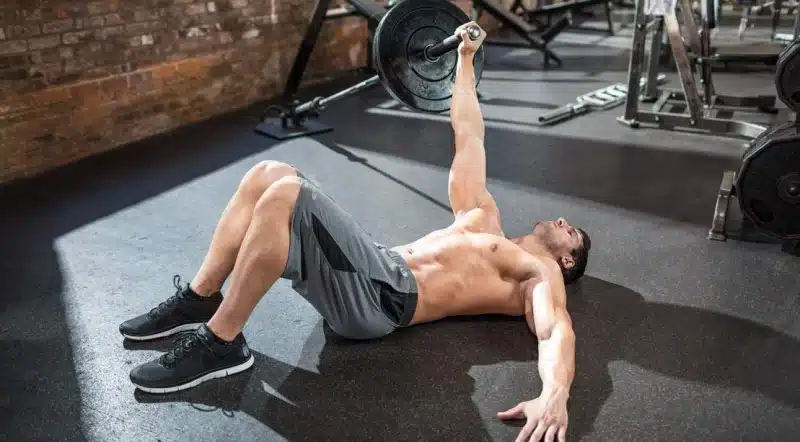
- Lie on your back with your knees bent and your feet flat.
- Hold the end of the bar in one hand above your chest.
- Lower the bar under control until your upper arm lightly touches the floor.
- Press the bar back up until your arm is almost straight.
Tip: don’t bounce your arm off the floor, and keep your lower back from arching.
11. Landmine Chest Fly
The chest fly is a one-arm movement where the arm travels out to the side, which puts a stretch across the chest. Keep the load light and stop at a depth you can control. See our chest fly guide for the dumbbell version.

- Lie on your back with your head towards the landmine.
- Hold the end of the bar in one hand above your chest with a slight bend in your elbow.
- Lower your arm out to the side until you feel a stretch across your chest.
- Bring your arm back up to the start.
Tip: move slowly and stop at the point where you still feel in control of the shoulder.
Landmine Exercises for the Back
Rowing from the end of a landmine gives you a few options, from a one-arm row to a heavier two-handed row.
The labelled illustration below shows the back and arm muscles that a landmine row works. For other back options, see our lats exercise guide. Our full landmine row guide has more detail.

12. Landmine Single-Arm Bent-Over Row
The one-arm row works one side at a time and asks you to keep your torso still while the arm moves. That makes it a good fit if you want to even out strength between sides.

- Stand beside the bar with your feet about hip-width apart.
- Hinge forward with a flat back and take the bar end in one hand.
- Pull your elbow towards your hip.
- Lower the bar until your arm is straight again, then repeat.
Tip: keep your hips and shoulders square to the floor so your body doesn’t twist.
13. Meadows Row
The Meadows row is a one-arm row from a staggered stance, with your body angled side-on to the bar.
You hold the bar end with an overhand grip, so your grip gets tested too.

- Stand side-on to the bar in a staggered stance and hinge forward.
- Take hold of the bar end with an overhand grip.
- Pull your elbow back and towards your hip.
- Lower the bar under control until your arm is straight.
Tip: don’t swing your body to move the weight, and keep your spine in the same position as the bar moves.
14. Landmine T-Bar Row
The T-bar row is the classic two-handed landmine row and typically lets you use the most weight of the three. See our chest-supported T-bar row guide if you want back support.

- Stand over the bar with your feet about shoulder-width apart.
- Hinge forward with your chest up and take hold of the bar just behind the plates, or use a V-handle.
- Pull the plates towards your chest.
- Lower the bar under control until your arms are straight.
Tip: keep your back flat and don’t jerk the weight up.
Landmine Exercises for the Shoulders
Landmine presses and raises let you work your shoulders on a path that feels different from a dumbbell or barbell press. For more shoulder options, see our shoulder exercise guide. Our full landmine press guide has more detail.
15. One-Arm Landmine Shoulder Press
The one-arm press can be done standing or half-kneeling. Half-kneeling takes away some leg drive, so you’re likely to use less weight.

- Hold the end of the bar at shoulder height with one hand and tuck your elbow in.
- Brace your core and keep your ribs down.
- Press the bar up and forward until your arm is straight.
- Lower the bar back to your shoulder under control.
Tip: keep your torso tall and don’t lean back to push the weight up.
16. Kneeling Alternate Landmine Press
Pressing from your knees takes your legs out of the movement, so your shoulders and trunk have to do the work. Working one arm at a time also shows up any difference between sides.

- Kneel facing the landmine and hold the end of the bar at shoulder height with one hand.
- Press the bar up and forward until your arm is straight.
- Lower it under control, then switch arms.
- Keep your hips and ribs stacked as you alternate.
Tip: keep your body still and don’t twist as you press.
17. Landmine Lateral Raise
The landmine lateral raise works the side of your shoulder along a diagonal path, because the bar moves in an arc rather than straight out to the side. For the standard version, see our dumbbell lateral raise guide or the lateral deltoid guide.

- Stand holding the end of the bar in one hand in front of your thigh.
- Keep your arm fairly straight and raise it up and out to the side.
- Stop around shoulder height.
- Lower the bar slowly.
Tip: use a light weight and don’t lean back to lift it.
18. Landmine Rear Delt Raise
The rear delt raise works the back of your shoulder. It’s a light, strict movement and not one for heavy weight. See our rear delt guide for other options.

- Stand with your feet about shoulder-width apart and hinge forward with a flat back.
- Hold the end of the bar in one hand, with your arm hanging down.
- Raise your arm out to the side until it’s about parallel to the floor.
- Lower the bar slowly and repeat.
Tip: move the weight with your shoulder, not by swinging your body.
Landmine Exercises for the Core
The two moves below train your trunk through rotation. For other options, see our core exercises for beginners and standing oblique exercises.
19. Landmine Twist
The landmine twist swings the bar from side to side while your arms stay straight, so your trunk muscles control the rotation.
Our landmine twist guide covers the muscles worked, form and tips in more detail.

- Stand with your feet about shoulder-width apart and hold the end of the bar in front of you with both hands.
- Keep your arms straight and your knees slightly bent.
- Rotate your trunk and swing the bar to one side.
- Reverse the movement to swing the bar to the other side.
Tip: let your feet pivot and move from your trunk, not just your arms.
20. Landmine Hip Rotation
The hip rotation moves the bar from one side of your hips to the other by rotating your hips and trunk. Start with a light weight.

- Stand with your feet about shoulder-width apart and hold the end of the bar with both hands at one side of your hips, arms almost straight.
- Brace your core.
- Rotate your hips and trunk to carry the bar across to the other side.
- Reverse the movement and repeat.
Tip: keep your core braced and don’t strain your lower back to rotate further.
How Many Sets and Reps?
There isn’t a landmine-specific prescription, so these are general starting points based on the resistance-training research above, not programmes tested in a study.
| Goal | Suggested sets and reps | Notes |
|---|---|---|
| Strength | 3 to 5 sets of 3 to 6 reps | Heavier loads suit strength (ACSM). Use the exercises where you can load heavily, such as the squat, deadlift and presses. |
| Muscle size | 2 to 4 sets of 8 to 15 reps | Aim for 10 or more sets per muscle group per week across your workouts (ACSM). |
| Endurance and conditioning | 2 to 3 sets of 15 to 20 reps | Use lighter weights and shorter rests. The lunge to knee drive is one option. |
ACSM found no difference in muscle growth between training once and more than five times a week when total volume was equal, so pick a schedule you can keep. Two or three sessions a week is a reasonable start.
Three Simple Landmine Workouts
Rest as shown in each table, and a little longer if you’re lifting heavy. Add weight or a rep once you reach the top of the range on every set with good form.
Full-Body Workout for Beginners
| Exercise | Sets and reps | Rest |
|---|---|---|
| Landmine squat | 3 x 8 to 12 | 60 to 90 seconds |
| Landmine single-arm row | 3 x 8 to 12 each side | 60 to 90 seconds |
| Landmine chest press | 3 x 8 to 12 | 60 to 90 seconds |
| Landmine Romanian deadlift | 3 x 8 to 12 | 60 to 90 seconds |
| Landmine shoulder press | 3 x 8 to 12 each side | 60 to 90 seconds |
| Landmine twist | 2 x 10 each side | 60 seconds |
Upper-Body Workout
| Exercise | Sets and reps | Rest |
|---|---|---|
| One-arm floor landmine press | 3 x 10 to 12 each arm | 60 to 90 seconds |
| Landmine T-bar row | 3 x 8 to 12 | 60 to 90 seconds |
| Landmine shoulder press | 3 x 8 to 10 each side | 60 to 90 seconds |
| Landmine rear delt raise | 3 x 12 to 15 | 60 seconds |
| Landmine twist | 3 x 10 each side | 60 seconds |
Lower-Body Workout
| Exercise | Sets and reps | Rest |
|---|---|---|
| Landmine squat | 3 x 8 to 12 | 60 to 90 seconds |
| Landmine Romanian deadlift | 3 x 8 to 12 | 60 to 90 seconds |
| Landmine lateral lunge | 3 x 8 to 12 each leg | 60 to 90 seconds |
| Landmine reverse lunge | 3 x 8 to 12 each leg | 60 seconds |
| Landmine hip rotation | 3 x 10 each side | 60 seconds |
Landmine Safety and Set-Up Tips
- Check that the bar end is secure before every set, especially if you use a corner. Re-check after you load or change plates.
- Warm up with a few light sets of the first exercise before you go heavier.
- Add weight in small steps. Plates let you do this easily.
- Brace your core and keep your ribs down so you don’t arch your lower back, especially on presses.
- If you have a shoulder, back or other injury, or an exercise causes pain, stop and speak to a doctor or physiotherapist before continuing.
FAQs
Do landmine exercises build muscle?
They load your muscles with a barbell, so they can be part of a muscle-building programme. I haven’t found a study that measured muscle size after landmine training, so I can’t say they build more muscle than other exercises.
The general research finding is that higher weekly volume (10 or more sets per muscle group per week) enhanced muscle growth.
Can I do landmine exercises without an attachment?
Yes. Wedge the end of the bar into a corner or against a wall, with something padded behind it, and check it can’t slip before every set.
Are landmine exercises good for beginners?
Many are, because the pivot guides the bar along a set path. Start with the bar alone or light plates, learn the movement first, and then add weight.
Is the landmine squat better than the goblet squat?
Not for the quadriceps, at least in that study. In Collins 2021 it reduced quadriceps activity compared with the goblet squat, though it may balance hamstring and quad activity. The study used a light load, so it doesn’t settle the question.
Go Deeper on One Exercise
- Landmine squat: how to do it, muscles worked and variations
- Landmine deadlift: muscles worked, form and benefits
- Landmine press: how to do it, muscles worked and variations
- Landmine chest press: muscles worked, benefits and form
- Landmine row: how to do it, muscles worked and variations
- Landmine twist: how to do it and muscles worked
References
- Collins KS, Klawitter LA, Waldera RW, Mahoney SJ, Christensen BK. Differences in muscle activity and kinetics between the goblet squat and landmine squat in men and women. J Strength Cond Res. 2021;35(10):2661-2668.
- Park BJ, Jang MY, Seon SY. The effects of a 16-week periodized linear strength training program incorporating landmine exercises on physical performance in professional female volleyball players. Phys Act Nutr. 2025;29(4):75-82.
- Currier BS, D’Souza AC, Singh MAF, et al. American College of Sports Medicine position stand. Resistance training prescription for muscle function, hypertrophy, and physical performance in healthy adults: an overview of reviews. Med Sci Sports Exerc. 2026;58(4):851-872.
- Omcirk D, Vetrovsky T, O’Dea C, et al. Reliability of three landmine-punch-throw variations and their load-velocity relationships performed with the dominant and nondominant hands. Int J Sports Physiol Perform. 2024;19(8):765-772.
- Zhao R, Cong R, Zhou R, et al. Landmine press kinematics measured with an enhanced YOLOv8 model and mathematical modeling. Sensors (Basel). 2026;26(4):1161.

Manish is a NASM-certified fitness and nutrition coach with over 10 years of experience in weight lifting and fat loss fitness coaching. He specializes in gym-based training and has a lot of knowledge about exercise, lifting technique, biomechanics, and more.
Through “Fit Life Regime,” he generously shares the insights he’s gained over a decade in the field. His goal is to equip others with the knowledge to start their own fitness journey.