
The T push-up is a push-up variation that adds a single-arm rotation at the top of each rep.
After pressing up to a full plank, you rotate your torso and lift one hand off the ground, raising it straight toward the ceiling until your body forms a “T.” Then you lower it, perform another rep, and rotate to the opposite side.
It’s built on the standard push-up pattern, so the pressing demand on the chest, shoulders, and triceps is similar to a regular push-up.
What’s different is the rotation: lifting and stabilizing one arm overhead while the other arm and your core support your full-body weight adds a meaningful anti-rotation and shoulder-stability challenge that a standard push-up doesn’t have.
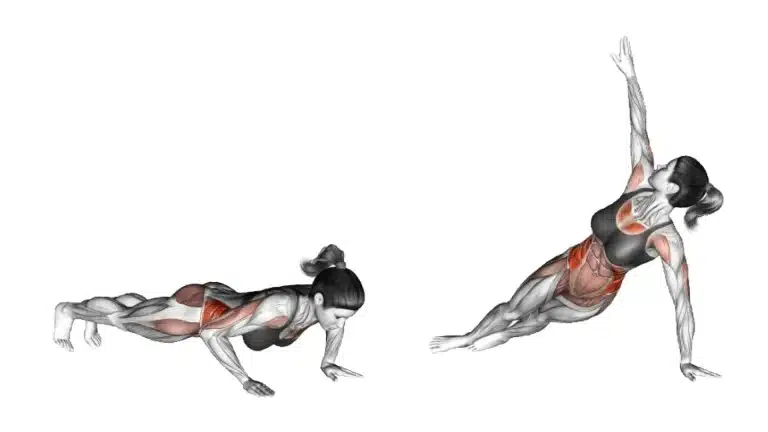

Muscles Worked During T Push Up
The T push-up is a compound exercise that targets multiple muscle groups, including: It has two phases with different muscular demands: the press (standard push-up mechanics) and the rotation (the arm lift to T).
- They primarily work the chest muscles (pectoralis major and minor), as well as the triceps and the shoulders (deltoids).
- They also engage the core muscles, serratus anterior as they help to stabilize the body during the exercise.
- Furthermore, it is worth mentioning that the legs and glutes are indirectly targeted during the Push-up-to-t move.
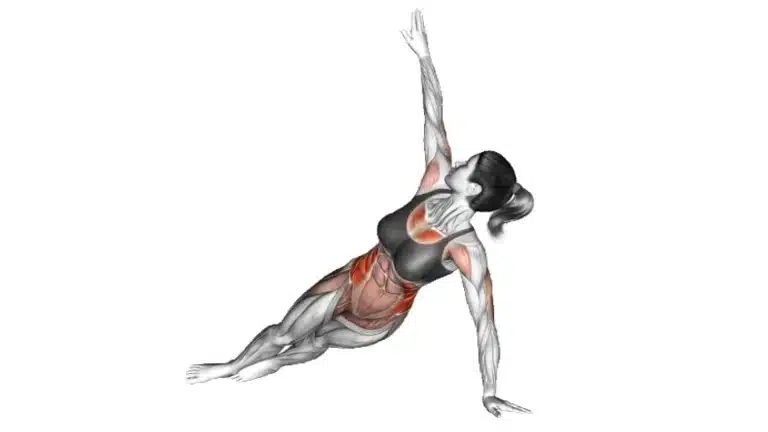
Here’s how these muscles are engaged during the push-up to T:
- Chest muscles: These muscles are responsible for pushing the body up and down.
- Shoulder muscles: They are responsible for lifting the arm and rotating it out to the side, forming the “T” shape. The front, side and rear deltoids are all worked during the exercise.
- Triceps: The triceps are responsible for extending the arm.
- Core muscles: The rotational movement engages the core muscles, which helps to improve overall stability and strengthen the abdominal and oblique muscles.
How To Do T Push-Ups
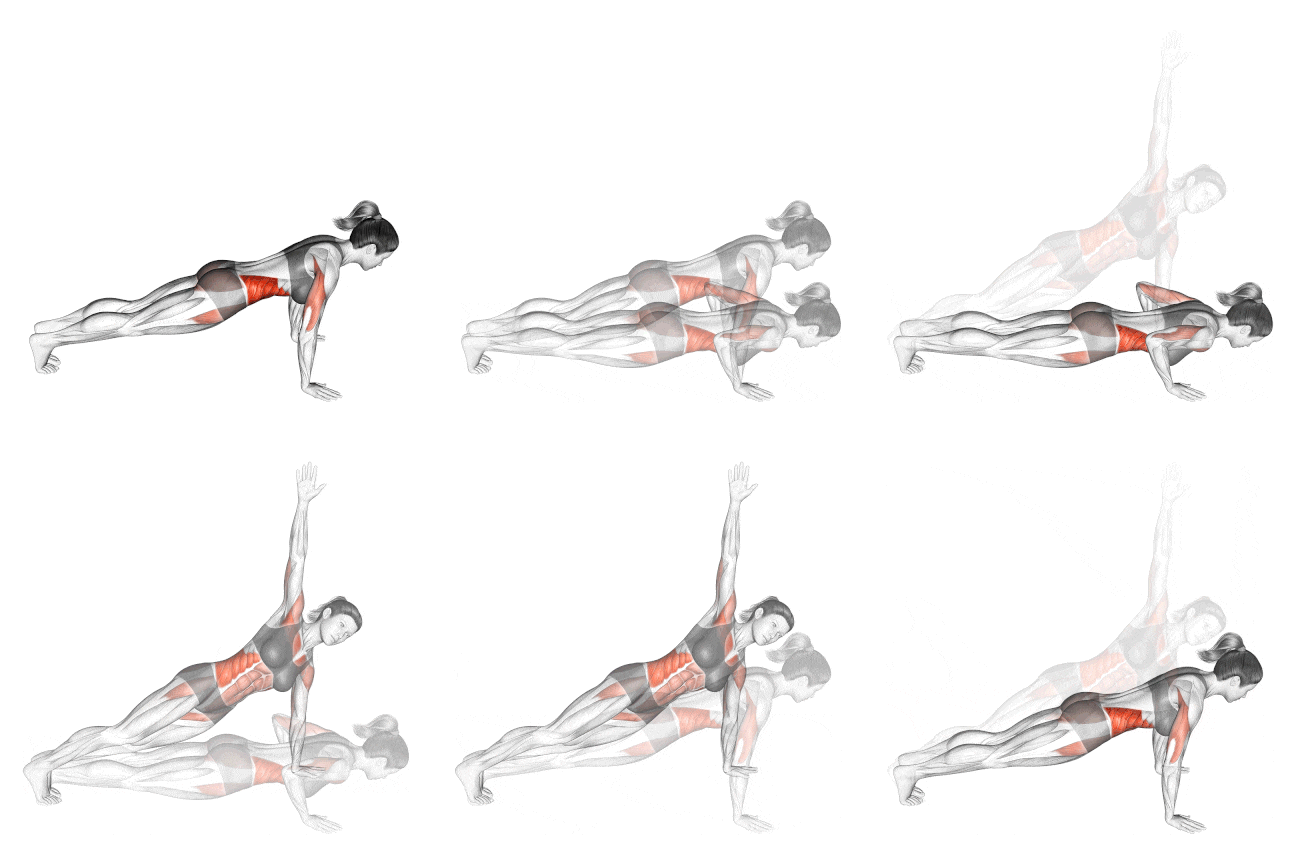
Here is a step-by-step guide on how to perform the T push-up:
- Start in a traditional push-up position with your hands placed slightly wider than shoulder-width apart and your feet together.
- Lower your body towards the ground, keeping your core engaged and your back straight.
- As you reach the bottom of the push-up, lift one arm off the ground and rotate your body so that your arm is pointing straight up toward the ceiling.
- Your body should now be in the shape of a “T”.
- Hold this position for a moment.
- Then, return your arm to the starting position and repeat the movement on the other side.
- Continue to alternate sides, completing one full push-up each time.
Sets and Reps
The number of sets and reps for T push-ups will depend on your fitness level and goals. Here are some general guidelines:
- Beginners: Start with 2–3 sets of 8–12 reps. Focus on proper form and building strength.
- Intermediate: Aim for 3–4 sets of 12–15 reps.
- Advanced: Aim for 4–5 sets of 15-20 reps or more.
As you become more comfortable with the exercise, you can increase the number of sets and reps.
Tips and Techniques for Doing T Push-Ups
Here are some tips and techniques for doing T push-ups:
- Make sure you start in the traditional push-up position with your hands placed slightly wider than shoulder-width apart.
- Keep your back straight and your core engaged throughout the entire exercise.
- Keep your core tight throughout the entire exercise.
- Avoid rushing through the exercise, and take your time to focus on proper form and engaging the right muscle groups.
- Exhale as you push up, inhale as you rotate your arm.
- As you become more comfortable with the exercise, you can increase the number of sets and reps or add weights or resistance bands to make the exercise more challenging.
- The more you practice it, the more comfortable you will become with the movement. And the more you will be able to increase the difficulty of the exercise.
- Before doing so, it is important to warm up properly. It can be a light cardio or dynamic stretching exercise to get your muscles ready for the workout.
- Don’t Flare your elbow out to the side. This can put unnecessary stress on the shoulder joint and make the exercise less effective.
Variations and Modification of T Push-Up
Variations are a great way to mix up your T push-up routine and keep it fresh.
With a little creativity and variety, you’ll never get bored with mastering this classic move.
Here are some variations and modifications that you can use to make the T push up easier or more challenging, or adapt it to your fitness level.
1. Knee T push-up
Knee T push-up is a variation that is performed on the knees rather than with the feet on the ground.
They are a fantastic stepping stone to mastering full T push-ups. They reduce the amount of bodyweight you are lifting, making it easier for you to learn and perform the movement correctly.
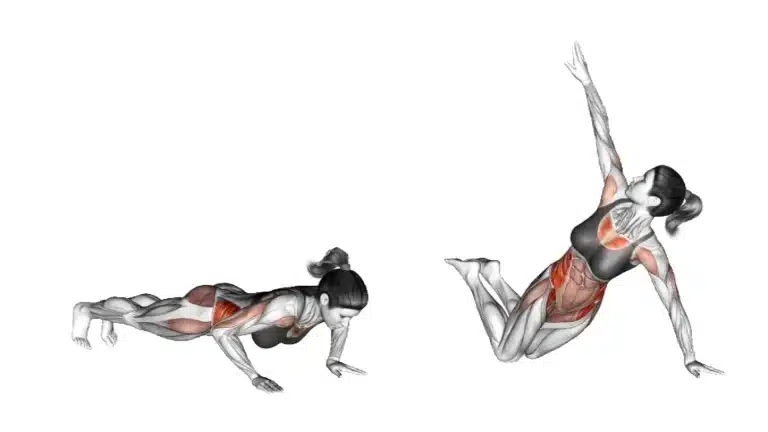
How To Do Knee T Push-Ups
- Start in a traditional push-up position with your knees on the ground.
- Lower your body towards the ground.
- As you reach the bottom of the push-up, lift one arm off the ground and rotate your body so that your arm is pointing straight up toward the ceiling. Your body should now be in the shape of a “T”.
- Hold this position for a moment.
- Then, return your arm to the starting position and repeat the movement on the other side.
- Continue to alternate sides, completing one full knee push-up each time.
2. Dumbbell T Push up
While T push-ups have great benefits, please don’t get stuck doing them forever. Once you’re strong enough, you can progress to regular T push-ups for increased difficulty or try dumbbell variations.
Dumbbell T push-ups involve lifting one hand with a dumbbell off the ground and reaching it towards the ceiling to form a T shape with the body.
Dumbbells provide a neutral grip, which can be more comfortable for those with wrist discomfort.
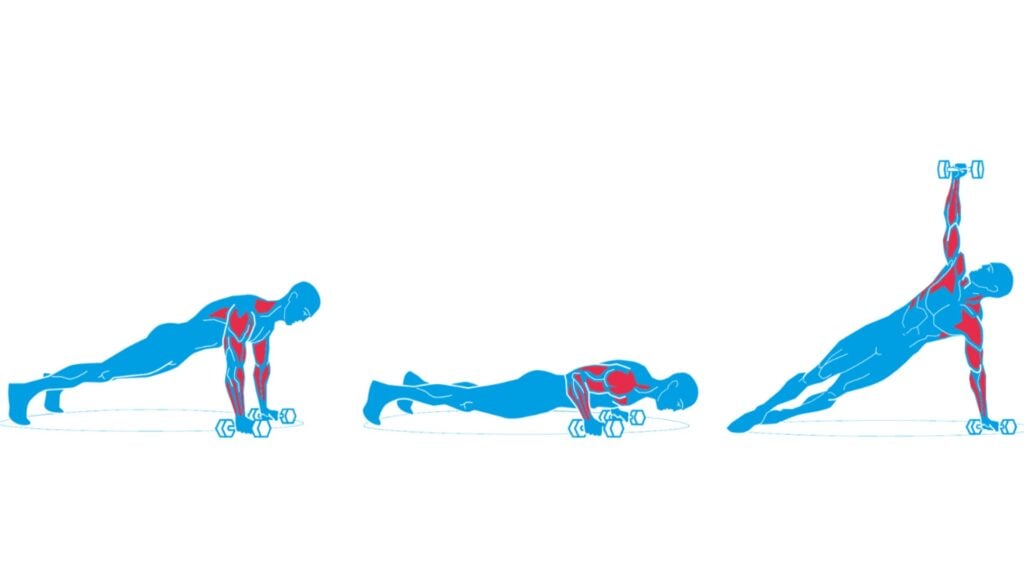
How To Do Dumbbell T Push-Ups
- Grip a dumbbell in each hand.
- Walk your feet back until your body is straight from head to heels.
- Your arms should be fully extended, with your hands on the dumbbells directly under your shoulders.
- Engage your core and keep your body straight as you lower your chest down towards the dumbbells.
- Once your chest touches the dumbbells, press back up to the starting position and lift one hand off the dumbbell.
- Reach the hand towards the ceiling, forming a T shape with your body.
- Lower the hand back down to the dumbbell and repeat the movement on the other side.
3. T Push Up With Resistance Band
T push-up with a resistance band adds extra resistance to the exercise. Using a resistance band increases the challenge to your upper body and engages your core even more.
It’s important to choose the right resistance band for your fitness level.
- You may not get the desired result if the band is too light.
- It can be not easy to maintain proper form if it’s too heavy.
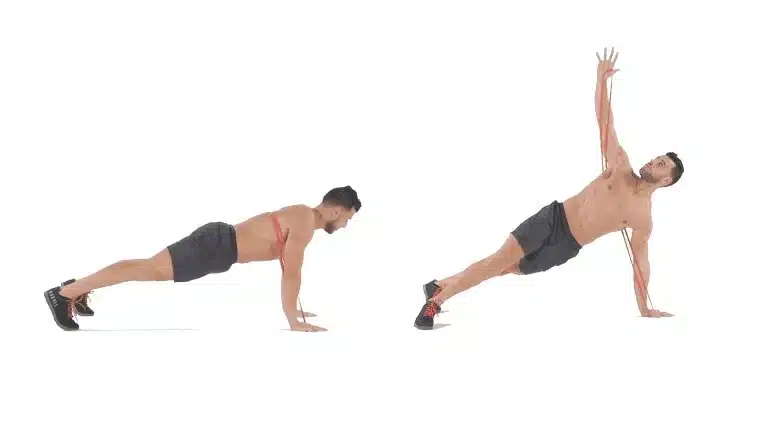
How To Do Resistance Band T Push-Ups
- Place the resistance band around your back and hold the handles with both hands.
- Start in a traditional push-up position.
- Lower your body towards the ground, keeping your core engaged and your back straight.
- At the end of a push-up, lift one arm off the ground and rotate your body so that your arm is pointing straight up toward the ceiling. Your body should now be in the shape of a “T”.
- Hold this position for a moment and then return your arm to the starting position.
- Repeat the movement on the other side.
- Continue to alternate sides.
Benefits of T Push-Up
The T push-up is a great way to add variety to your workout routine and challenge your upper body strength.
- It is a compound exercise that targets the chest, shoulders, and triceps, which helps to increase upper body mass.
- The rotational movement of the T push-up engages the core muscles.
- It is a full-body exercise that helps to increase functional fitness and improve overall fitness levels.
- It improves upper body strength and stability.
- T push-up improves the stability of the shoulder joint, which can help reduce the risk of injury.
How To Incorporate T Push-Ups Into Your Routine
Here are some ways to incorporate it into your workout routine:
- As a standalone exercise: It can be done as a standalone exercise, adding 2–3 sets of 8–12 reps to your bodyweight workout routine.
- As a finisher: T push-up can be added as a finisher at the end of your workout, adding 2–3 sets of 8–12 reps.
- Incorporate it into your push-up routine: Incorporate it into your regular push-up routine.
- Add it to your upper body workout: Incorporate it into your upper body workout, adding 3–4 sets of 8–15 reps.
- Incorporate it into your circuit training: Incorporate it into your circuit training in between other exercises like pull-ups, rows, etc.
References
- Ebben WP, Wurm B, VanderZanden TL, Spadavecchia ML, Durocher JJ, Bickham CT, Petushek EJ. Kinetic analysis of several variations of push-ups. The Journal of Strength & Conditioning Research. 2011 Oct 1;25(10):2891-4.
- Cogley RM, Archambault TA, Fibeger JF, Koverman MM, Youdas JW, Hollman JH. Comparison of muscle activation using various hand positions during the push-up exercise. J Strength Cond Res. 2005 Aug;19(3):628-33. doi: 10.1519/15094.1. PMID: 16095413.

Manish is a NASM-certified fitness and nutrition coach with over 10 years of experience in weight lifting and fat loss fitness coaching. He specializes in gym-based training and has a lot of knowledge about exercise, lifting technique, biomechanics, and more.
Through “Fit Life Regime,” he generously shares the insights he’s gained over a decade in the field. His goal is to equip others with the knowledge to start their own fitness journey.