
The bench press is a standard chest exercise, but not everyone finds it comfortable on the shoulders. The landmine chest press is a two-hand press from the chest, using a barbell anchored at one end, so the bar travels up and slightly forward in an arc. It makes a useful chest-focused option when you want some variety or when a flat bench feels awkward.
This guide covers the two-hand, chest-focused version. If you mainly want to train the shoulders with a one-arm press, see the full landmine press guide. For other exercises you can do with the same setup, see our list of landmine exercises.
You will need a barbell and some weight plates. A landmine attachment makes setup easier, but you can also wedge the end of the bar into a corner of a room with a towel or pad, as long as it cannot slip.

- Landmine Chest Press Muscles Worked
- How to Do the Kneeling Landmine Chest Press
- Form and Tips
- Sets, Reps and Rest
- Variations of the Landmine Chest Press
- 1. Standing Landmine Chest Press
- 2. Single-Arm Landmine Press
- Related Exercises
- Landmine Chest Press Benefits
- FAQs
- What is the difference between the landmine chest press and the landmine press?
- Is the landmine chest press better than the bench press?
- Should I do the landmine chest press kneeling or standing?
- References
Landmine Chest Press Muscles Worked
- Main muscles: the chest (pectoralis major), the front of the shoulder (anterior deltoid) and the triceps.
- Helpers and stabilisers: the serratus anterior and other muscles around the shoulder blade, plus the core, which has to resist the bar pulling you forward. Kneeling or standing asks more of the core than lying on a bench, because no bench supports your trunk.
These roles follow from how the movement works. No study has measured muscle activity in the landmine chest press.
Is it an upper-chest exercise? Because the bar rises at an angle, this press resembles an incline press more than a flat one. Strength coach Ben Bruno describes the regular two-hand landmine press as “more of a standing incline press to target the upper chest and shoulders” (Bruno). That is a coach’s description, not a measurement.
The incline bench research gives mixed support. In 15 men bench pressing at 70% of their one-rep max, the upper (clavicular) part of the chest was more active at 44 and 56 degrees of incline than on a flat bench (Trebs 2010). A 2016 study of 14 men found no difference in upper-chest activity across the whole lift, only at some points in the middle of it (Lauver 2016). So an upper-chest emphasis is plausible but unproven, and how chest-dominant the press feels also depends on bar angle and body position. If upper chest is a priority, see our guide to the best upper chest exercises.
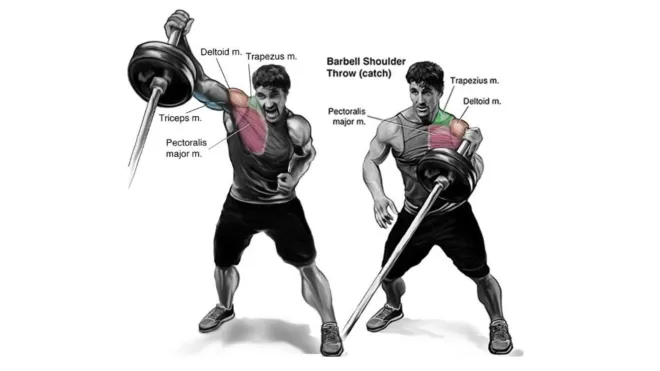
How to Do the Kneeling Landmine Chest Press
Kneeling takes your legs out of the movement, so it is a good place to learn the pattern.
- Place one end of the barbell in a landmine attachment, or wedge it securely into a corner.
- Add weight plates to the free end of the bar.
- Kneel facing the bar with your knees about shoulder-width apart. Hold the end of the bar with both hands, with your thumbs around it.
- Bring the end of the bar to your upper chest, just below the collarbone.
- Press the bar up and slightly forward until your arms are almost straight, without snapping the elbows into lockout.
- Lower the bar back to your chest under control. Do not let it drop.
Form and Tips
- Keep your ribs down and your spine neutral. Do not lean back to finish the rep.
- Interlace or stack your hands around the end of the bar so it stays secure.
- A slight forward lean from the hips is natural when standing. Keep your core braced so it does not turn into a back bend.
- Breathe freely while keeping your core braced rather than forcing a rigid pattern. See the breathing section of the landmine press guide for the source and a note for people with high blood pressure.
- If the bar is uncomfortable on your chest, wrap it in a towel or a bar pad.
Sets, Reps and Rest
No research has tested sets and reps for this exercise, so these are starting points. Muscle can grow across a wide range of loads (Schoenfeld 2021), so choose a weight you can control, stop a few reps short of failure, and adjust to how you feel.
| Goal | Sets | Reps | Rest |
|---|---|---|---|
| Muscle size | 2-4 | 8-15 | 1-3 minutes |
| Strength | 3-5 | 3-6 | 2-3 minutes |
| Muscle endurance | 2-3 | 15 or more | 1-2 minutes |
Variations of the Landmine Chest Press
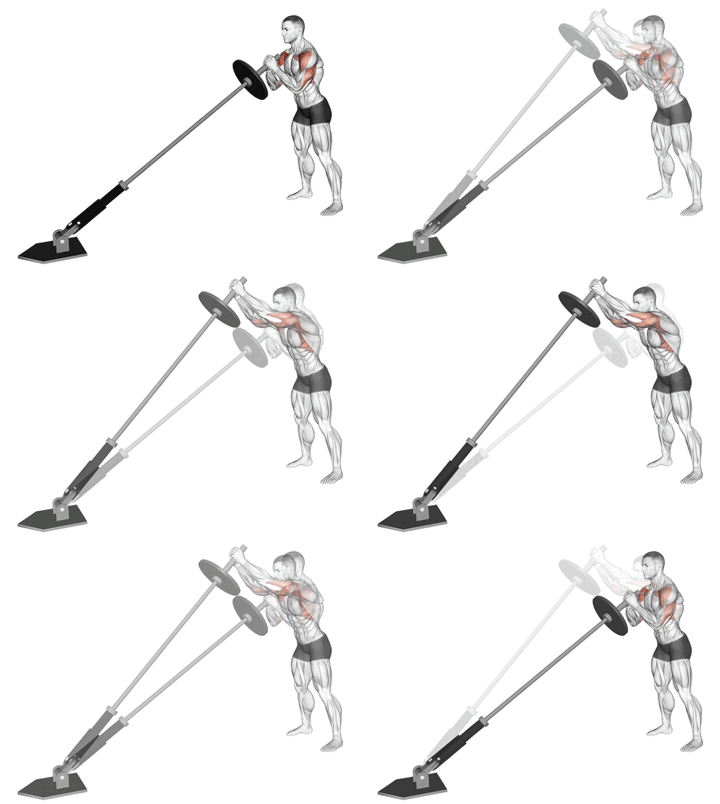
1. Standing Landmine Chest Press
Standing adds balance and lets you use your legs for stability, and your core has to work to keep your body steady. Your usable load can change between kneeling and standing, so treat each as its own starting point rather than copying weights across.
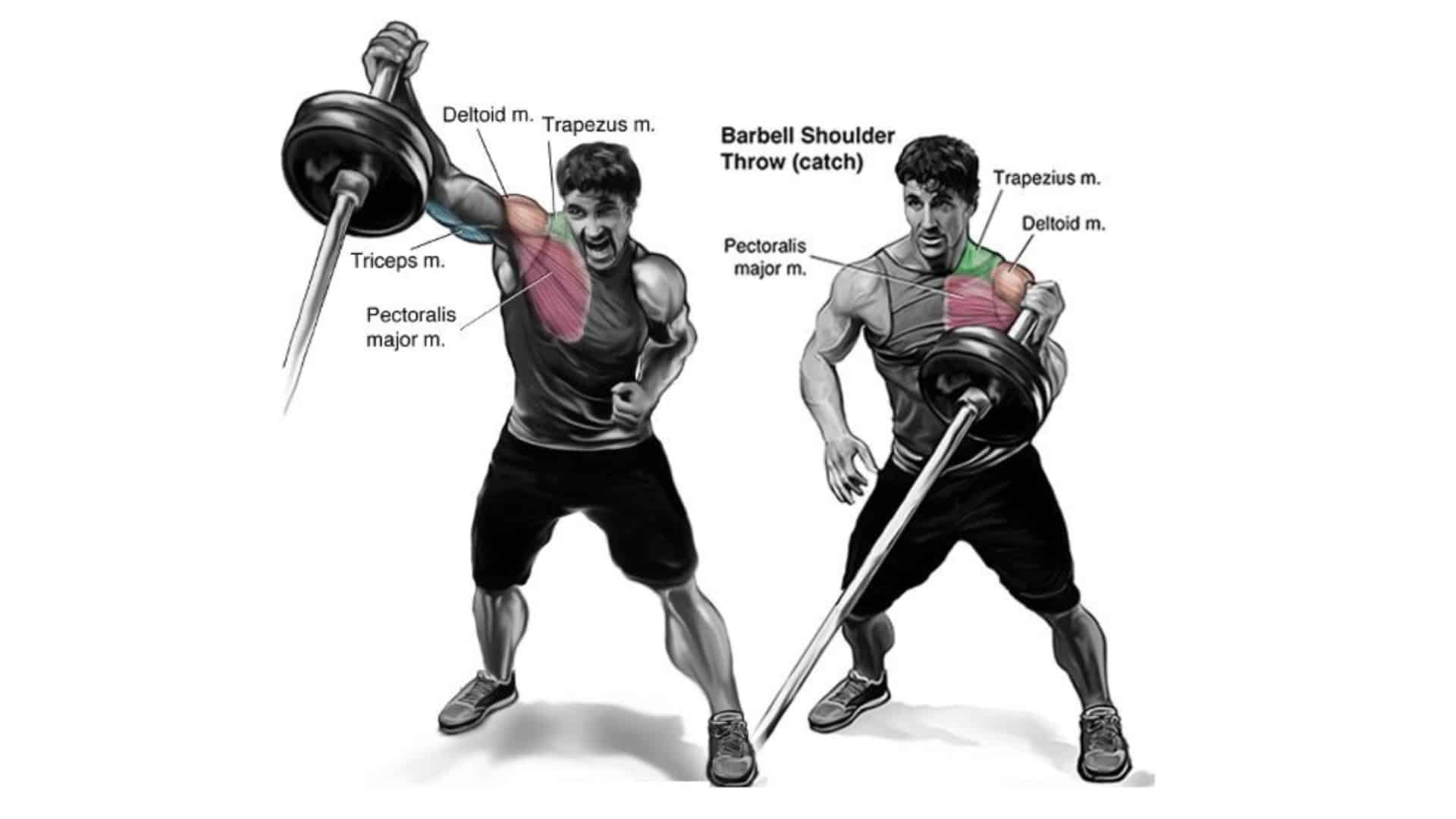
2. Single-Arm Landmine Press
Pressing with one arm lets you work each side separately and makes your core resist rotation. It is usually done as a shoulder-focused press from the shoulder, so we cover it in the landmine press guide rather than repeating the steps here.
Related Exercises
The banded press, side-to-side press and squat to press are covered in the landmine press guide. For a full-body option, see the landmine squat. For trunk work with the same setup, try the landmine twist.
Landmine Chest Press Benefits
- Easy to progress: you add weight in plates, so you can increase the load in small steps.
- A different angle: the arcing, upward bar path varies your chest training. Some lifters find it more comfortable on the shoulders than a flat bench. That varies from person to person, and no study has compared the two directly.
- Trunk demand: kneeling or standing, the core has to resist the bar pulling you forward. That makes it a useful addition to your core training, not a replacement for it.
- Variety: it fits well beside other chest work, such as cable chest exercises.
If a pressing movement hurts your shoulder, stop and get it checked by a clinician rather than trying to find a pain-free variation.
FAQs
What is the difference between the landmine chest press and the landmine press?
The landmine chest press is a two-hand press from the chest, aimed at the chest, front shoulders and triceps. The landmine press is usually a one-arm press from the shoulder, which coaching sources describe as shoulder-first. See the landmine press guide for that version.
Is the landmine chest press better than the bench press?
Not clearly. No study compares them. They are different exercises: the bench press is straight and flat, while the landmine press moves on an arc. Many people use both.
Should I do the landmine chest press kneeling or standing?
Start kneeling to learn the movement. Move to standing when you want to use your legs for stability and add balance work. Reset your starting weight when you change position.
References
- Trebs AA, Brandenburg JP, Pitney WA. An electromyography analysis of 3 muscles surrounding the shoulder joint during the performance of a chest press exercise at several angles. J Strength Cond Res. 2010;24(7):1925-1930. PubMed
- Lauver JD, Cayot TE, Scheuermann BW. Influence of bench angle on upper extremity muscular activation during bench press exercise. Eur J Sport Sci. 2016;16(3):309-316. PubMed
- Schoenfeld BJ, Grgic J, Van Every DW, Plotkin DL. Loading recommendations for muscle strength, hypertrophy, and local endurance: a re-examination of the repetition continuum. Sports (Basel). 2021;9(2):32. PubMed
- Coaching source (practice-based, not research): Ben Bruno, 6 upper body landmine exercises.

Manish is a NASM-certified fitness and nutrition coach with over 10 years of experience in weight lifting and fat loss fitness coaching. He specializes in gym-based training and has a lot of knowledge about exercise, lifting technique, biomechanics, and more.
Through “Fit Life Regime,” he generously shares the insights he’s gained over a decade in the field. His goal is to equip others with the knowledge to start their own fitness journey.